
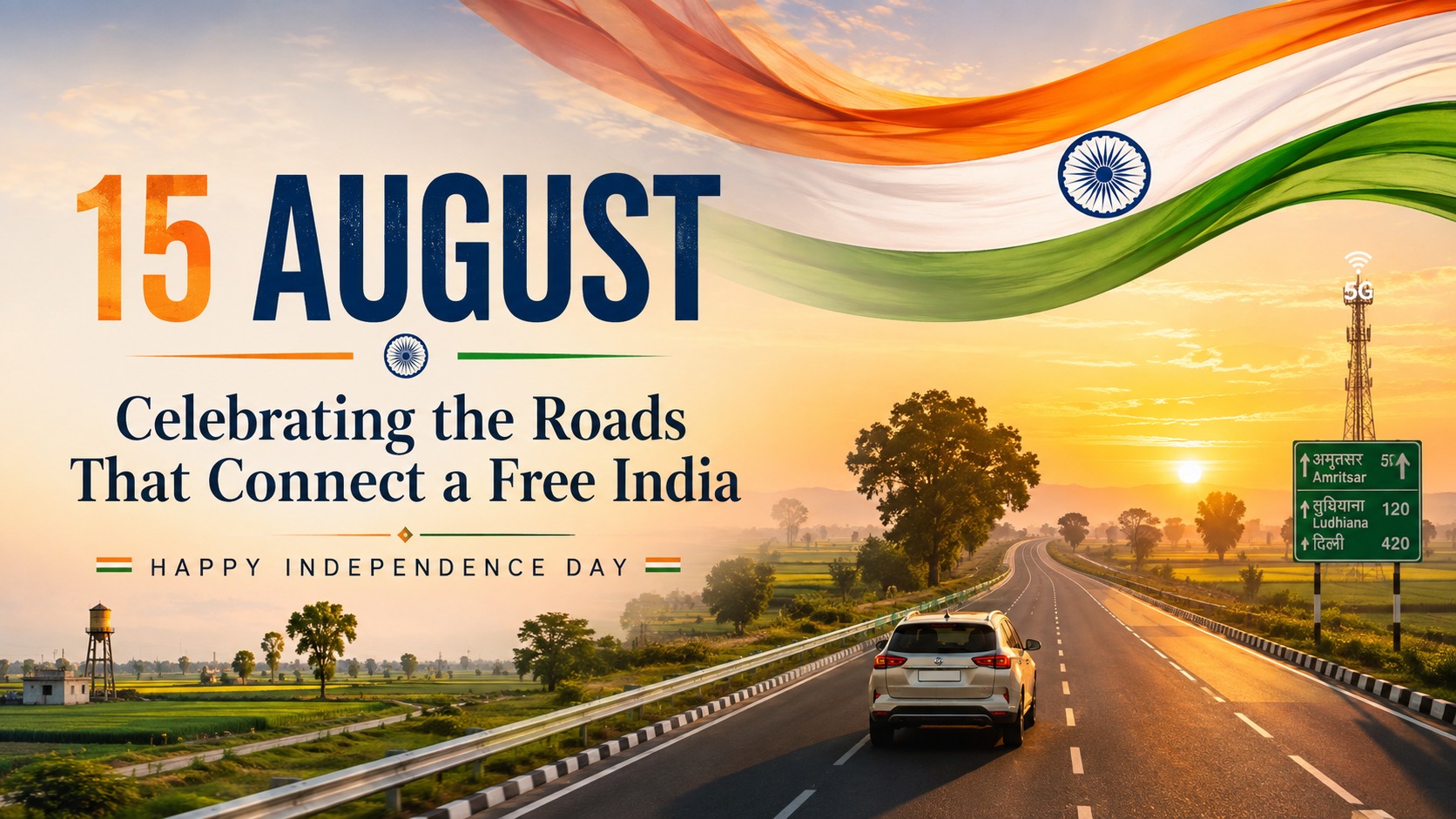
15 August: Celebrating the Roads That Connect a Free India
Every 15 August, the Indian tricolour rises above schools, homes, government buildings, markets, offices and neighbourhoods across the country. Patriotic songs return to the air, children carry small flags, communities gather for ceremonies, and millions of Indians take a moment to remember the freedom secured in 1947.
Independence Day is naturally connected with history, sacrifice and national identity. But freedom can also be understood through something much more ordinary: the ability to move.
To leave a village in the morning and reach a university in the city. To drive from Punjab to Delhi for an international flight. To travel home to see parents after months away. To take produce from a farm to a market. To visit a Gurudwara in another district, attend a family celebration hundreds of kilometres away or simply take a road toward somewhere you have never been before.
India's roads carry all of these journeys.
On 15 August, they offer an interesting way to think about what freedom means in everyday life. Roads connect the country physically, but the journeys taking place on them connect families, cultures, opportunities and generations.
For Punjab Wedding Cars, whose work involves travelling across Punjab, Chandigarh and intercity routes every day, the road is more than the distance between a pickup and a destination. It is where we see Punjab changing, expanding and remaining connected at the same time.
Freedom Is Also the Freedom to Go Somewhere
Political freedom is larger and more important than any individual journey, but mobility is one of the ways people experience opportunity in daily life.
A road can connect a student in a small town with a college in a larger city. It can connect a family with better medical care. It can give a farmer access to a larger market or allow a business to serve customers far beyond its immediate neighbourhood.
For millions of Indians working away from their hometowns, roads are also the beginning and end of the journey home.
Someone arriving at Delhi Airport may still have several hours to travel before reaching Jalandhar, Ludhiana, Amritsar, Hoshiarpur or another part of Punjab. A person landing at Chandigarh Airport may continue toward Patiala, Mohali, Rupnagar or the Doaba region.
The aircraft crosses countries, but the final connection home is often made by road.
That simple ability to move between places is easy to take for granted. On Independence Day, it is worth noticing.
Punjab Is a State Built Around Movement
Punjab has always been defined partly by movement.
People move between villages and towns every day for work, education, agriculture and business. Families frequently have members living in different districts. Thousands of households also maintain close connections with Canada, the United Kingdom, Australia, the United States, Europe and other parts of the world.
A family may have grandparents in a village near Jalandhar, children working in Chandigarh, relatives in Ludhiana and another generation living overseas.
The road keeps those connections practical.
Drive through Punjab and the landscape can change quickly. Busy urban streets give way to farmland. A highway interchange leads toward an old village road. New commercial developments appear beside fields that have been cultivated for generations.
The journey between Jalandhar and Ludhiana is not merely movement between two large cities. Every exit leads toward smaller communities, factories, colleges, markets and homes.
The road tells a story of an India that is modernising without becoming disconnected from where people come from.
From Village Roads to National Highways
Not every important road is a major expressway.
Some of India's most meaningful journeys begin on narrow village roads.
A farmer may use one to reach his fields before sunrise. A school bus may collect children from several villages. Families may use the same road for generations to reach the nearest town, hospital, market or Gurudwara.
Those roads eventually connect with larger district roads and national highways.
That is how a country becomes physically connected: not through one grand road but through a network.
A journey from rural Punjab to Delhi may begin on a small local lane, join a district route, continue onto a major highway and eventually enter one of India's largest metropolitan areas.
Each part matters.
Good connectivity changes what is possible for the places along those roads. Better access can bring education, employment, tourism, logistics and investment closer to communities that once felt much farther away.
When we speak about India's progress, these quieter improvements deserve recognition too.
Roads Connect Families Before They Connect Cities
Maps show roads connecting locations.
People experience them as connections between relationships.
Ask someone why they are driving from Amritsar to Jalandhar and the answer is unlikely to be, “because these two urban centres require transport connectivity.”
They are going to see their parents.
They are collecting someone from the airport.
They are attending a birthday.
They are returning to their pind.
They are visiting a friend.
They are going somewhere because another person matters to them.
This is particularly visible in Punjab, where family networks frequently extend across districts and continents.
The road from Amritsar may carry an NRI family returning after years abroad. The road toward Patiala may carry students, working professionals and families returning home for a few days. The route toward Chandigarh connects Punjab with one of North India's most important administrative, educational and commercial centres.
What looks like traffic from above is actually thousands of individual stories moving at the same time.
Independence Day Is Also a Day to Remember the Journey
The India of today did not appear overnight.
The country inherited enormous challenges at independence. Since then, generations of Indians have built institutions, farms, businesses, schools, factories, hospitals, technology companies, transport networks and communities.
Progress has never been perfectly even, and there is always more work to do. Roads themselves remind us of this. Some are world-class; others still need improvement. Some regions enjoy strong connectivity while others continue waiting for the infrastructure that could transform local opportunities.
Patriotism does not require pretending that everything is already complete.
It can also mean recognising how far the country has travelled while remaining serious about how much further it can go.
That makes a road an appropriate Independence Day symbol.
There is always another kilometre ahead.
The People Behind Every Journey
Infrastructure matters, but roads do not move people by themselves.
Drivers do.
Truck drivers carry goods across states through long nights and difficult weather. Bus drivers transport thousands of passengers every day. Taxi and commercial drivers connect railway stations, airports, villages and neighbourhoods. Ambulance drivers move through traffic when minutes matter.
Mechanics keep vehicles roadworthy. Highway workers maintain surfaces and barriers. Police officers manage traffic. Dhaba workers feed travellers throughout long journeys. Fuel-station staff work while most people are asleep.
Countless professions exist around movement.
At Punjab Wedding Cars, professional chauffeurs are a central part of our own work. Whether operating a Mercedes Maybach, Range Rover Sport, Audi A6 or another vehicle from our luxury fleet, the responsibility is ultimately the same: take people where they need to go safely and professionally.
On Independence Day, it is worth appreciating the millions of people whose work keeps India moving.
The Road Home Has a Different Meaning for NRIs
For Punjabis living overseas, the final road home often carries a special emotion.
A flight may land in Delhi or Amritsar after eight, ten or fifteen hours. Immigration is completed. Bags are collected. Airport doors open.
Then comes the drive home.
For someone who has not returned for several years, familiar details begin appearing through the window. Punjabi signboards. Roadside dhabas. Fields. Gurudwaras. Tractor traffic. Town names that bring back memories.
The destination may still be hours away, but psychologically the traveller has already begun arriving home.
This is why airport connectivity matters so much for Punjab's large overseas community.
The journey between Delhi Airport and Punjab or between Amritsar Airport and different districts is not only transport. It is the final stage of returning to family.
Freedom also means being able to leave, build a life elsewhere and still have a road that brings you home.
A Road Does Not Ask Where You Come From
India is extraordinarily diverse.
Languages change. Food changes. Clothing changes. Landscapes change. Religious traditions change. Even driving from one region to another can feel like moving through several different worlds.
Yet the same highway carries everyone.
A truck may be travelling across several states. A family may be on holiday. A student may be heading to university. A pilgrim may be travelling toward a religious site. Someone may be beginning a new job, while another person is returning to the town where they were born.
The road does not separate these stories.
It carries them together.
That is one of the simplest pictures of India: different people travelling in different directions while sharing the same country.
Travel Lets Us Understand India Beyond Our Own City
It is easy to think of India through the place where we live.
Travel changes that.
Leave Punjab and drive toward Himachal Pradesh and the flat agricultural landscape gradually moves toward hills. Head toward Rajasthan and the colours, architecture and terrain begin to change. Travel toward Delhi and the scale of urban India becomes impossible to ignore.
Every region adds something different to the country.
Road journeys make those differences visible in a way that flying directly between airports often does not.
You see towns that rarely appear in national conversations. You stop for food where local flavours dominate the menu. You hear different accents. You notice how agriculture, architecture and daily routines change from one district to another.
Travel reminds us that India is not one experience.
It is millions of experiences connected together.
Drive With Responsibility on 15 August
Independence Day also brings people onto the roads for flag ceremonies, family visits, community programmes and short trips.
Celebration should never become careless driving.
A national flag displayed on a vehicle should be treated respectfully and should never obstruct the driver's visibility. Seat belts should be used. Speed limits and traffic rules still matter. Drivers should avoid using mobile phones while moving, and nobody should feel pressure to race simply because roads appear quieter during a public holiday.
Freedom on the road comes with responsibility toward everyone else using it.
The most patriotic journey is one that brings everyone home safely.
A Free India Is Still Moving Forward
On 15 August, attention naturally turns toward the past.
It should.
India's independence was won through sacrifices that deserve to be remembered by every generation.
But Independence Day can also look forward.
The highways being built today, the villages receiving better connections, the young people travelling for education, businesses reaching new markets, families returning from overseas and millions of ordinary journeys taking place across the country all belong to India's continuing story.
Progress does not always arrive in dramatic moments.
Sometimes it looks like a shorter journey to a hospital.
Sometimes it is a new road allowing a farmer to reach a market faster.
Sometimes it is a daughter travelling safely to university.
Sometimes it is an NRI family driving through Punjab after landing in India for the first time in years.
And sometimes it is simply the freedom to get into a car, choose a destination and begin moving.
This 15 August, Notice the Road Ahead
When the tricolour rises this Independence Day, remember the history behind it.
Remember those who fought for India's freedom.
But when the ceremony finishes and everyday life resumes, also look at the road outside.
Someone will be heading to work.
Someone will be returning home.
Someone will be starting a new journey.
Someone will be seeing their family after years apart.
Those journeys are part of what a connected, free country looks like.
At Punjab Wedding Cars, roads are part of our everyday work, but on 15 August 2026 they represent something larger than transportation. They represent connection—the ability of people, families, communities and opportunities to reach one another across an enormous and diverse country.
From the smallest village road in Punjab to India's expanding national highway network, every route leads somewhere.
And every generation gets the responsibility of deciding where India travels next.
Happy Independence Day from Punjab Wedding Cars.