Punjab & Delhi Wedding Transport for Overseas Guests: Cars, Airports & Intercity Planning
When overseas guests are flying into India for a Punjabi wedding, transportation quickly becomes more complicated than booking one bridal car and one groom car. A family may have parents arriving at Delhi Airport, cousins landing in Amritsar, another group coming through Chandigarh, guests staying in different hotels and wedding functions taking place across Jalandhar, Ludhiana, Amritsar or another Punjab city.
That is when wedding transportation needs to be planned as one connected journey rather than a collection of unrelated car bookings.
For an NRI family, the transport plan often begins before the wedding guests even reach Punjab. Someone may have already spent ten or twelve hours on an international flight before collecting baggage at Delhi Airport and beginning a long road journey north. Another guest may arrive much closer to the wedding through Amritsar Airport. Meanwhile, the bride and groom still need their own principal wedding cars protected from normal family and airport duties.
The most effective approach is to separate the transport by purpose while keeping everything under one coordinated plan. Airport transfers should move overseas guests comfortably into Punjab. Local hotel transport should move relatives between accommodation and wedding functions. Intercity cars should handle longer journeys between cities. The headline groom and bridal cars should remain focused on the wedding moments they were selected for.
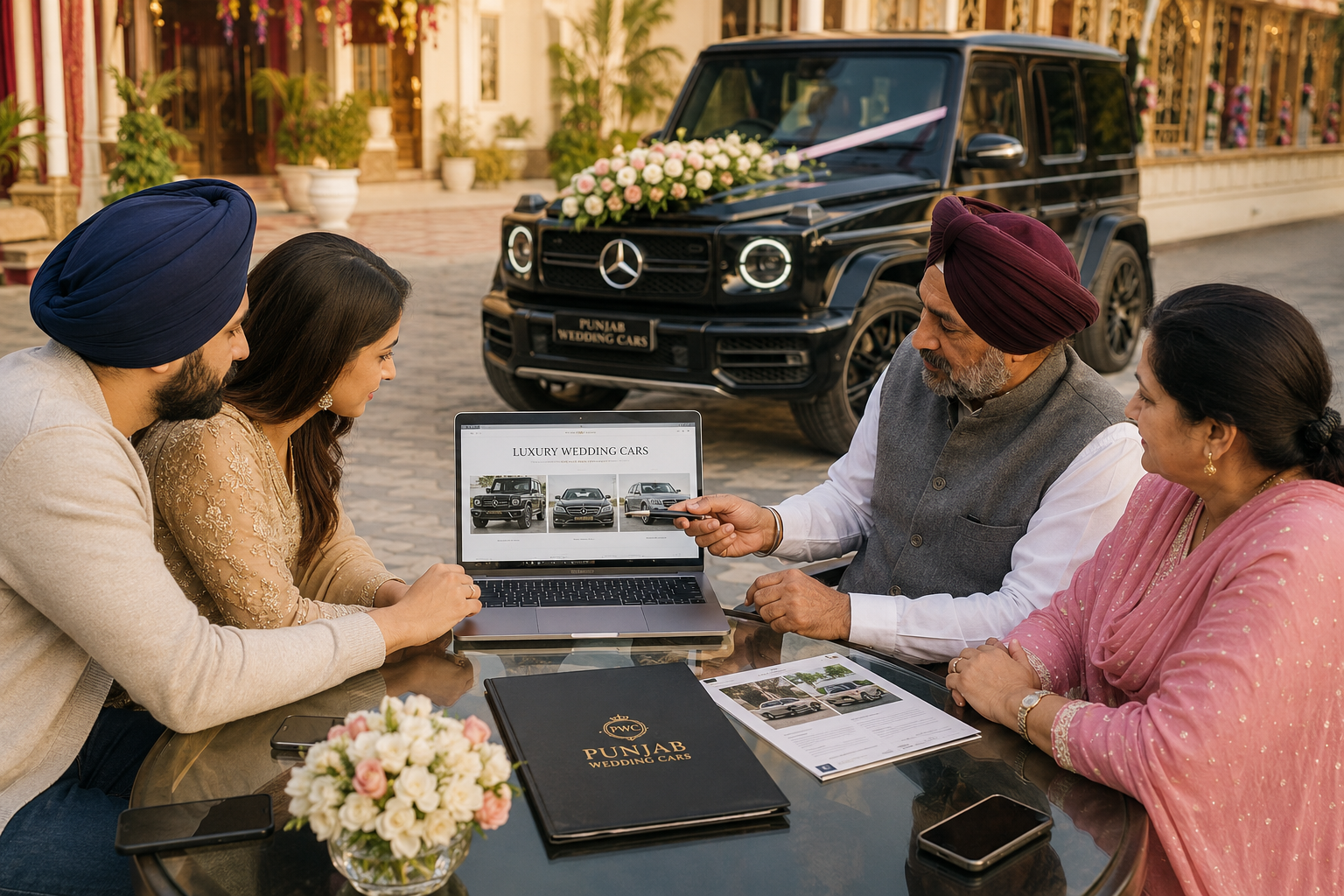
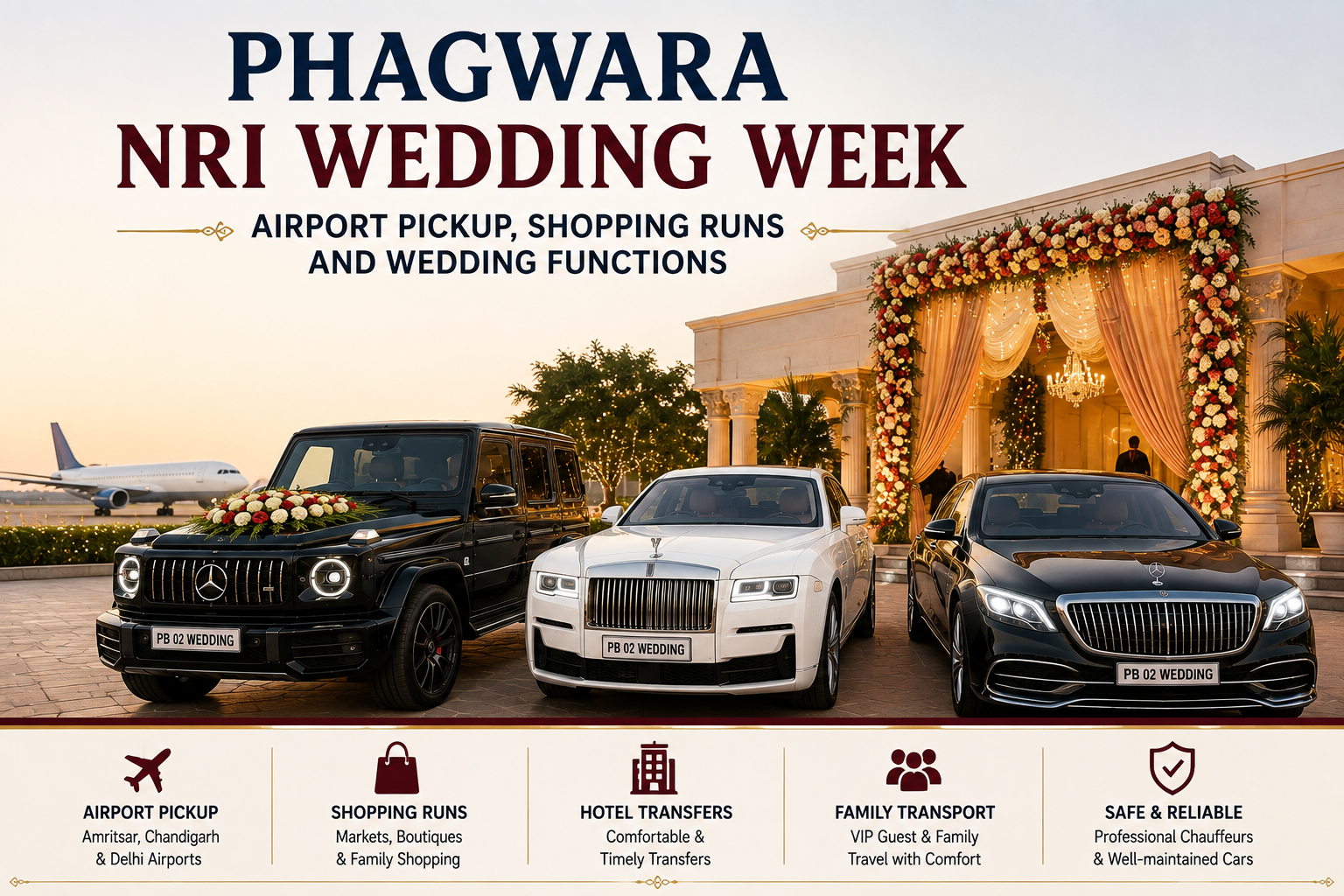
Punjab Wedding Cars provides chauffeur-driven luxury wedding cars across Punjab as well as airport transportation from Delhi, Amritsar and Chandigarh, with wider service into Delhi NCR and other parts of North India. citeturn726286search2turn726286search3 Families can therefore plan the Punjab Wedding Cars luxury fleet, airport movements and principal wedding vehicles as connected parts of the same wedding rather than treating each requirement as a separate last-minute problem.
Start With the Guest Journey, Not the Car
Families often begin wedding transport planning by asking how many cars they need.
For overseas guests, that is usually the wrong first question.
The better starting point is understanding how each group is travelling.
A couple arriving from Vancouver at Delhi Airport with several large suitcases has a very different requirement from grandparents landing at Amritsar with one overnight bag. A family travelling from Delhi to Jalandhar needs a long-distance transfer, while relatives already staying in Ludhiana may need only local hotel-to-venue transport.
Once those journeys are understood, vehicle selection becomes much easier.
This prevents the family from booking luxury cars without knowing what job each one will perform.
It also prevents a common NRI wedding problem where the most impressive cars are reserved early but practical transportation for luggage, elderly guests or late-night hotel returns remains unresolved.
Delhi Airport Should Be Treated as an Intercity Transfer
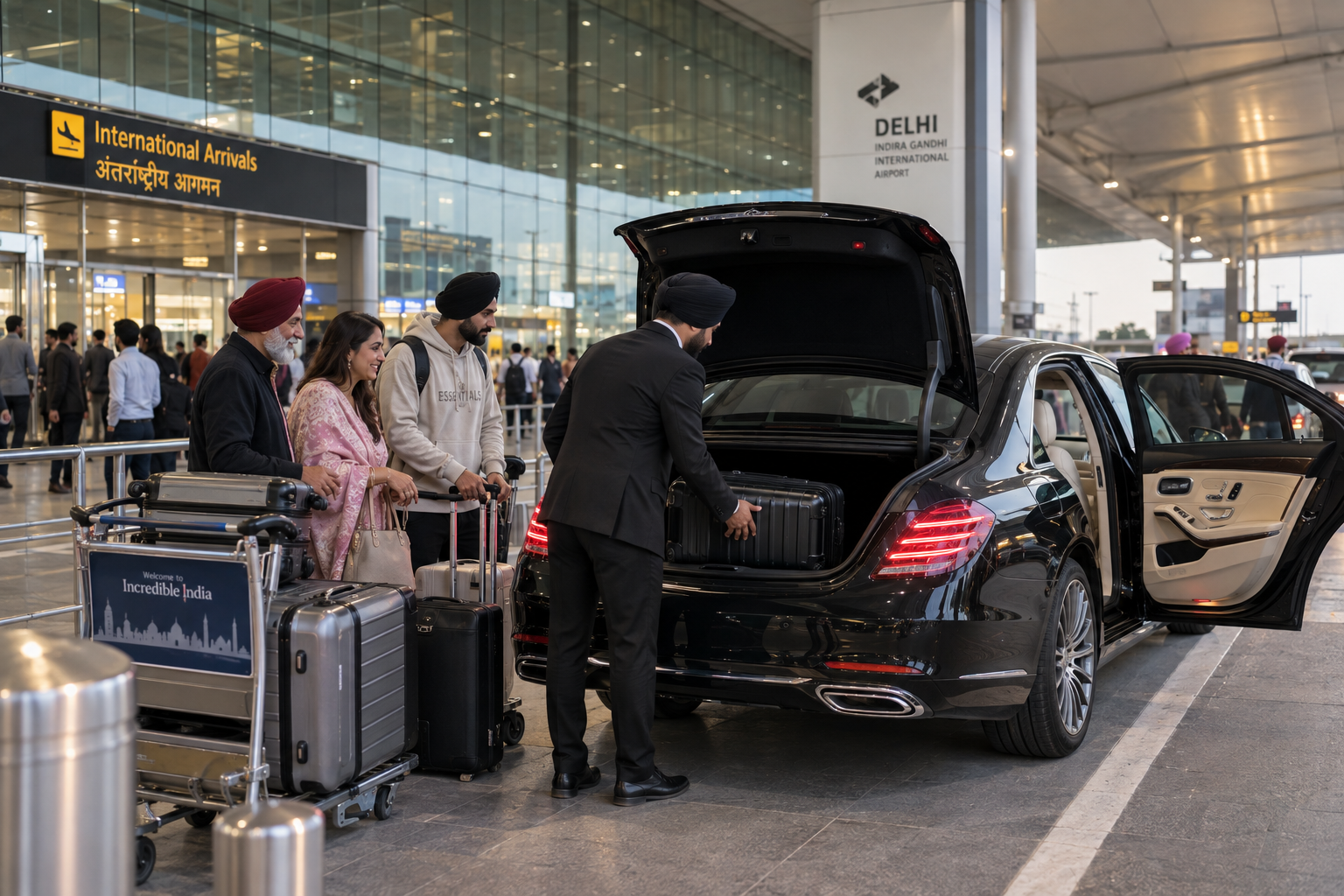
Delhi Airport is not simply another local airport pickup when the final destination is Punjab.
For many Punjab weddings, collecting a guest from Delhi means beginning a substantial road journey before that person reaches the family home or hotel.
That affects the vehicle decision.
A guest who has already completed a long international flight usually benefits more from rear-seat comfort, effective climate control, luggage capacity and a smooth chauffeur than from the most visually dramatic wedding car available.
The Punjab Wedding Cars fleet includes executive saloons and SUVs suitable for these movements, and the company currently lists airport transfers from Delhi, Amritsar and Chandigarh among its services. citeturn726286search1turn726286search6
A Jaguar XJL or Audi A6 can make sense for one or two VIP guests who value a comfortable rear seat. A larger SUV may be more suitable when baggage volume is substantial.
The important thing is to select the airport vehicle around the passenger journey rather than around the wedding photograph.
Delhi Is Not Automatically the Best Airport for Every Guest
Delhi has extensive international connectivity, which is why many NRI families naturally route overseas relatives through it.
That does not mean every guest should automatically enter Punjab through Delhi.
Someone attending a wedding centred around Amritsar may find a suitable connection into Sri Guru Ramdas Ji International Airport. A guest whose wedding functions are around Chandigarh, Mohali or Rupnagar may find Chandigarh more practical when the flight schedule works.
The right decision should consider the complete journey from the overseas departure airport to the final Punjab destination.
A cheaper or more convenient international flight into Delhi can sometimes create several additional hours of road travel after landing.
For an elderly guest or someone travelling with young children, reducing that road journey may be worth more than saving a small amount on the airfare.
Punjab Wedding Cars currently supports airport pickups from Delhi, Amritsar and Chandigarh, which allows NRI families to use different gateways according to where each guest actually needs to go. citeturn726286search3turn726286search6
Luggage Should Influence Airport-Car Selection
Passenger count does not tell the whole story when overseas guests are involved.
Four people arriving from Canada for a Punjabi wedding may have four large suitcases, several cabin bags, garment bags containing wedding outfits and gifts for relatives.
A car that seats four people comfortably may not carry that amount of luggage comfortably.
This is why the family should communicate baggage requirements before the vehicle is assigned.
A premium saloon may be perfect for two passengers travelling with moderate luggage. A larger SUV can become more practical when the same journey includes several large suitcases.
Trying to solve the luggage problem outside Delhi Airport after the chauffeur has arrived is unnecessary when it can be planned beforehand.
Overseas wedding transportation works best when the family thinks about what is travelling inside the car as carefully as who is travelling inside it.
Keep the Groom and Bridal Cars Out of Routine Airport Work
The principal wedding car should have a protected role.
If the groom has selected the Mercedes G Wagon G63 AMG specifically for a grand baraat entry, that car should not automatically become an airport shuttle because an important relative happens to be arriving two days earlier.
Likewise, a Mercedes Maybach selected for the bridal doli or a formal groom arrival should not be treated as general guest transport simply because it is one of the most prestigious vehicles in the fleet.
There are situations where using an ultra-luxury car for a VIP airport pickup makes sense.
The decision should simply be deliberate.
The main wedding car should not accumulate unrelated mileage and scheduling commitments simply because the family has already booked it.
Using executive vehicles or suitable SUVs for guest movement allows the headline wedding car to remain focused on the bride or groom.
Build the Transport Plan Around Where Guests Are Staying
Once overseas guests reach Punjab, the airport stage ends and the hotel stage begins.
This is where another common transport problem appears.
Several relatives may be staying at one hotel, others at another property and close family members at the family home. On the wedding morning, all of them need to move toward the ceremony, but they do not necessarily need to leave at the same time.
The hotel should therefore be treated as a transport hub.
Older guests may travel earlier or in a more comfortable dedicated car. Younger relatives may leave as a group. The groom may be staying in the same hotel but using a completely separate headline wedding vehicle.
Planning those movements before the morning prevents everyone from simultaneously asking where their car is.
The principal groom car should remain untouched by this local guest movement.
If the G63 is outside waiting for the groom, it should not be redirected to another hotel because a cousin's vehicle has been delayed.
Intercity Weddings Need a Route Plan, Not Just City Names
Many Punjabi weddings naturally cross district and city boundaries.
A family may be based in Jalandhar while the marriage palace is closer to Ludhiana. Guests may stay in Phagwara while the Anand Karaj takes place elsewhere. A bride's family may be in Amritsar while the groom arrives from another district.
These bookings should be planned using the actual route rather than broad labels such as “Punjab wedding transport.”
The driver needs to know where the journey starts, where guests need to arrive and what movements happen afterwards.
This becomes particularly important when vehicles remain with the family throughout the day.
A car that takes parents from a hotel to the Gurudwara Sahib may later need to continue to the reception. Another vehicle may finish earlier. The bridal car may stay through the doli and travel to an entirely different city.
If the family does not distinguish those routes, cars that appear plentiful in the morning can suddenly become unavailable when everyone needs to leave later.
Good intercity planning is therefore about knowing where each vehicle finishes, not only where it starts.
Think in Transport Zones Rather Than One Huge Fleet
For a large NRI wedding, it helps to mentally divide the transport into zones.
Delhi may be the long-distance arrival zone. The family's main Punjab city may become the accommodation zone. The Gurudwara Sahib and reception area may form the wedding-day zone.
The family does not need to formally label them or create a complex spreadsheet.
The idea simply helps distinguish which journeys require long-distance chauffeur-driven transport and which are short local movements.
A Delhi Airport car may finish once the guests reach their Punjab hotel.
A local vehicle can then take over for pre-wedding functions.
The groom's G Wagon or Maybach remains completely separate.
This approach reduces empty running and prevents one expensive vehicle from becoming attached to one guest for several days simply because nobody decided when that assignment should end.
Overseas Grandparents Need a Different Transport Standard
The best vehicle for an energetic group of cousins may not be the right vehicle for grandparents arriving from abroad.
For elderly guests, ease of entry, rear-seat comfort, climate control and a smooth journey usually matter more than road presence.
After a long international flight, the aim should be to reduce effort.
A chauffeur should be prepared for a calmer journey and understand that the passengers may want to stop on the way.
That is why executive chauffeur-driven cars can be extremely useful within an NRI wedding fleet.
They may never appear in the main baraat photographs, but they often perform some of the most important work during the wedding.
A family that spends heavily on a principal wedding car but leaves elderly relatives dealing with uncertain transport has focused on the wrong part of the experience.
Protect the Baraat Vehicle From Family Logistics
The groom's car has a precise wedding-day function.
If he has selected the G Wagon G63 AMG, the vehicle may need to report early for photography, remain clean and properly positioned and reach the venue according to the planned baraat timing.
That cannot happen reliably if relatives keep reassigning it.
A cousin may suggest using the G Wagon for an important guest because the car looks impressive. Another person may decide the vehicle should collect the groom from a second location first.
Those changes can easily interfere with the planned arrival.
Punjab Wedding Cars also provides convoy and supporting-car options through its luxury wedding-car rental service, including executive saloons and SUVs for family movement. citeturn726286search1
The groom's headline car should therefore remain protected while other vehicles carry the operational burden around it.
The Bridal Doli Needs Its Own Intercity Plan
The bridal car may perform the longest emotionally important journey of the day.
A bride may leave the wedding venue and travel only a few kilometres to the groom's family home.
Another bride may travel between cities after the doli.
For an NRI couple, the final destination may be a hotel or resort rather than the traditional home because another reception or family function follows.
That changes the car requirement.
A longer doli places much more emphasis on rear-seat comfort.
The Mercedes Maybach and Rolls-Royce Ghost are particularly suited to this type of premium rear-passenger use, while the Jaguar XJL offers another long-wheelbase bridal option.
The doli should not be treated as an afterthought to the baraat transport plan.
It deserves its own final destination, timing expectation and vehicle decision.
Airport Arrivals and Wedding-Day Transport Should Not Share One Timeline
A family may have overseas guests arriving during wedding week while other functions are already happening.
That creates a temptation to use whatever vehicle happens to be available.
A Delhi Airport guest may arrive while the family is at a jaggo. Another relative may reach Amritsar on the morning of a pre-wedding function.
Those journeys should have their own assigned cars.
Wedding-day vehicles should not be pulled away to solve airport problems unless that possibility was deliberately built into the schedule.
The same principle works in reverse.
An airport-transfer vehicle should not automatically be assumed to remain available for a late-night wedding function simply because it brought the guest into Punjab earlier.
Separate assignments create cleaner expectations.
Flight Landing Time Is Not the Same as Passenger Pickup Time
International flight schedules can create false precision.
An aircraft may land at a particular time, but passengers still need to disembark, complete immigration formalities, collect luggage and exit the terminal.
A family should therefore avoid building a tight Punjab function schedule around the printed landing time.
This is especially important at Delhi Airport.
A guest should not be expected to land from an international flight and immediately begin a long road journey with a wedding function scheduled closely at the other end.
Allowing breathing room produces a more comfortable guest experience and makes chauffeur planning more realistic.
Flight tracking remains useful, but a human contact is still important because a passenger can be delayed inside the airport even when the flight itself arrived on time.
One Transport Coordinator Should See the Whole Wedding
A large NRI wedding can involve too many well-intentioned coordinators.
One cousin handles Delhi Airport. Another relative handles hotels. The groom's brother manages the wedding cars. Someone else arranges the return to Delhi.
Each person understands one part of the transport plan.
Nobody understands the whole thing.
This is where errors appear.
One person should have visibility across the complete transport arrangement, even if individual journeys are delegated.
That person should understand which car is assigned to the groom, which vehicles are handling airport transfers, where grandparents are staying and which guests need return transportation after the reception.
They do not need to personally call every chauffeur.
They simply need to make sure one change does not accidentally create a problem somewhere else.
This is particularly valuable for overseas families because the bride and groom should not become the central transport coordinators once the wedding functions begin.
Return Transport Should Be Planned Before the Reception Starts
Families often plan how guests reach the wedding more carefully than how they leave it.
That is a mistake.
Overseas relatives staying in hotels may leave the reception at completely different times.
Grandparents may want to return early. Parents may stay somewhat longer. Younger cousins may remain until the final music ends.
If everyone is depending on one return vehicle, somebody will eventually be waiting.
The return movement should therefore be considered part of the original guest transport plan.
The exact departure time can remain flexible, but there should be enough capacity to move different groups without affecting the bridal car or another principal wedding vehicle.
The bride and groom should never reach the end of their own wedding and discover that their car is being used to take guests back to a hotel.
Return Flights to Delhi Need Realistic Road Buffers
The final stage of an overseas guest's wedding journey is often the trip back to the airport.
A Delhi departure should be planned conservatively.
The road journey from Punjab is only one part of the trip. International passengers also need enough time at the airport itself.
Different starting cities in Punjab require different departure planning.
A guest leaving from Jalandhar should not automatically use the same departure calculation as somebody leaving from Ludhiana, Amritsar or Patiala.
The chauffeur plan should work backwards from the flight while allowing sensible road and airport buffers.
This is another reason one universal “Delhi Airport transfer time” is not useful for every wedding.
The real pickup time depends on where the guest is starting.
Delhi NCR Wedding Functions Need Their Own Vehicle Strategy
Sometimes Delhi is not merely the airport.
The wedding itself may include a Delhi or NCR reception.
A family could hold the Anand Karaj in Punjab and a formal reception in Delhi, or guests may stay in Delhi before travelling to Punjab.
Punjab Wedding Cars currently has a dedicated Delhi NCR luxury wedding-car service, with wedding vehicles available for Delhi-area functions. citeturn726286search8
That allows families to think separately about the best vehicle for each event.
The same car does not automatically need to travel through every Punjab and Delhi movement.
A G Wagon may make sense for the Punjabi baraat while a Maybach suits the Delhi reception. An executive car may handle the intercity transfer in between.
Planning by event can be more sensible than trying to keep one vehicle with the couple for several days.
Use Statement Cars for Statement Moments
The headline luxury cars should be reserved for the moments where they create the greatest value.
A Mercedes G Wagon G63 AMG makes sense for the groom's baraat entry.
A Mercedes Maybach can create a formal chauffeur-led arrival or an especially comfortable bridal departure.
A Rolls-Royce Ghost creates a very different doli or couple-arrival experience.
Executive cars can then perform the support work.
Punjab Wedding Cars currently positions vehicles such as Jaguar, Audi and BMW saloons for VIP guests, family convoys and airport transfers, while the G Wagon and Range Rover are specifically highlighted for bold baraat use. citeturn726286search1
This creates a much better allocation than trying to use the most expensive car for every journey.
Luxury should appear where it adds something.
Reliability and comfort should appear everywhere.
Overseas Guests Should Receive Their Transport Information Before Flying
Guests travelling internationally should not have to work out their transport after landing.
The family should ideally tell them who is collecting them, where they are going and which contact person to use before they board the flight.
That becomes particularly important for elderly relatives or guests who may not have immediate mobile data after arriving in India.
The driver or transport coordinator should also have enough passenger information to identify the correct arrival group.
The objective is simple.
A guest should leave the airport and already understand what happens next.
That small level of preparation can make the family's hospitality feel much more organised than arranging an impressive car but leaving the passenger unsure where to find it.
The Best Punjab & Delhi Wedding Transport Plan Feels Almost Invisible
When wedding transportation is organised properly, guests barely notice the planning behind it.
They simply move.
The overseas family leaves Delhi Airport and a chauffeur is ready. The luggage fits. Grandparents reach their hotel comfortably. Relatives know when they are leaving for the Anand Karaj. The groom's G Wagon is not being used for another task. The bridal car remains available through the doli. Guests who leave the reception early have a way back to the hotel. Those flying home know when their Delhi Airport car will arrive.
That is what good transportation looks like.
It is not the number of luxury vehicles parked outside the venue.
It is the absence of unnecessary calls, delays and uncertainty.
Punjab Wedding Cars currently provides luxury wedding vehicles across Punjab, airport-transfer services from Delhi, Amritsar and Chandigarh and coverage extending into Delhi NCR. citeturn726286search2turn726286search6 That makes it possible for NRI families to think about the complete guest journey rather than treating airport pickup, intercity travel and wedding-day cars as unrelated problems.
For an overseas guest, the wedding does not begin when the dhol starts.
It can begin when the airport doors open after a long international flight.
Planning that first journey properly makes everything that follows feel easier.