Cars for Parents and Grandparents: Comfort Planning for a Punjabi Wedding
Wedding transport discussions usually begin with the bride and groom. Which car will the groom use for his baraat arrival? Which luxury vehicle will look best for the bridal doli? Should the couple choose a Mercedes Maybach, Range Rover Sport, G Wagon or Rolls Royce? These are important decisions, but there is another group whose transportation deserves just as much attention: the parents and grandparents.
At many Punjabi weddings, older family members actually travel more than the couple. They may leave home early for the Gurudwara, move to a marriage palace after the Anand Karaj, return to a hotel or family home between functions, attend an evening reception and then travel again late at night. Some grandparents may also need regular breaks, easier vehicle access, comfortable seating or extra time getting in and out.
A beautiful luxury car is useful, but for parents and grandparents the best wedding vehicle is usually the one that combines presentation with genuine comfort.
Punjab Wedding Cars provides chauffeur-driven wedding transportation across Punjab and Chandigarh, and one of the most useful things a family can do is separate ceremonial cars from comfort-focused family transport. The groom's dramatic entrance vehicle and the car carrying grandparents do not necessarily need to be the same type of vehicle.
Thinking about those roles separately can make the entire wedding day easier.
Parents and Grandparents Usually Have a Different Wedding-Day Journey
The groom may have a fairly clear transport sequence: home, Gurudwara, marriage palace and possibly reception.
Parents can have a more complicated day.
The groom's parents may need to arrive at the Gurudwara before other relatives so they can coordinate the ceremony. The bride's parents may already be at the venue while other family members are still travelling. Grandparents may need to leave one function earlier than younger guests and reach the next location before the crowd.
This means their transport should not simply depend on whichever family car happens to be available.
If grandparents are expected to travel from a home in Jalandhar to a Gurudwara, then continue to a marriage palace and later return home, write that journey down just as carefully as the groom's route.
The same applies to family weddings in Ludhiana, Amritsar, Patiala and Chandigarh.
The goal is to ensure senior family members always know which vehicle they are using and who is responsible for getting them to the next location.
Comfort Starts With Getting Into the Car
Families often judge a wedding car by how comfortable it feels once everyone is seated.
For an elderly passenger, the first challenge can be getting into the vehicle at all.
A very low car may require more bending. A very high SUV can require a bigger step. Heavy Punjabi wedding clothing can make either situation more difficult.
This is why there is no single car that is automatically best for every grandparent.
A senior passenger who is comfortable with a luxury saloon may appreciate the smooth rear-seat experience of the Mercedes Maybach, particularly for a longer intercity journey.
Others may prefer the more upright seating position of the new Range Rover Sport.
The important thing is to think about the actual passenger rather than simply choosing the largest or most expensive car.
If a grandparent uses a walking stick, requires assistance or has limited knee movement, tell the family member coordinating transport before the wedding day.
A few minutes of planning can make boarding much calmer.
Rear-Seat Space Matters More on Longer Journeys
A fifteen-minute local journey is different from a two-hour intercity wedding transfer.
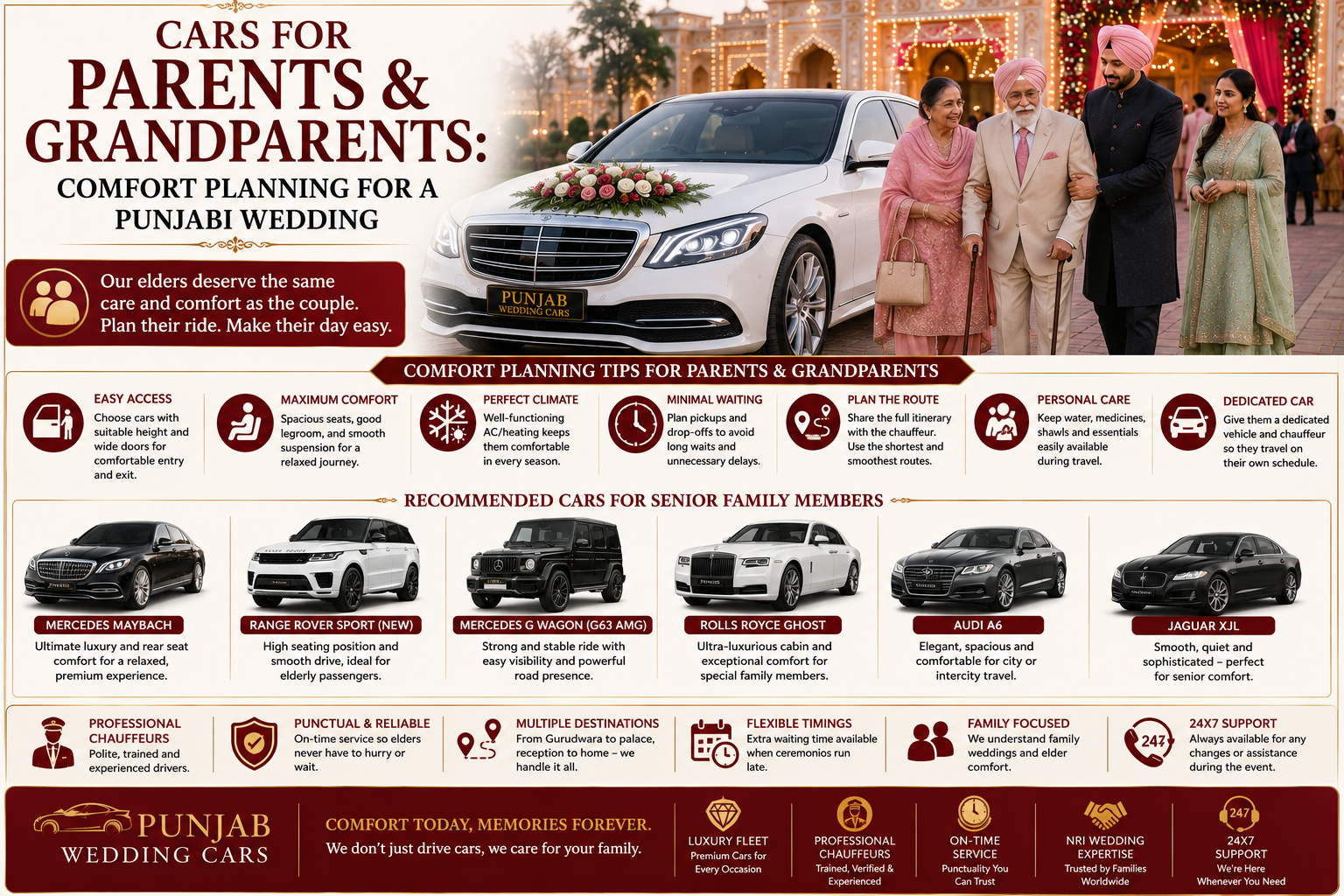
For longer distances, parents and grandparents benefit from adequate legroom, comfortable rear seating, controlled cabin temperature and a smooth chauffeur-driven journey.
This is where vehicles such as the Mercedes Maybach, Jaguar XJL and Audi A6 can make sense for family transport.
The Rolls Royce Ghost can also provide a particularly luxurious rear-cabin experience where the family wants an ultra-premium vehicle for senior parents, VIP relatives or important NRI family members.
Not every family needs to book an ultra-luxury car for the parents. The broader principle is what matters: if someone will spend a substantial amount of time travelling, choose the vehicle around passenger comfort rather than only wedding photographs.
You can compare the wider Punjab Wedding Cars luxury fleet according to the role each car needs to perform.
Do Not Automatically Put Grandparents in the Groom's Car
The groom's car attracts attention, so relatives sometimes assume it is also the most comfortable family vehicle.
That is not always true.
A groom may deliberately choose the Mercedes G Wagon G63 AMG because he wants a bold SUV for the baraat arrival.
That vehicle can be excellent for the role it was selected to perform.
But if grandparents would be more comfortable in a luxury saloon with a different entry height and rear-seat layout, there is no reason they should travel in the G Wagon simply because it is the most prominent car at the wedding.
Treat the groom's ceremonial vehicle and senior-family transport as separate jobs.
This also prevents situations where parents are left waiting because the groom's car is being used for photography or positioned for an entrance.
Give Parents Their Own Reliable Vehicle
Parents usually have responsibilities throughout the wedding.
They may be carrying ceremony-related items, handling relatives, coordinating with the Gurudwara or speaking with the marriage palace.
Depending entirely on another guest for transportation can add unnecessary stress.
A dedicated chauffeur-driven vehicle gives the parents more control over when they leave one location and reach the next.
It does not have to be the most extravagant car in the fleet.
Reliability, clean presentation, comfortable seating and a professional chauffeur can matter more than dramatic styling.
If the parents need to reach the Gurudwara before the baraat, their vehicle should be scheduled independently from the groom's arrival.
That way, an unexpected delay at the groom's home does not also make the parents late.
Grandparents Should Not Have to Follow the Baraat Convoy
A large Punjabi wedding convoy can be exciting for younger relatives.
For grandparents, it can be tiring.
Vehicles move at different speeds. Cars repeatedly stop to keep the convoy together. Some relatives overtake and then wait farther ahead. Parking becomes crowded around the venue.
Senior family members usually benefit from a calmer plan.
Their chauffeur should know the destination and travel there normally rather than trying to remain directly behind the groom's vehicle.
This means grandparents can reach the Gurudwara or marriage palace comfortably without being caught in unnecessary convoy movements.
If the family is arranging many guest vehicles, our wider wedding-transport planning principle remains useful: give each vehicle a clear job instead of expecting every car to travel as one large group.
Allow More Time for Boarding and Departure
A younger guest can receive a WhatsApp message saying, “Everyone is leaving in five minutes,” and be sitting in the car almost immediately.
Parents and grandparents may need more time.
They might need to collect medication, change footwear, use the washroom, find a shawl in winter or simply walk carefully from the home or hotel room to the car.
Wedding transport planning should account for this.
If the family wants grandparents at the Gurudwara by 9:30 AM, do not schedule their vehicle as though they can leave at the absolute latest possible minute.
Ask the chauffeur to report early enough for a calm departure.
Our guide on what time your wedding car should arrive from groom pickup through doli explains why wedding-car reporting time should always include a sensible preparation buffer.
The same principle is even more useful for senior family members.
Avoid Making Older Family Members Wait in a Parked Car
There is a difference between having a vehicle ready and asking passengers to sit inside it unnecessarily.
If the Anand Karaj is running late and grandparents are comfortable inside the Gurudwara or another suitable waiting area, they do not need to sit in the car simply because the chauffeur is outside.
Likewise, if a reception is delayed, parents may prefer to remain inside the venue until the vehicle is properly positioned for departure.
A professional chauffeur can wait with the car while the passengers remain somewhere more comfortable.
Our guide on what happens when a Punjabi wedding ceremony runs late explains why waiting time should be planned before the event.
For elderly relatives, this is not only a pricing question. It is a comfort question.
Think Carefully About Gurudwara Drop-Off and Pickup
Gurudwara parking and entrance arrangements can be very different from a hotel or marriage palace.
At a busy Anand Karaj, many vehicles may arrive within a short period.
Parents and grandparents should ideally be dropped at the most practical permitted point rather than being expected to walk a long distance from wherever the rest of the convoy parks.
The chauffeur should then know where to reposition the vehicle.
After the ceremony, the family member coordinating transport should make sure the driver knows when the grandparents are actually ready to leave.
This is particularly valuable during summer heat, winter cold or rainy weather.
A few metres can make a meaningful difference to someone with limited mobility.
Marriage Palaces and Resorts Need a Pickup Plan Too
A large marriage palace may have a main entrance, valet area and separate guest parking.
Parents may enter through one gate and later discover their car is parked far away.
That is why the departure arrangement should be discussed before everyone starts leaving.
The family transport coordinator can call the chauffeur shortly before the parents are ready.
The car can then be brought to the appropriate pickup point instead of leaving elderly passengers waiting outside.
This becomes even more useful during peak wedding season when several hundred cars may be moving around the venue.
Planning where the vehicle should wait and where the passengers will actually board are two different decisions.
Summer Weddings Need Strong Air Conditioning
Punjab's warmer wedding months make air conditioning especially important for senior relatives.
Wedding clothing can be heavy. Parents may be wearing formal suits, sherwanis or layered traditional outfits. Grandmothers may be in embroidered suits or sarees.
A car that has been parked in direct sunlight can become extremely hot.
The chauffeur should have the cabin comfortable before elderly passengers get inside where practical.
This is another reason to use an organised chauffeur-driven vehicle rather than depending on a family car whose driver may be busy elsewhere in the function.
Comfort begins before the journey starts.
Winter Weddings Bring Different Problems
Winter wedding transportation requires the opposite preparation.
An early-morning Anand Karaj can mean leaving home before sunrise.
Older family members may feel the cold more strongly, and winter fog can extend travel times on Punjab roads.
Parents and grandparents should therefore leave with enough time that the chauffeur does not feel pressured to rush.
A shawl or coat should remain accessible rather than being packed into luggage.
For longer journeys, route timing should consider visibility conditions rather than relying on the normal daytime travel estimate.
The safest plan is the one that accepts that winter driving may take longer.
Medication and Essential Items Should Stay With the Passenger
This is particularly important for grandparents.
Medication should not be placed in a large suitcase travelling in another family vehicle.
Likewise, spectacles, hearing aids, walking sticks, important documents and other personal essentials should remain with the passenger or a responsible relative travelling with them.
A small handbag is far easier to manage than trying to locate a suitcase after the vehicle has already departed.
For NRI parents returning from Canada, the UK, Australia or the United States for a family wedding, passports and important travel documents should also remain clearly accounted for.
The same logic appears in our Bridal Doli Transport Checklist because wedding-day luggage should always have a clear owner and transport plan.
Do Not Overfill the Car
A luxury vehicle does not become more useful because every available seat is occupied.
If two grandparents are travelling comfortably in the rear, adding several relatives, handbags and ceremony items can make the same car feel completely different.
Plan who actually needs to travel together.
If parents want a sibling or trusted relative with them, include that person.
But avoid turning the parents' designated vehicle into the general family overflow car.
Senior passengers deserve enough space to sit comfortably and enter or leave without navigating piles of bags.
If luggage, gifts or ceremony items need moving, allocate another family vehicle.
Parents May Need to Leave the Reception Earlier
One of the advantages of giving parents or grandparents their own vehicle is flexibility at the end of the night.
Younger relatives may want to remain at the reception until the final song.
Grandparents may be ready to leave much earlier.
If everyone arrived in the same family car, older relatives can become effectively trapped at the function until the driver decides to go home.
Dedicated transportation solves this.
A chauffeur can take grandparents home or back to the hotel while the rest of the family continues celebrating.
This can be particularly valuable at destination-style weddings where guests are staying at hotels away from the venue.
Late-Night Journeys Should Be Planned Before the Reception
Do not wait until midnight to ask how the parents are getting home.
If they will require a vehicle after the reception, arrange it beforehand.
The chauffeur should know the expected pickup location and approximate departure window.
If the wedding is likely to run substantially late, this should form part of the booking requirement.
Our guide Does Wedding Car Waiting Time Cost Extra? explains why families should discuss likely waiting rather than assuming a chauffeur-driven car remains available indefinitely.
Senior-family transport is much easier when everyone knows the expected return arrangement before the function begins.
Intercity Weddings Need Even More Comfort Planning
Parents and grandparents travelling between cities should be treated differently from guests moving a few kilometres across town.
A wedding involving Amritsar and Jalandhar, Jalandhar and Ludhiana, Patiala and Chandigarh or another intercity combination can mean several hours of cumulative road travel.
The exact pickup address matters because the family home may itself be some distance from the highway. Our guide on Why the Pickup Address Matters When Calculating an Intercity Wedding Car Quote explains why the actual starting point, rather than merely the city name, defines the real journey.
For senior passengers, this information also helps determine whether rest time is needed between functions.
If the Anand Karaj finishes in one city and the reception is elsewhere, older family members may benefit from returning to a hotel or home before the evening programme rather than spending the entire day travelling from venue to venue.
Multi-Venue Weddings Need a Dedicated Parent Plan
Punjabi weddings increasingly involve several locations.
Jaggo may be at home. Anand Karaj may take place at a Gurudwara elsewhere. Lunch may be in a marriage palace. The reception may be at another venue.
Younger family members can adapt relatively easily.
Grandparents should not have to ask after every function, “Which car are we going in now?”
Give them a simple, repeated arrangement wherever possible.
The same chauffeur and vehicle can be particularly helpful because the grandparents already recognise the driver and know which car they are looking for.
Our guide on planning cars for one wedding across three venues explains why vehicle roles become more important as the number of venues increases.
Full-Day Transport Can Make Sense for Parents
Parents often have enough separate movements that a longer vehicle assignment deserves consideration.
If the same car takes them from home to Gurudwara, waits through the ceremony, continues to the palace and later returns them home, a properly planned longer booking may be easier than repeatedly arranging different cars.
Our guide on Full-Day vs Ceremony-Only Wedding Car Packages explains that better value depends on how many meaningful jobs the vehicle actually performs.
If the parents only require one transfer, a shorter booking can be perfectly adequate.
If they need the car throughout the day, plan it that way from the beginning.
Choose a Chauffeur, Not Just a Car
For parents and grandparents, the chauffeur can be just as important as the vehicle.
A professional driver should understand that an elderly passenger may take longer to board.
There should be no rushing.
The car should stop where practical and safe for easier access. The chauffeur should know the route before departure and drive smoothly rather than aggressively trying to remain with a baraat convoy.
For a long intercity journey, route familiarity and a calm driving style can make more difference to passenger comfort than any decorative feature on the vehicle.
This is why chauffeur-driven family transportation deserves to be planned as a service rather than merely renting a premium car.
Luxury Can Mean Making the Day Easier
When people hear “luxury wedding car,” they often imagine dramatic entrances and photographs.
For parents and grandparents, luxury can mean something quieter.
A vehicle waiting when they are ready.
A clean rear seat.
Working air conditioning or heating.
Enough room to sit comfortably.
A chauffeur who is not in a hurry.
Being dropped close to the entrance.
Knowing that when they decide to leave the reception, their car is already arranged.
Those details rarely appear in wedding photographs.
But they can make an enormous difference to how senior family members experience the day.
Build the Wedding Transport Around the People Who Need It
Punjabi families put enormous effort into making parents and grandparents part of wedding ceremonies.
Transportation deserves the same level of thought.
Start by mapping their actual wedding day. Identify when they leave home, where they need to be before the groom or bride, which functions they will attend, whether they need a break and when they are likely to return.
Then select the car around that journey.
A Mercedes Maybach can suit a formal luxury experience. The Range Rover Sport gives families a premium SUV option. The Jaguar XJL and Audi A6 can offer comfortable chauffeur-driven saloon travel, while the Rolls Royce Ghost can be reserved for families looking for an ultra-luxury experience.
But do not begin with the badge.
Begin with the passenger.
Parents and grandparents should not spend a Punjabi wedding worrying about which relative has the car keys, whether someone will take them home or how far they need to walk from the parking area.
When their transport is planned properly, they can concentrate on what they came to do: watch their children and grandchildren celebrate, meet family members they may not have seen for years and enjoy the wedding without the road between each function becoming another source of exhaustion.
That is the real purpose of comfortable family wedding transportation.