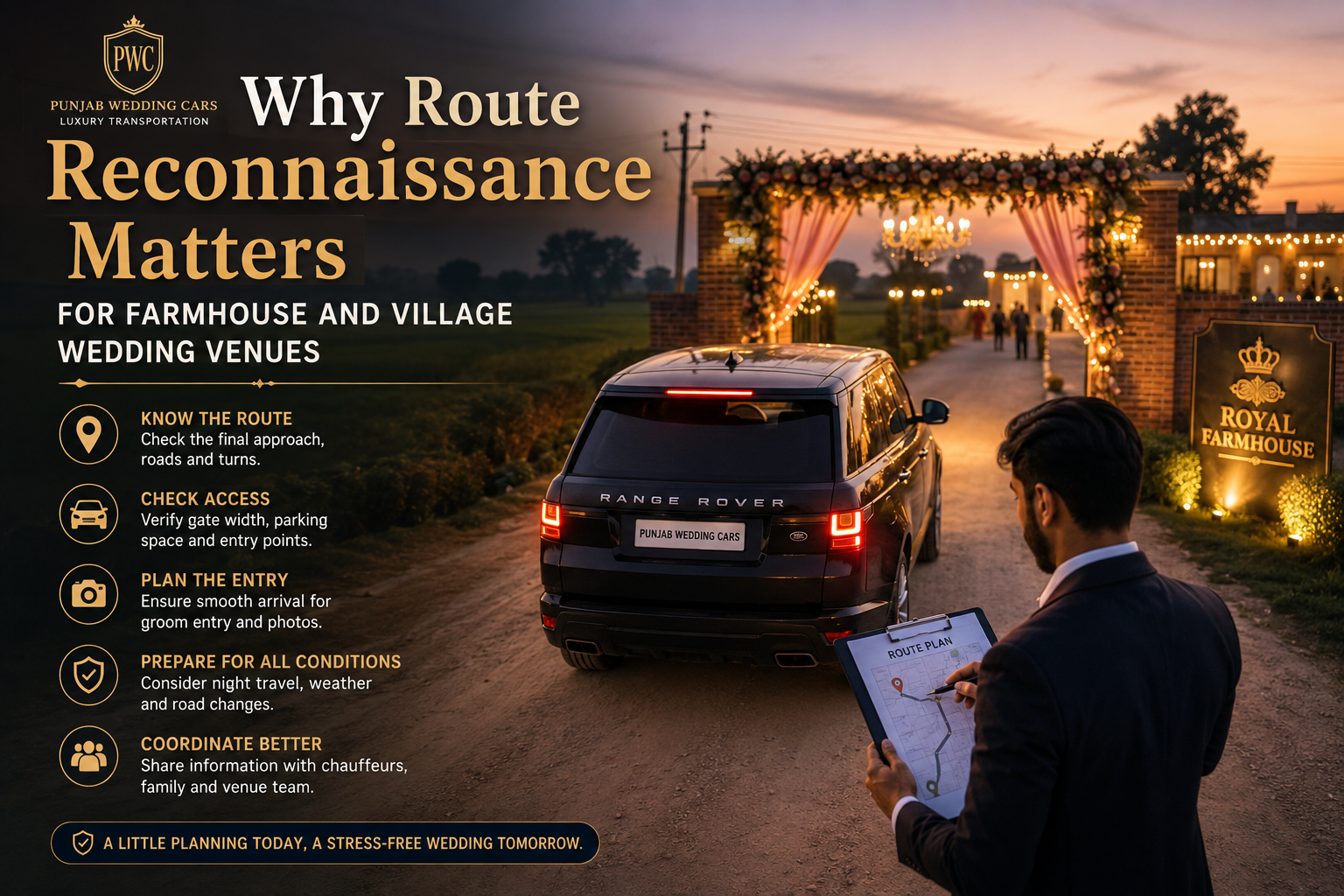
Why Route Reconnaissance Matters for Farmhouse and Village Wedding Venues
A wedding route can look perfect on Google Maps and still become completely different during the final two kilometres.
That is particularly true with farmhouse and village wedding venues across Punjab. The main highway may be wide, newly surfaced and easy for a chauffeur-driven luxury car. The real challenge can begin after the vehicle leaves that highway and turns towards the venue.
The approach may narrow into a village road. A drainage edge may reduce usable width. A temporary wedding gate may have been erected close to the entrance. Guest cars may already be parked on both sides. The final turn into the farmhouse may be tighter than it appears on the map. Rain from the previous day may have softened an unpaved parking area. At night, the entrance that looked obvious during a daytime venue visit can become surprisingly difficult to identify.
For a normal car arriving as a guest, these details may only create a small inconvenience. For a Mercedes-Maybach carrying the bride, a G Wagon prepared for the groom's arrival, a Rolls-Royce positioned for photography or a convoy of luxury wedding cars, they can affect timing, presentation and the entire entry plan.
That is why route reconnaissance matters.
It does not necessarily mean somebody must conduct an elaborate road survey before every Punjab wedding. It means the transport team and family should verify the parts of the journey that are uncertain, especially the final approach to a farmhouse, resort or village property where online navigation alone may not tell the complete story.
Punjab Wedding Cars already discusses venue entrance, road condition and wedding-day access in its guide to Luxury Cars for Farmhouse Weddings in Punjab. Route reconnaissance takes that planning one step further by asking a very practical question: Can the selected wedding car reach the exact place where the family expects it to arrive, turn, stop, wait and leave comfortably?
In Short
Route reconnaissance for a farmhouse or village wedding means checking more than the distance between the family home and venue. The useful information includes the final approach road, road surface, narrow sections, sharp turns, gate width, overhead decorations, parking conditions, turning space, correct entrance, photography position and an alternative approach if the normal road becomes blocked.
This becomes more important when the bride or groom is using a large or low-value-clearance luxury vehicle, when the reception is taking place after dark, when hundreds of guest cars will reach the same rural venue or when doli will leave late at night.
A ten-minute route check before the wedding can sometimes solve a problem that would otherwise appear when a decorated luxury car is already surrounded by the baraat.
The Highway Is Often the Easy Part
Families naturally pay most attention to the longest part of the journey.
If the groom is travelling from Jalandhar towards a farmhouse near Ludhiana, everyone discusses the Jalandhar-to-Ludhiana road. If relatives are coming from Amritsar, they think about the main intercity journey. If the bride is leaving a city hotel for a rural Gurudwara or farmhouse, the estimated travel time is often calculated from the major roads.
Those roads are important, but they may not be the difficult part.
The journey can progress smoothly for sixty or seventy kilometres and then lose fifteen minutes at the final village turn because the entrance is not obvious.
A luxury car may reach the correct village according to navigation but still be on the opposite side of the venue boundary.
A chauffeur may discover that the map-selected road technically reaches the farmhouse but uses an approach that is much narrower than another road used by local families.
This is why the existing PWC guide on why the pickup address matters for an intercity wedding-car quote emphasises the exact home, hotel or village location rather than relying on broad city names. The same logic applies at the destination.
The destination should not be “farmhouse near Ludhiana.”
It should be the correct entrance to that farmhouse.
Google Maps Is Useful, but the Pin Is Not the Road
Digital navigation has transformed wedding transport. Exact pins are far better than old instructions such as “turn after the petrol pump and ask somebody near the Gurudwara.”
But a location pin answers only one question: where is the destination?
It does not always tell you what the road will be like when the wedding car reaches it.
A satellite image may be outdated. A road that appears usable may currently have construction. A venue may have created a new main entrance since the map imagery was recorded. A local road may be perfectly suitable in dry weather but less attractive after heavy rain.
Wedding-season traffic can create another difference. A road that looks empty on an ordinary Tuesday afternoon may have vehicles parked along both sides when two marriage functions are happening nearby on Saturday evening.
This is not an argument against navigation apps. Chauffeurs should absolutely have the correct destination pin.
The point is that map navigation and route reconnaissance perform different jobs.
Navigation finds the location. Reconnaissance verifies whether the planned wedding movement works when the vehicle actually arrives.
The Last Kilometre Can Decide the Groom Entry
Consider a groom arriving in a Mercedes G Wagon G63 AMG.
The family may have selected the G Wagon precisely because of its road presence. The photographer may be waiting near the entrance. Friends may be gathering around the approach road. The venue may have arranged dhol players, lighting and a floral entry.
The entire visual plan assumes the vehicle reaches the intended arrival point.
If the chauffeur discovers that guest parking has blocked the main gate, the G Wagon may have to stop much farther away. If the entrance turn is occupied by buses or badly parked cars, the planned photograph changes. If the baraat has gathered in the only area where the vehicle needs to turn, the chauffeur may have to wait while people are moved.
None of these situations means the venue is unsuitable.
They mean vehicle movement should have been considered before the entry.
A route check allows the family to decide exactly where the groom car should stop, where the baraat should gather and where general guest cars should not be parked.
That is much easier to arrange before the wedding than after the groom has arrived.
Vehicle Size Changes the Route Question
A road that is easy for an Audi A6 may require more consideration for a larger luxury SUV.
Likewise, a route that works comfortably for a Range Rover may not provide ideal manoeuvring space for a long limousine.
The family therefore should not only ask whether cars can reach the venue. They should ask whether their selected car can reach the intended arrival position comfortably.
The Punjab Wedding Cars fleet includes vehicles with very different dimensions, body styles and wedding uses. A Maybach, G Wagon, Range Rover Sport, Rolls-Royce Ghost, Jaguar XJL and limousine cannot automatically be treated as though they need identical approach space.
A farmhouse that routinely hosts hundreds of guests may still have one decorative entry lane that is much tighter than the main service entrance.
If the couple wants a particular vehicle to pass through that decorative entrance for photography, confirm that before the car is booked around that visual idea.
Land Rover Defender Makes Sense for Some Rural Settings, but Route Planning Still Matters
A Land Rover Defender naturally suits certain farmhouse and village wedding settings because families often value its SUV character, ground clearance and strong visual presence.
That does not mean the route can simply be ignored.
Ground clearance does not solve a gate that is too narrow.
It does not solve a low decorative structure.
It does not solve forty guest cars parked through the only turning area.
Vehicle capability and venue logistics are different questions.
The Defender may be an excellent match for a rural farmhouse wedding, but the chauffeur still benefits from knowing which road provides the best approach and where the family wants the vehicle positioned.
Ground Clearance Is Only One Part of the Decision
Families sometimes reduce rural wedding-car suitability to one question: “Is the car high enough?”
That is incomplete.
Road surface matters, but so do width, gradient, turning radius, drainage edges, temporary ramps, speed breakers and parking conditions.
A low luxury saloon may be perfectly comfortable on a well-paved village road. A large SUV may face more difficulty than expected if the lane is physically narrow.
That is why seeing the route is more useful than making assumptions from the words “village road.”
Punjab contains rural properties with excellent paved access and large parking grounds. It also contains venues reached through older local roads where more care is required.
The venue should be judged by its actual approach.
The Venue Gate Should Be Checked Before Floral Decoration Is Finalised
Farmhouse entrances are frequently decorated specifically for the wedding.
That can unintentionally change vehicle access.
A gate that normally has excellent height and width may receive flower structures, fabric, hanging decorations, lighting equipment or temporary pillars.
The decorators are thinking about visual impact.
The chauffeur is thinking about whether the wedding car can pass through.
Both objectives can work together if somebody checks.
If the family expects the groom's Range Rover or G Wagon to drive directly underneath the decorated arch, the decorator should know that a large vehicle needs to pass through.
Likewise, if the bride's car will leave through the same gate during doli, the exit should remain clear late into the night.
The safest time to discover a decoration is too low is before it has been completed.
Farmhouse Parking Can Change the Luxury-Car Plan
Some Punjab farmhouses have very large parking grounds.
Others use an adjacent field or temporary parking area during major functions.
That difference matters for a luxury wedding car expected to remain at the venue.
The groom's car may arrive on a paved approach and later be directed into an unpaved overflow area. The bridal car may need to remain spotless until doli. A Rolls-Royce being kept for evening photography may need a more controlled waiting position than general guest cars.
The family should therefore know where the principal wedding vehicles will wait.
A chauffeur-driven hero car should not automatically be sent wherever guest parking marshals are directing every other car.
The transport coordinator can agree a suitable waiting position with the venue beforehand.
This is particularly useful for full-day assignments where the vehicle is expected to remain through Anand Karaj, reception or doli.
Rain Can Change a Farmhouse Route Quickly
Weather can transform an otherwise simple rural approach.
An unpaved shoulder may become soft. A field being used for overflow parking may no longer be suitable for every vehicle. Water may collect beside an entrance. A temporary surface laid for the wedding may need attention.
Route reconnaissance does not mean predicting the weather weeks in advance.
It means recognising which parts of the venue access are weather-sensitive.
If the entire journey is paved from highway to entrance, there may be little concern.
If the final section crosses temporary ground, the family should know that and have an alternative parking or vehicle-positioning plan if conditions deteriorate.
The car should not be used to discover the ground condition.
Someone at the venue can check it first.
Dust Matters When the Car Is Part of the Photography
Dry rural roads create a different issue.
Dust may not stop the vehicle from reaching the venue, but it can affect presentation.
A freshly detailed black G Wagon following several guest vehicles along a dusty approach may reach the groom-entry point visibly different from when it left the family home.
If the route check identifies a dusty final section, the family can plan accordingly. Perhaps the groom car enters before the bulk of guest traffic. Perhaps the venue has another paved approach. Perhaps a quick exterior presentation check can be arranged before photography.
This is not about demanding perfect road conditions from a rural wedding venue.
It is about understanding the environment in which the luxury car will be used.
Do the Check at Approximately the Right Time of Day
A route inspected at noon can feel very different at 10:30 PM.
This matters when reception or doli will happen after dark.
A rural junction that is obvious during daylight may have limited signage at night. A farmhouse entrance may rely heavily on decorative lighting. An unlit side road can be easy to miss. Construction material on the road edge becomes harder to see.
If the main concern is a late-night bridal departure, information about night access is more valuable than a beautiful daytime venue video.
The PWC guide on Wedding Car Safety for Night and Intercity Travel similarly emphasises complete route information, realistic timing and preparation when wedding journeys continue after dark.
A daytime route check can still be useful, but somebody should also understand what the final approach looks like at the time the car will actually use it.
Doli Needs the Exit Checked, Not Only the Arrival
Most venue planning concentrates on getting the groom in.
The bridal departure can be the more demanding journey.
By doli, it may be late at night. Guest cars can be parked differently from when the wedding began. Some lighting may have been switched off. Family members may gather around the bridal vehicle. The couple may need to travel a substantial distance after leaving the farmhouse.
The route should therefore be considered in both directions.
Can the bridal car leave the venue without reversing through a crowd?
Is there enough space for a support vehicle to follow?
Will parked buses block the exit?
Does the chauffeur know the correct road back towards the highway?
Is the final destination already pinned?
The answers should be known before the bride enters the car.
A Narrow Village Street Needs Traffic Management More Than Driving Skill
When a groom is being collected from a village home, another common challenge is congestion outside the property.
The road itself may be perfectly suitable.
The problem is that family vehicles, tractors, caterer vans, photographers and relatives have occupied both sides before the wedding car arrives.
Suddenly the usable width is half what it normally is.
A route check can identify where the groom car should approach and where relatives should avoid parking.
Sometimes the best solution is remarkably simple: leave a short section of road clear for fifteen minutes before the luxury car reports.
That small instruction can create a much smoother groom pickup than expecting the chauffeur to manoeuvre through a road that the family itself has blocked.
Village Pickups Need a Reliable Local Contact
An exact pin should always be supplied.
A local contact is also useful.
Village properties do not always follow the address patterns that someone unfamiliar with the area expects. A house may sit behind another lane. Two roads may approach the same village. Navigation may stop at the right general area without clearly identifying which gate the family wants the decorated car to use.
One local contact solves that.
The chauffeur should not need to call six relatives.
One person who understands the actual approach can confirm the final turn if necessary.
This is especially valuable when a wedding car is reporting before sunrise or when dense wedding traffic has changed normal road access.
NRI Families Should Ask for a Current Video of the Final Approach
Families planning from the UK, Canada, Australia or the United States may not see the venue themselves until shortly before the wedding.
That does not prevent route reconnaissance.
A trusted Punjab-based family member can make a short video showing the final approach from the main road to the venue gate.
The video does not need professional production.
Its value is practical.
It can show road width, surface condition, the turn into the property, the gate and the area where the wedding car is expected to stop.
This can be far more useful than a venue promotional reel that focuses on chandeliers, décor and lawns but never shows how a vehicle actually enters the property.
For an NRI family booking an expensive wedding car remotely, that simple video creates confidence around the part of the journey that online photographs usually ignore.
Route Reconnaissance Helps the Photographer Too
Photographers often plan groom and couple arrivals around a particular entrance.
A route check allows them to understand how the vehicle will actually move.
They can decide where to stand before the car arrives rather than asking the chauffeur to repeat the entry several times.
They can see whether the sun, lighting or venue layout favours one direction.
They can position the team so they are not blocking the turning path.
For a major groom entry, this coordination can create better photographs without making the chauffeur perform unnecessary manoeuvres.
The objective is not to make the car perform for the camera.
It is to position the camera intelligently around the real vehicle movement.
Reconnaissance Can Prevent a Baraat From Blocking Its Own Car
This happens more easily than families expect.
The groom's friends gather at the entrance.
Dhol begins.
Everyone spreads across the road.
The hero vehicle now has nowhere to move.
The family wanted the groom to arrive through the crowd, but nobody decided where the car should actually stop.
Checking the venue beforehand lets the family establish a simple sequence. The vehicle approaches through a clear lane, reaches the planned stopping point and only then does the larger gathering surround the groom.
That creates a better arrival and a safer, more controlled environment for photographers and guests.
The Cheapest Route Is Not Always the Best Wedding Route
Navigation software may offer several possible approaches.
The shortest may use narrow internal roads.
Another route may be slightly longer but stay on wider roads almost until the venue gate.
For a normal solo journey, saving two kilometres may be attractive.
For a groom travelling in a luxury SUV with photographers and family cars behind, the wider route may be much more practical.
This connects directly with Punjab Wedding Cars' guide to Hidden Wedding Car Route Costs: Tolls, Detours, Parking and Extra Stops. That guide explains why the real wedding route can differ from the simple route displayed between two city names.
The best route is the one that supports the wedding safely and efficiently, not necessarily the one containing the smallest number beside “kilometres.”
Avoid Sending the Entire Convoy Down an Unverified Shortcut
A local relative may know a shortcut.
That does not automatically mean a twenty-car wedding convoy should use it.
A shortcut that works perfectly for a hatchback may become awkward when several large luxury vehicles, family SUVs and buses follow one another.
If the convoy becomes separated on a narrow rural road, reversing or turning around can become difficult.
The main vehicles should have a confirmed approach to the venue. General guests can use their own navigation where appropriate.
There is little benefit in forcing every wedding car to remain physically together if all of them know the correct destination.
Share One Correct Entrance Pin With Everyone Who Matters
Large venues can have more than one gate.
There may be a service entrance, guest entrance, parking gate and ceremonial entry.
Sharing only the farmhouse name can therefore create several different arrival experiences.
The transport coordinator should send the correct entrance pin to the groom chauffeur, bridal chauffeur, parents' driver, photographer and any major guest-transport vehicle that needs the same access.
If different groups should use different entrances, say so clearly.
This is one of the simplest benefits of route reconnaissance. Once somebody has physically confirmed the correct gate, that information can be distributed to everybody before the wedding starts.
Reconnaissance Can Improve the Wedding-Car Quote Too
Venue access can affect more than timing.
The actual journey may involve additional local distance, a different approach road, a waiting location or another planned movement that was not visible when the booking was described only by city names.
That is why a meaningful quotation should reflect the complete assignment.
If the groom is being collected from a village outside Jalandhar and travelling to a farmhouse outside Ludhiana, “Jalandhar to Ludhiana” is only a broad description.
The real route begins at the groom's door and ends where the chauffeur's responsibility finishes.
The PWC guide on why the pickup address matters and the guide to hidden route costs both reinforce the importance of describing the actual wedding movement rather than relying only on two city names.
Do Not Wait Until Wedding Morning to Discover Roadworks
Road conditions change.
Construction can begin.
A local bridge may be temporarily restricted.
A road near the farmhouse can be resurfaced.
The venue itself may be building another entrance.
For an important farmhouse booking, recent information is much more useful than somebody saying, “I went there last year and the road was fine.”
The family does not need to inspect every kilometre of the highway.
It should verify the uncertain section closest to the pickup or venue.
A quick call to the venue or a current video from a local coordinator may be enough.
The closer the wedding becomes, the more valuable current information is.
Not Every Farmhouse Requires a Physical Pre-Drive
Route reconnaissance should remain practical.
If the venue is a well-known property on a major paved road, the transport team already knows the entrance and there are no unusual vehicle requirements, a separate physical route drive may add very little.
The important thing is verification.
That verification can come from prior chauffeur familiarity, a recent venue visit, current local information, photographs of the access road, a video from the family or an actual pre-drive when the final approach is genuinely uncertain.
The level of checking should match the risk.
A familiar urban hotel needs less reconnaissance than a newly opened farmhouse reached through an unfamiliar village road.
That is sensible transport planning, not over-planning.
Vehicle Choice Should Follow What the Route Actually Requires
Route reconnaissance may occasionally change the family's original vehicle preference.
That is useful information, not bad news.
Perhaps the road turns out to be excellent and the bride can comfortably use the Maybach she wanted.
Perhaps the venue has a generous paved entrance and the Rolls-Royce will work beautifully.
Perhaps a rougher rural approach makes the family more comfortable choosing a Land Rover Defender or Range Rover-style SUV.
Perhaps a large limousine does not suit the decorative gate the family intended to use.
It is better to discover that while choosing the car than while the car is outside the venue.
The existing PWC guide to Luxury Cars for Farmhouse Weddings in Punjab makes the same central point: venue entrance, road condition, entry style and doli plan should influence the vehicle decision.
Route Familiarity Is Part of Professional Chauffeur Service
A professional chauffeur cannot control potholes, wedding traffic, temporary road closures or where guests decide to park.
What the chauffeur can do is begin with the best available information.
The correct pin helps.
A known entrance helps.
A local coordinator helps.
Knowledge of an alternative route helps.
Clear instructions about where the car should stop help.
This is why chauffeur-driven wedding transportation is not simply about providing somebody to operate the steering wheel.
The chauffeur is part of a planned movement involving timing, presentation, passengers, photography and venue access.
For farmhouse and village weddings, route familiarity becomes a particularly important part of that service.
The Best Route Check Ends With a Boring Wedding Journey
That is the ideal outcome.
The chauffeur leaves the main highway, takes the correct village road and reaches the venue without hesitation. The entrance is wide enough because the decorator knew the vehicle was coming. Guest parking has been kept away from the groom's stopping point. The photographer is already positioned. The car turns comfortably, the groom steps out and the wedding continues.
Later, the bridal car has a clean route out of the property. The support vehicle knows which road to follow. The receiving family has the final location. Nobody is asking the bride for directions at midnight.
Nothing dramatic happens.
That is precisely why the reconnaissance was worthwhile.
Punjab farmhouse and village weddings can create some of the most beautiful luxury-car arrivals because they offer space, scenery, dramatic entrances and a setting very different from a city hotel. Those advantages should not be undermined by assuming that the map pin tells the entire transport story.
Check the real approach. Understand the gate. Know where the car will turn and wait. Consider the route after dark. Keep one local family coordinator available and match the vehicle to the road that actually exists.
A wedding car can travel fifty kilometres perfectly and still lose the arrival in the final five hundred metres.
Route reconnaissance protects those final five hundred metres—and with them, the timing, photography, vehicle presentation and calm arrival the family planned in the first place.