Eco-Conscious Does Not Have to Mean Giving Up Luxury
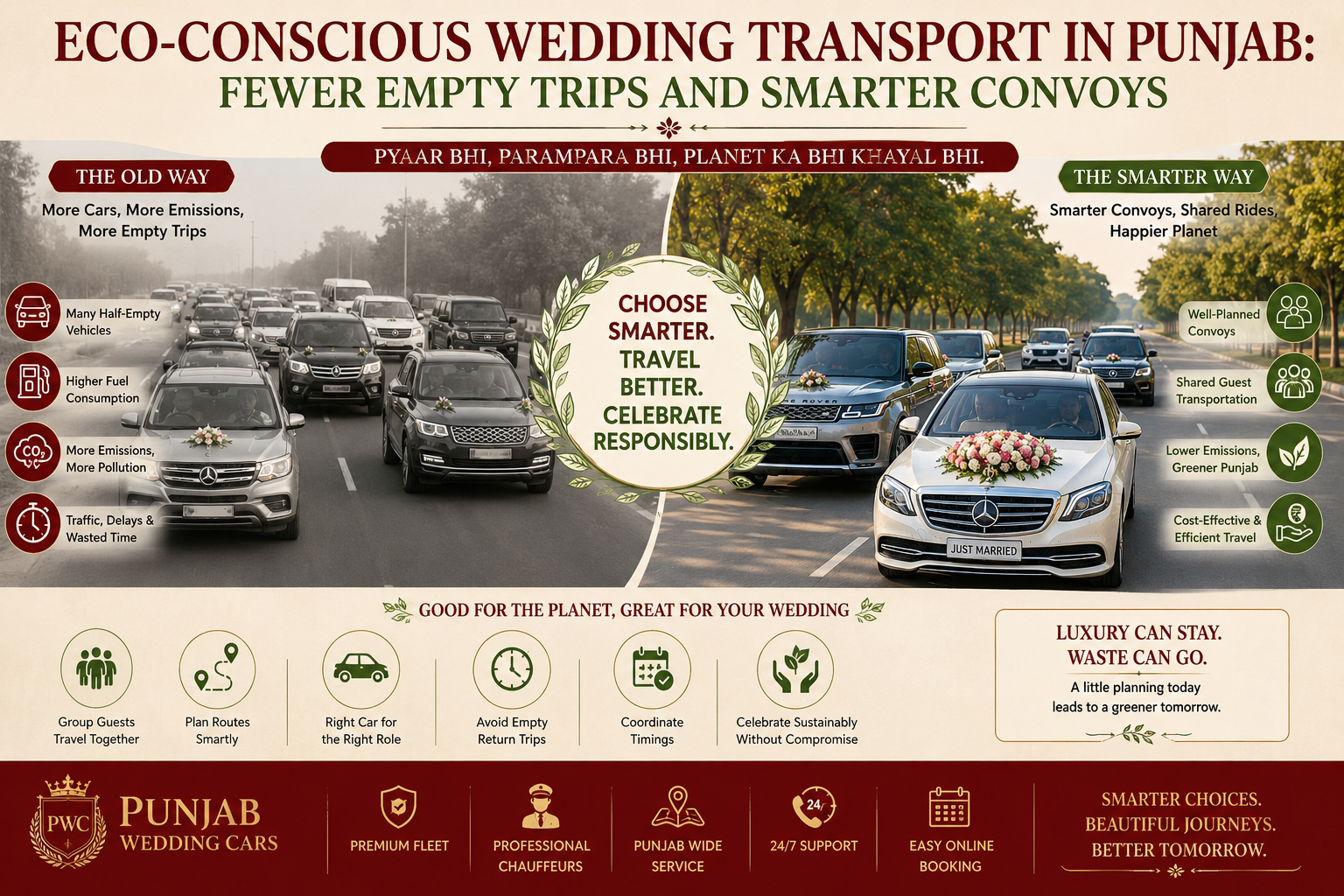
Eco-conscious wedding transport in Punjab does not have to mean replacing every wedding car with an electric vehicle or removing luxury from the celebration. In many weddings, the most practical improvement is simpler: reduce unnecessary vehicle movement.
A Punjabi wedding can involve the groom’s home, the bride’s home, a Gurudwara, a marriage palace, hotel pickups, photography stops and a late-night return. When every relative arranges a separate car and several vehicles make empty return trips, the transport plan quickly becomes inefficient.
The smarter approach is to plan the wedding as one connected movement. Use the right number of cars, give each vehicle a clear passenger role and avoid repeating the same route when one organised trip can do the job.
Start With the Number of Cars You Actually Need
The first place to improve transport efficiency is fleet size.
A family may imagine a long line of premium cars because it looks impressive in photographs, but a larger convoy is not automatically a better plan. If several vehicles travel half-empty for most of the day, the wedding is using more road space, fuel and chauffeur time than necessary.
Punjab Wedding Cars’ guide to how many wedding cars a Punjabi wedding really needs explains that the right number depends on the actual roles: bride, groom, immediate family, guests and multi-venue movement.
A smaller wedding may work with one signature groom car and a separate bridal vehicle. A larger celebration may genuinely need several cars, but each one should have a reason to be there. The eco-conscious decision is not “book fewer cars at any cost.” It is “do not book cars that have no real transport role.”
Use One Hero Car and Practical Support Vehicles
One of the easiest ways to balance luxury with efficiency is to choose one main “hero” vehicle and use practical support cars around it.
A groom may want a G Wagon G63 for the baraat entry. That does not mean every close relative needs another G Wagon. Parents and grandparents can travel in suitable premium SUVs or sedans, while general guests use shared transport.
The bride may have a separate Maybach or Rolls-Royce for privacy and doli photography. This keeps the special wedding moments intact while reducing duplicated luxury-car movement.
Couples can compare options through the Punjab Wedding Cars luxury fleet and assign each selected car to an actual role instead of simply adding more premium vehicles because they are available.
Empty Trips Are Where the Waste Usually Starts
A car carrying passengers is doing its job. An empty car travelling across the city because the schedule was poorly coordinated is where unnecessary movement begins.
Consider a hotel group travelling to the Gurudwara. If four family cars collect small groups at different times and then all return empty to the hotel, the same route is being repeated several times.
A better plan may use one larger guest vehicle or combine passengers with similar schedules.
The Wedding Guest Transport Plan: Hotel, Gurudwara, Palace and Return Journey is useful because it treats these movements as one connected journey rather than unrelated pickups.
That change in thinking is important. Instead of asking, “Which car is taking this person?” ask, “Which passengers are travelling to the same place at approximately the same time?”
Group Guests by Destination and Departure Time
Shared transport works best when guests are grouped by where they are going and when they need to leave.
Grandparents may need an earlier return from the reception. Younger relatives may stay until the end. NRI guests may all be staying at the same hotel. Parents may need to reach the venue before the general baraat.
Instead of automatically giving each group a separate vehicle, match people with similar timings.
If several overseas guests are returning to the same hotel, one suitable vehicle is usually more efficient than multiple lightly occupied cars.
The same thinking can be used after the Anand Karaj. Family members travelling to the same marriage palace do not need to arrange separate cars simply because they arrived at the Gurudwara differently.
Good guest grouping makes the transport plan easier for the family while reducing repeated journeys.
A Smarter Convoy Is Often a Smaller Convoy
Luxury convoys can still be part of an eco-conscious wedding plan. The key is purpose.
A groom arriving in one G Wagon followed by two family SUVs can create a strong visual sequence. Ten luxury cars following one another, each carrying one or two people, may add little beyond extra traffic.
The lead car should carry the groom. The following vehicles should carry parents, siblings or grandparents. General guests can travel independently or in shared transport and do not need to remain inside the formal convoy.
This makes the arrival easier to photograph and easier for the venue to manage.
It also gives the main groom car more visual importance. A carefully positioned G Wagon or Range Rover with two supporting SUVs often looks more deliberate than a long collection of unrelated vehicles fighting for space around the entrance.
Keep Bride and Groom Cars Out of Guest-Shuttle Duty
The principal wedding cars should stay focused on the bride and groom.
Using the groom’s G Wagon for extra hotel collections before the baraat or sending the bride’s Maybach back and forth for relatives creates extra movement and can interfere with the main schedule.
The bride and groom cars should have clearly defined journeys. Guest transport should be planned separately.
The Punjab Wedding Cars guide on what time your wedding car should arrive explains why the main vehicle needs time for decoration checks, photography, passenger preparation and the actual journey.
Adding unrelated pickups into that window can create delays that later encourage another car to make an emergency trip.
Good efficiency often begins by keeping each vehicle focused on the job it was originally booked to perform.
Plan Multi-Venue Weddings as One Route
A Jaggo in one location, Anand Karaj in another and reception in a third can create a large number of car movements if each function is planned independently.
Instead, map the entire wedding.
Where are guests staying? Where does the groom begin? Which vehicles remain at the Gurudwara? Which cars need to reach the reception early? Where will the bride’s doli finish?
Once those answers are visible, duplicate journeys become easier to spot.
One vehicle may be able to take family members from the hotel to the Gurudwara, continue with the same group to the palace and return them later. That is more efficient than arranging a new car for every stage and also makes route and waiting requirements clearer before booking.
Families can also use the Punjab Wedding Cars online booking process to keep the actual pickup, destination, reporting time and route attached to the correct vehicle.
Add Airport Guests to the Same Transport Plan
NRI weddings can create another source of unnecessary movement: airport pickups arranged one passenger at a time.
If several relatives are arriving at Amritsar Airport within a reasonable window and staying at the same hotel, the family can consider whether a shared premium transfer makes more sense than sending several separate cars.
The same principle applies to Chandigarh or Delhi Airport travel into Punjab.
Flight times, luggage and passenger comfort still come first. Nobody should be asked to wait unreasonably simply to save a trip. But where arrivals naturally align, coordination can reduce unnecessary journeys.
The Punjab Airport Pickup and Wedding Transportation Guide for NRI Families is useful because it connects airport arrival, hotel movement and wedding-day transportation into one itinerary.
For larger NRI celebrations, that can prevent the family from repeatedly sending separate cars between the same airport, hotel and wedding city.
Waiting Can Sometimes Beat an Empty Return
Families sometimes assume a chauffeur should leave as soon as passengers have been dropped and then return later.
That is not always the most efficient arrangement.
If the vehicle is needed again after a relatively short ceremony or photography session, waiting nearby may involve less unnecessary driving than travelling back across town and returning later.
The correct choice depends on the wait, route, parking conditions and booking arrangement. That is why the family should share the complete schedule rather than asking for isolated pickup-and-drop quotes.
The Wedding Car Price in Punjab guide explains how factors such as route and waiting requirements can influence the final quotation.
This is where efficiency and pricing planning often overlap. The shortest-looking booking is not always the most sensible overall movement.
Professional Chauffeurs Reduce Unnecessary Detours
Good route planning is another form of efficiency.
A chauffeur who knows the pickup point, Gurudwara, venue entrance and final destination before the wedding is less likely to spend time circling unfamiliar roads or calling several relatives for directions.
Punjab Wedding Cars’ guide on what a professional wedding chauffeur should confirm 24 hours before the event focuses on route, timing and passenger coordination before the wedding begins.
One clear map pin, one family transport coordinator and one confirmed route can prevent avoidable movements during a busy wedding day.
This becomes especially valuable when several chauffeurs are handling bride, groom, family and guest vehicles at the same time.
The Most Sustainable Trip Is Often the One You Do Not Need
A more efficient wedding does not require removing the Rolls-Royce, Maybach, G Wagon or Range Rover that the couple genuinely wants. The main car may be an important part of the photographs, groom entry, bridal journey or overall experience.
The more realistic goal is to remove waste around that car.
Keep the signature vehicle. Reduce unnecessary support cars. Combine guest trips where schedules naturally match. Avoid empty returns when waiting is more practical. Keep the formal convoy focused on close family instead of every guest.
This is more credible than calling a conventional luxury fleet “green” simply because the wedding has an environmental theme. Eco-conscious transport is about making better operational choices within the celebration the family actually wants.
Wedding transport will always involve movement. The aim is not to remove that movement, but to make each journey count.
One well-planned guest vehicle can replace several half-empty cars. One coordinated family SUV can serve relatives travelling to the same place. One sensible waiting period can remove an unnecessary return trip. One carefully planned convoy can create the same visual impact as a much larger line of vehicles.
That is what eco-conscious wedding transport in Punjab can realistically look like today.
The luxury can stay.
The empty kilometres do not have to.