
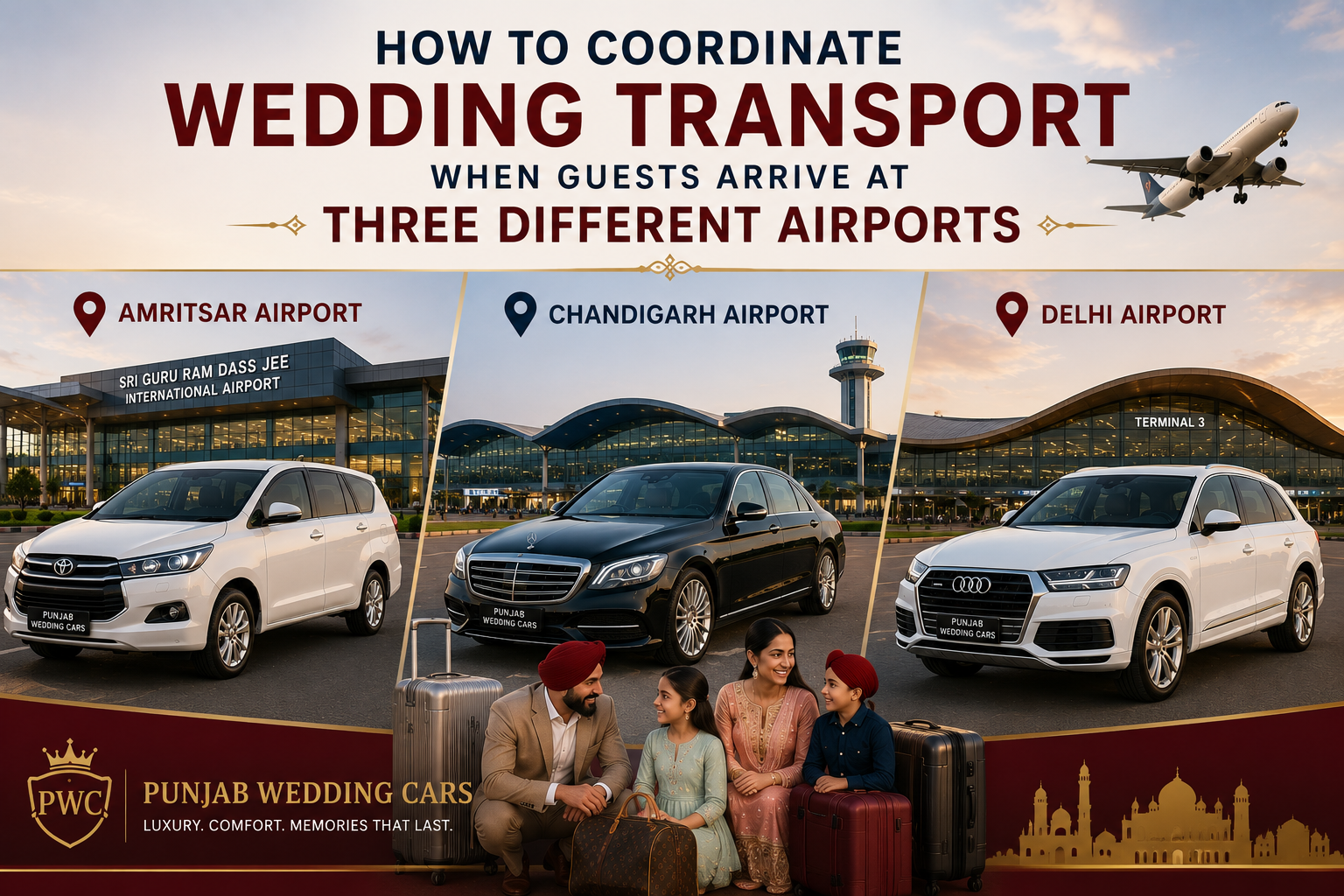
How to Coordinate Wedding Transport When Guests Arrive at Three Different Airports
A large NRI Punjabi wedding can have relatives arriving in India through three completely different gateways. One side of the family may land at Sri Guru Ram Dass Jee International Airport in Amritsar, another group may use Shaheed Bhagat Singh International Airport serving Chandigarh and Mohali, while relatives with better international connections may land at Delhi Airport and continue to Punjab by road.
Once that happens, wedding transportation is no longer an airport-pickup problem. It becomes a small transport operation running alongside the wedding.
The mistake is to treat every arriving flight independently. One cousin books a car from Amritsar. Another tells somebody to collect grandparents from Chandigarh. An uncle landing in Delhi messages the groom's brother after clearing immigration. Meanwhile, the bride's Maybach and the groom's G Wagon are already being assigned to wedding functions.
That is exactly how a family ends up with several cars moving in the wrong direction, guests waiting at airports and ceremonial wedding vehicles being used for luggage runs.
Punjab Wedding Cars already provides airport pickup and drop services for Amritsar, Chandigarh and Delhi. The more effective way to use those services for an NRI wedding is to organise all three airports under one transport plan and then connect each guest group to its hotel, family home and wedding-day schedule.
In Short
When wedding guests are arriving through Amritsar, Chandigarh and Delhi airports, appoint one transport coordinator and build one master arrival schedule covering every flight, passenger group, luggage requirement and final destination. Keep airport transfers separate from the bride's and groom's principal wedding cars, and do not send every arriving guest directly to the wedding venue.
Amritsar generally works naturally for weddings around Amritsar, Tarn Taran, Jalandhar, Kapurthala and parts of Doaba. Chandigarh can be particularly practical for Mohali, Chandigarh, Rupnagar, Fatehgarh Sahib, Patiala and many central Punjab weddings. Delhi arrivals require a much longer onward road movement and should be planned as proper intercity transfers rather than ordinary airport pickups.
The objective is not to make all three airport groups arrive together. It is to make each group reach the correct hotel or family home comfortably and then bring everyone into one coordinated wedding transport schedule.
Create One Master Arrival Schedule Instead of Three Airport Plans
The family should have one document containing every airport arrival.
It does not need to be complicated. What matters is that the person coordinating transport can see who is landing, which airport they are using, when the flight is expected, how many passengers are travelling together, how much luggage they have and where they need to go after leaving the terminal.
This prevents one of the most common NRI wedding mistakes: different family members arranging cars without knowing what the others have already booked.
A guest arriving in Amritsar may be travelling to the same Jalandhar hotel as relatives landing in Chandigarh later that day. Another passenger from Delhi may be staying at a family home instead. Those journeys should not be merged simply because all three groups are attending the same wedding.
The existing Punjab Wedding Cars guide to VIP wedding guest transport from airport pickup to venue entry follows the same principle. Airport pickup, hotel check-in, Gurudwara travel, reception transport and the final return should be seen as one guest journey rather than unrelated car bookings.
Give One Person Authority Over Airport Transportation
Every large Punjabi family has several people willing to help.
That is useful until all of them begin giving instructions to different chauffeurs.
The Chandigarh driver receives an updated hotel from one cousin. The Amritsar driver is told by somebody else to stop at the family home first. A third relative tells the Delhi Airport chauffeur that the passengers now want to travel directly to Ludhiana.
The transport team should have one principal family contact.
That person does not have to personally collect anyone. They simply need access to the flight schedule, guest accommodation and wedding itinerary.
For an NRI family organising much of the wedding from Canada, the UK, Australia or the United States, it can also help to have one overseas coordinator and one local Punjab coordinator. The NRI guide to booking wedding cars in Punjab explains why keeping communication between a small number of decision-makers usually makes the booking much clearer.
Treat Amritsar Airport as the Majha and Doaba Gateway
For many weddings in northern Punjab, Amritsar is the simplest arrival point.
A family wedding in Amritsar itself can connect international guests directly with city hotels, family homes and local wedding venues. Punjab Wedding Cars provides Wedding Car Hire in Amritsar for the wedding functions while airport transfers can remain a separate guest responsibility.
For overseas relatives staying close to the airport before the celebrations begin, there is also dedicated wedding and airport transport near Amritsar Airport.
Amritsar becomes equally useful when the wedding is farther into Doaba. A large number of NRI families attending weddings around Jalandhar, Phagwara and Kapurthala use Amritsar as their international gateway before travelling onward by road.
The Amritsar to Jalandhar wedding-car route is therefore especially relevant to wedding families whose relatives land in Amritsar but are staying or celebrating in Jalandhar.
The important detail is still the final address.
“Jalandhar” could mean a hotel in the city, a house near Jalandhar Cantt or another family property elsewhere in the district. The chauffeur should receive the actual pin before the guests leave the airport.
Chandigarh Airport Needs Its Own Guest Group
Relatives landing at Chandigarh should not be treated as though they are simply another version of the Amritsar group.
Their wedding geography can be completely different.
Chandigarh Airport is especially relevant when families are staying around Mohali, Chandigarh, Zirakpur or the wider Tricity before continuing towards Patiala, Fatehgarh Sahib, Rupnagar, Ludhiana or other parts of Punjab.
Punjab Wedding Cars' Mohali wedding-car service specifically notes how important airport movement is for NRI weddings in this area and why those airport cars should remain separate from the principal bride and groom vehicles.
For a wedding centred in Jalandhar, guests arriving through Chandigarh may still need a significant road journey after landing. The Chandigarh to Jalandhar wedding-car route is a useful example of how airport arrivals, Tricity hotels and Jalandhar wedding functions can connect within one booking.
The passengers may have chosen Chandigarh because their flight connection was better, not because it is the closest airport to the marriage palace.
Transport should respect the route they actually have rather than trying to force every overseas guest through the same airport.
Delhi Airport Must Be Planned as a Long-Distance Transfer
Delhi is the airport where families most often underestimate the road journey.
An overseas relative lands at Delhi Airport and the family thinks, “We just need a car to Punjab.”
That is not an ordinary airport pickup.
It is a substantial road transfer following an international flight.
Passengers may already have spent ten, twelve or more hours travelling. They can be carrying several large suitcases and wedding garment bags. Grandparents and children may be part of the group.
The vehicle should therefore be chosen around passenger comfort, luggage and the length of the onward journey.
Punjab Wedding Cars provides Delhi Airport to Punjab transfer services alongside its Amritsar and Chandigarh airport services.
The family should treat these Delhi arrivals as a separate transport category. The chauffeur needs a clear reporting plan, passenger details, luggage requirement and final Punjab destination before the flight lands.
Most importantly, do not attach another important wedding responsibility to that same vehicle immediately afterwards.
A delayed international arrival in Delhi can shift the road journey by hours.
Do Not Send the G Wagon to Delhi Airport Before Sehra-Bandi
The most expensive scheduling mistake is using a ceremonial wedding car as an airport shuttle.
Imagine the groom has booked the Mercedes G Wagon G63 AMG for his baraat. The family also wants an impressive car to collect important relatives from Delhi Airport the previous night or early on the wedding day.
On paper, using the same vehicle appears efficient.
Then the flight is late.
Baggage takes additional time.
The Delhi-to-Punjab road transfer takes longer than hoped.
Now the groom's car is still returning while photography, decoration and sehra-bandi are approaching.
The same rule applies to the bride's Maybach, Rolls-Royce Ghost or Jaguar XJL.
Airport transfers should normally have their own vehicles.
The principal bride and groom cars should remain protected from flight schedules.
Match Vehicles to Passenger Groups, Not Social Status
Multi-airport weddings often become expensive because every arriving relative is assigned a premium car individually.
That is usually unnecessary.
Some guests genuinely benefit from dedicated chauffeur-driven luxury transport. Grandparents, parents, elderly relatives, key NRI family members or people unfamiliar with Punjab may deserve their own vehicle.
Other passengers can travel together when their flight times, luggage and destinations genuinely align.
The key is that grouping should happen naturally.
If four relatives land at Amritsar within a reasonable window and all are staying at the same Jalandhar hotel, one coordinated transfer may make far more sense than repeatedly sending cars along the same corridor.
Punjab Wedding Cars' article on smarter wedding transport and fewer empty journeys discusses this exact principle for airport arrivals.
But nobody should be left waiting several hours after an international flight purely to save one vehicle journey.
Efficiency should improve the guest experience, not worsen it.
Luggage Can Completely Change the Vehicle Requirement
A three-airport wedding makes luggage planning especially important because different groups may be arriving after different lengths of travel.
A couple flying into Chandigarh for a short stay may have manageable luggage.
A Canadian family landing in Delhi may have several large cases each.
Another family arriving in Amritsar may be carrying garment bags, children's luggage and gifts.
Do not select all three airport cars from the same vehicle category.
An executive Audi A6 may be perfect for two VIP passengers with limited luggage. A larger SUV may be more practical for another group. A larger passenger vehicle may be required if several relatives are travelling together with numerous cases.
The Punjab Wedding Cars luxury fleet should therefore be used according to the job each car needs to perform rather than attempting to make every airport movement look like a ceremonial wedding entry.
Send Airport Guests to Hotels Before Wedding Venues
An international arrival should rarely flow directly into a busy wedding function unless the timing genuinely demands it.
Guests usually need to check in, change clothing, eat, rest and organise their luggage.
A passenger landing in Amritsar should not automatically be sent straight to a Jaggo in Jalandhar simply because the function begins that evening.
A family arriving through Delhi may need several hours of road travel before even reaching Punjab.
Give the guest somewhere to settle first.
Then create the next transport movement from the hotel or family home to the function.
This also makes the wedding-day schedule much easier because guests can be grouped according to accommodation rather than according to which airport they used.
Once everyone reaches Punjab, the airports should effectively disappear from the transport plan.
Hotels and family homes become the new transport hubs.
The Hotel List Is Just as Important as the Flight List
Many NRI families spend enormous effort recording flight numbers and then pay very little attention to accommodation.
That creates problems the following morning.
Ten relatives landed in Amritsar, six came through Chandigarh and four arrived through Delhi. But where are all twenty actually staying?
If they are spread across four hotels and two family homes, the wedding-day pickup plan needs to reflect that.
This is particularly common in Jalandhar weddings where airport groups from Amritsar and Chandigarh eventually converge in the same city. Once everybody is settled, the family can use Wedding Car Hire in Jalandhar for the wedding-day movements while airport transfers are considered complete.
The same logic applies to Wedding Car Hire in Ludhiana, Amritsar, Patiala and other Punjab wedding markets.
Airport planning gets guests into Punjab.
Hotel planning gets them to the wedding.
Morning Anand Karaj Transport Should Ignore the Airport They Used
By the wedding morning, it should not matter whether a guest originally landed in Delhi, Amritsar or Chandigarh.
What matters is where they slept the night before.
If eight relatives are staying at one Jalandhar hotel, they should share one hotel departure plan even if they arrived through three different airports over the previous two days.
That is much cleaner than continuing to think in airport groups.
The chauffeur needs the hotel pickup time, passenger count and Gurudwara location.
Families can use the Punjab Wedding Cars guide on wedding-car arrival and reporting times when setting these morning movements. The correct pickup should be calculated backwards from when guests need to be inside the Gurudwara Sahib, not from the formal ceremony start alone.
This is especially important for grandparents and overseas guests who do not know the area.
Keep Elderly Guests Independent From the Main Family Schedule
Grandparents arriving from different airports should eventually be given their own comfort plan.
They may want to reach the Gurudwara earlier.
They may want to leave the reception before younger guests.
They may need a car positioned closer to an accessible entrance.
Do not attach their entire schedule to the bride, groom or younger relatives simply because everyone belongs to the same family.
A dedicated executive vehicle can be far more valuable to an elderly couple than placing them in the most dramatic wedding SUV.
This is where wedding transportation becomes hospitality rather than display.
Use Exact Map Pins for Every Airport Group
Airport-to-Punjab transfers can cover significant distances, yet the greatest confusion often happens during the last few kilometres.
The guest's hotel may have a similar name to another property.
The family home may be outside the town indicated in the booking.
A wedding resort may technically use a city in its marketing while actually sitting beside a nearby highway or village.
Give chauffeurs exact map pins.
Do the same for hotels.
If the final destination is a village home, add one reliable local contact who understands the final approach.
The wedding-car app quote guide explains why airport bookings need the real destination, passenger count and luggage requirement rather than being entered like a normal city-to-venue wedding journey.
Plan Flight Delays Without Making Every Driver Wait
When three airports are involved, at least one flight may not follow the expected timing.
The transport plan should be able to absorb that.
This does not mean keeping every chauffeur waiting indefinitely.
It means linking each driver to the correct passenger group and ensuring the family coordinator updates the relevant transfer when a flight changes.
The most dangerous system is one where the Chandigarh driver is somehow expected to help cover an Amritsar arrival because another vehicle has been diverted elsewhere.
Keep each duty clear.
Airport.
Passengers.
Destination.
Vehicle.
When one flight changes, only that transfer needs to be adjusted.
The entire wedding transport network should not have to be rebuilt.
Airport Transfers Should Not Be Chained Too Tightly Together
A chauffeur collecting one passenger group from Amritsar should not have another airport pickup scheduled so tightly afterwards that a short delay affects the next family.
This is especially true when the second duty is at another airport or on another long route.
Airport movements need realistic buffers.
A vehicle could potentially perform more than one transfer in a day, but the schedule should account for passenger clearance time, road travel, luggage loading and unexpected delays.
The objective is not to maximise the number of jobs performed by one car.
It is to make each guest pickup reliable.
Delhi Arrivals Often Need Their Own Recovery Time
A Delhi Airport group may reach Punjab much later than relatives who landed directly in Amritsar or Chandigarh.
Do not plan the family schedule as though everyone has had the same journey.
If the Delhi group arrives at the hotel late at night, giving them an early morning hotel pickup for a pre-wedding breakfast or family visit may be unrealistic.
This becomes a wedding hospitality decision as much as a transport decision.
The family coordinator should know which guests need to be present at which functions and which movements are optional.
The chauffeur can provide the journey.
The schedule should still respect the passenger.
Keep Return Flights in the Same Master Plan
The three-airport problem returns at the end of the wedding.
Some relatives may fly home from Amritsar.
Others may depart from Chandigarh.
Another family may have an international departure from Delhi.
Do not start organising these journeys after the reception.
Add departure flights to the same master airport schedule used for arrivals.
A Delhi Airport departure needs significantly more road planning than an Amritsar departure from a nearby wedding city. Guests may need to leave Punjab while another wedding function is still happening.
Their airport car must follow the flight schedule rather than the wedding programme.
This is another reason the bride's and groom's main cars should remain separate. A ceremonial car should not disappear toward Delhi while the family still expects it at the wedding.
Multi-Airport Transport Can Actually Reduce Confusion When Planned Properly
Three airports sound complicated because there are more journeys.
But the structure can actually become straightforward once every airport has a clear role.
Amritsar handles one guest stream.
Chandigarh handles another.
Delhi handles longer-distance arrivals.
Each group is transferred to its accommodation.
Once guests have reached the hotel or family home, they join the ordinary wedding schedule.
The family no longer needs to think about three airports.
They only need to manage hotels, Gurudwara Sahib, marriage palace, reception and return journeys.
That transition is the key to good planning.
Punjab Wedding Cars as the Common Transport Layer
Using one wedding-transport provider across different arrival points can simplify communication because the family is not coordinating unrelated drivers through different relatives.
Punjab Wedding Cars provides luxury airport and VIP transfer support for Amritsar, Chandigarh and Delhi arrivals as part of its wider Punjab luxury wedding-car rental service. The same wider service covers wedding cars across Punjab for the bride, groom, parents, NRI relatives and intercity functions.
The important part is not using the same physical vehicle for every duty.
It is using one coordinated plan.
Airport cars remain airport cars when necessary. Guest vehicles follow hotel schedules. Bride and groom cars remain protected for their ceremonial responsibilities. Intercity routes are treated as genuine road journeys. Every chauffeur receives a clear passenger and destination.
That is what allows three airports to feed into one wedding without creating three separate transport problems.
Bring Three Airport Arrivals Into One Wedding Schedule
The successful plan is not to make every overseas relative land at the same airport.
Families choose different flights for good reasons. One route may be cheaper. Another may offer fewer connections. Grandparents may find Amritsar easier. A relative may already be spending time in Delhi. Another family may prefer Chandigarh because the wedding is near Mohali or Patiala.
Accept that the arrivals are different.
Coordinate what happens after them.
Record every flight. Assign each passenger group a vehicle. Match the car to the luggage and journey. Give the chauffeur the exact hotel or home. Protect the bride and groom cars from airport delays. Once relatives reach their accommodation, reorganise them according to hotel and wedding function rather than according to airport.
Then add the departures before the wedding begins.
When this is handled properly, guests landing at Amritsar, Chandigarh and Delhi can all arrive at the same Anand Karaj or reception without ever needing to understand the complicated transport plan behind them.
That is the goal.
Three airports.
One family transport system.