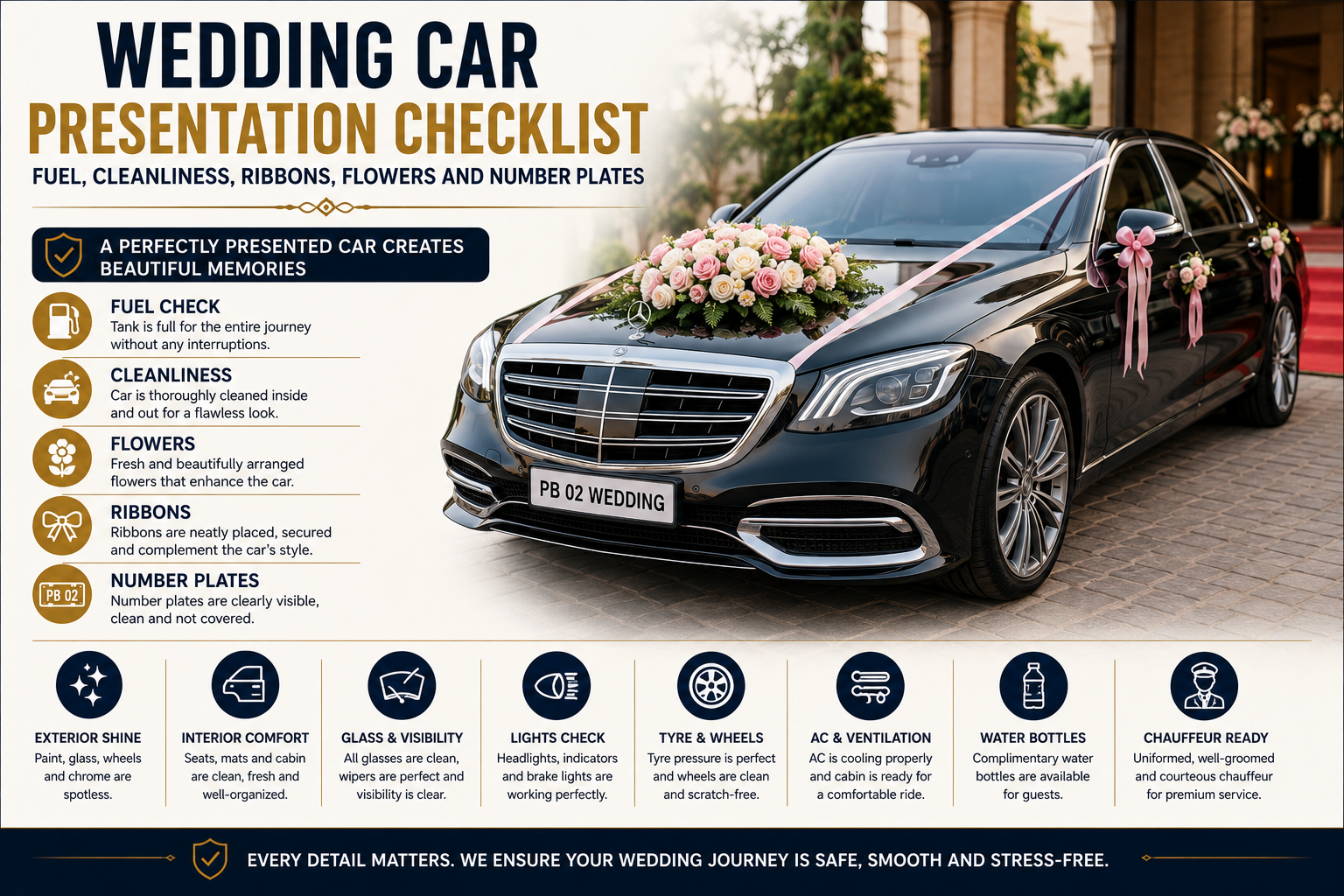
Wedding Car Presentation Checklist: Fuel, Cleanliness, Ribbons, Flowers and Number Plates
The best time to discover that a wedding car needs fuel, has dust on the rear door or has a loose ribbon is long before the groom walks outside or the bride begins her doli. When a chauffeur-driven luxury vehicle reports for a Punjabi wedding, the family should see a finished car rather than watch the final preparation happening around it. The bonnet should already be clean, the cabin should already be comfortable, the decoration should already be secure and the chauffeur should already know the journey ahead.
That standard becomes even more important when the family has booked a premium vehicle specifically for photography. A Mercedes-Maybach, Mercedes G Wagon G63 AMG, Range Rover Sport, Rolls-Royce Ghost, Jaguar XJL or Audi A6 can become one of the most photographed objects of the wedding morning. Professional cameras will show details that casual guests may never notice, which means road readiness and visual presentation need to be considered together.
Punjab Wedding Cars currently includes chauffeur service, decoration, fuel and tolls with vehicles across its luxury wedding-car fleet. That makes presentation more than a question of what flowers appear on the bonnet. The complete experience begins with a properly prepared car that can perform its wedding duty without unnecessary interruptions.
A Wedding Car Should Arrive Finished
There is a major difference between a vehicle reporting to the pickup location and a vehicle arriving there to be prepared. For a premium wedding service, most preparation should be complete before the family sees the car. The chauffeur may still perform a quick visual inspection after reaching the property because dust, road conditions or normal travel can change small details, but the family should not be waiting while the vehicle is fundamentally cleaned, fuelled or decorated.
This is particularly important during groom photography. If the groom's planned departure is 9:00 AM, photographers may want the G Wagon or Range Rover positioned earlier so that they can create portraits before Sehra Bandi departure. When the vehicle arrives with enough time to be positioned and checked, photography occupies its own part of the schedule rather than consuming the road buffer.
The same principle applies to bridal travel. A bride should approach a vehicle that is ready for her, especially during doli when the emotional part of the farewell has already begun. The final car check belongs before that moment rather than inside it.
Fuel Preparation Is Part of Luxury Service
Fuel is invisible in wedding photographs, but it can quickly become visible in the wedding experience if it has not been planned properly. A premium chauffeur-driven car should not normally collect the groom and then immediately stop at a petrol station because somebody realised the tank was too low for the complete duty.
This is especially important because wedding-car assignments are often longer than families initially describe. A booking may sound like a short Ludhiana or Jalandhar journey, but the actual vehicle duty can include reporting from another area, travelling to the groom's home, continuing to Gurudwara Sahib, waiting through the ceremony, reaching a marriage palace and later completing another drop. Bridal doli can create an even longer assignment when the couple travels to another district after the reception.
The chauffeur and transport provider therefore need to think about the complete route before the vehicle reports. Fuel preparation should match the real wedding duty rather than only the first journey shown on the schedule.
The Wedding Route Changes How the Car Should Be Prepared
A vehicle travelling ten kilometres inside a city does not face exactly the same conditions as a wedding car completing an intercity route. Ribbons that remain perfectly positioned during a short city journey may behave differently at highway speeds, while a floral arrangement prepared early in the morning may need to remain secure until a late-night reception or doli.
Farmhouse and village venues add another variable because the final approach can introduce dust, rougher surfaces or parking areas that are very different from the main highway. The car may begin the day looking freshly detailed and then reach a photography location after several kilometres of local road travel.
This is why the PWC guide on hidden route costs, detours, parking and extra stops is relevant even to vehicle presentation. A realistic understanding of the route makes it easier to prepare the car for the conditions it will actually experience.
Exterior Cleaning Should Happen Before Decoration
Wedding flowers should finish the appearance of the car rather than hide areas that were never cleaned properly. The bodywork, glass, wheels and visible trim should be prepared before major floral or ribbon decoration is installed because once the arrangement is in place, detailed cleaning can become harder without disturbing it.
Dark cars need particular attention because fine dust and fingerprints can become very visible under professional lighting. White vehicles may hide certain marks better but often show road dirt clearly around wheel arches, tyres and lower panels. A professional photographer using a low camera angle can make those areas a surprisingly large part of the final wedding image.
This is also why a final visual inspection after the chauffeur reaches the pickup location is useful. Even a properly prepared vehicle can collect light road dust while travelling to the groom's home, so a small presentation check before photography begins can protect the final result without turning the family driveway into a car-cleaning area.
Glass Should Be Clear Inside and Outside
Clean glass affects both presentation and driving visibility. Marks on the side windows can become prominent when the photographer captures reflections, while a dusty or smeared windscreen can weaken a front photograph of an otherwise immaculate luxury car.
The windscreen also needs to remain free from decorative material that compromises the chauffeur's view. A ribbon crossing part of the bonnet can look elegant, but decoration should not be extended upwards merely because the photographer likes the colour. The driver needs the same usable windscreen after sunset that they had when the car was initially decorated in daylight.
This matters particularly for winter Anand Karaj weddings, night receptions and late doli journeys, where clear glass and good visibility become part of comfortable chauffeur-driven travel rather than simply a cosmetic detail.
Ribbons Should Follow the Car Rather Than Fight Against It
A ribbon arrangement that works beautifully on one vehicle may not suit another. The Mercedes-Maybach has long saloon proportions, while the G Wagon has an upright and visually powerful body. A Range Rover Sport has another shape again, and the Rolls-Royce Ghost already has a distinctive grille and body line that families often want visible in photographs.
Rather than using one standard ribbon arrangement on every car, the decoration should work with the vehicle. A Maybach may look particularly refined with restrained diagonal ribbons and a compact bonnet arrangement, while a G Wagon may require even less decoration because the shape itself produces the visual impact the groom selected.
The objective is not to prove that the car is part of a wedding by attaching decoration to every panel. A premium wedding car should still look recognisable as the vehicle the family paid to hire.
Loose Ribbons Become a Different Problem Once the Car Moves
Wedding decoration is normally fitted while the car is stationary, but it has to survive a moving journey. A long ribbon tail that hangs beautifully outside a hotel can begin flapping against the paint once the car reaches a faster road. A decorative piece that seems secure at the family home can move after an hour of intercity travel.
The arrangement should therefore be checked as road decoration rather than only as stationary decoration. Ribbons need to remain secure without extending into mirrors, glass or other areas where movement can cause a distraction.
This becomes particularly important when the groom's vehicle has several different photography stages during the day. If the same car appears at home, Gurudwara Sahib and reception, the decoration needs to remain presentable through every journey connecting those locations.
Flowers Should Enhance the Vehicle Rather Than Hide It
Premium wedding vehicles generally benefit from restraint. A Rolls-Royce does not become more luxurious because its entire grille has disappeared beneath flowers, and a G Wagon does not need a huge bonnet arrangement to communicate that it is the groom's wedding car.
Flowers work best when they frame the vehicle's identity. A balanced bonnet arrangement can connect the car to the wedding colour palette while still allowing the grille, headlights and body shape to remain visible. Smaller door details can create continuity without covering the areas passengers need to use.
This approach also gives photographers more flexibility because the vehicle remains visually clean. The family sees both the decoration and the luxury model rather than only seeing a moving floral arrangement.
Fresh Flowers Need to Survive the Wedding Schedule
Fresh flowers can create beautiful close-up photographs because of their natural colour and texture, but they need to remain presentable beyond the moment they are installed. Punjab heat, wind and several hours of waiting can affect an arrangement, while rain or moisture may change how the decoration sits on the car.
This becomes especially relevant for a bridal vehicle. A car may be decorated before the main ceremony and then remain at the wedding venue for several hours before doli. By the time the bride approaches it late in the evening, the arrangement has been exposed to an entire wedding day.
A quick visual check before the car is repositioned for doli allows the chauffeur or decoration team to notice whether something has shifted without interfering with the bride's farewell. The car should be restored quietly before the family begins gathering around it.
Artificial Flowers Still Need Professional Fitting
Artificial flowers can be more durable across a long wedding assignment, but durability does not mean they can simply be attached anywhere. A decorative piece can still loosen, cover a sensor, restrict a door handle or move into an area required by the chauffeur.
The current Punjab Wedding Cars fleet information includes complimentary decoration as part of the wedding-car offering, which makes fitting quality just as relevant as the decoration style. The final arrangement should allow the vehicle to operate normally throughout the booking.
Whether the flowers are fresh or artificial, the finished car should be inspected as a road-going luxury vehicle before it is treated as a wedding photograph.
Number Plates Should Remain Clearly Visible
Flowers and ribbons should not cover the vehicle's registration plate. India's Central Motor Vehicles Rules require registration marks to be clearly and legibly displayed at the front and rear of motor vehicles, so the number plate should remain visible when a wedding vehicle is being used on public roads.
This is easy to accommodate without compromising decoration. A floral arrangement can sit above the front grille while leaving the plate open, and rear ribbons can be positioned around the boot without covering the registration mark.
In fact, leaving the number plate visible often makes the decoration look more professionally fitted because the flowers appear designed around the vehicle rather than attached indiscriminately across every available surface.
Bride and Groom Decorative Plates Need Sensible Use
Some families like decorative signs carrying the words “Bride” or “Groom,” the couple's initials or a wedding hashtag. These can work well for stationary photography, particularly when the car is positioned inside a private venue or controlled photoshoot area.
The decorative sign should not simply be placed over the normal registration mark for the road journey. If the family wants a specific plate-style photograph, the prop can be used while the car is stationary and removed or repositioned before public-road travel.
This distinction allows the photography concept and road requirements to coexist without forcing the family to choose between them.
Headlights Need to Remain Part of the Car
The front of the vehicle receives most wedding decoration because it appears prominently in groom and couple photographs. That makes headlights one of the easiest places for flowers to spread too far.
The car may begin its duty during daylight and still remain on the road after dark, so the floral design should assume that the headlights will actually be needed. The arrangement should frame them rather than partially hide them.
This matters especially for late doli, where the bridal car may begin a long intercity journey several hours after the daytime photography finished. The decoration prepared for the morning should still be practical for the road conditions at night.
Mirrors Need Space to Work Normally
Side-mirror ribbons or small floral details can look attractive, but the mirrors must remain usable for the chauffeur. A large luxury SUV navigating a marriage-palace driveway or farmhouse entrance may require careful reversing, and the driver should not be working around decorative material attached to the mirror housing.
The same principle applies to cameras and parking sensors on modern luxury vehicles. Wedding decoration should never assume that an area is available simply because there is no obvious moving component on it.
A professional final inspection allows the chauffeur to identify anything that could interfere with normal manoeuvring before the family starts using the car.
Modern Cars Have Cameras and Sensors Hidden in the Styling
Luxury vehicles increasingly depend on cameras and sensors integrated into grilles, bumpers and mirror areas. These systems can be particularly useful during weddings because chauffeurs frequently need to manoeuvre through crowded hotel entrances, marriage palaces and narrow farmhouse gates.
A decorative arrangement that covers one of those systems can make the vehicle less convenient to manoeuvre at exactly the moment the chauffeur needs additional visibility.
The decoration team does not need to become an expert on every luxury vehicle. The simplest solution is for the chauffeur or transport provider to inspect the completed arrangement and identify whether any operational area has been covered.
Door Handles Need to Remain Practical for Bridal Travel
Door-handle flowers can look beautiful in detail photographs, but they need to leave enough room for the chauffeur to open the door normally. This becomes particularly important on the bridal side because entering a luxury car while wearing a full lehenga is already slower than normal passenger boarding.
The bride may need a sister, mother or bridesmaid to arrange the outfit inside the rear cabin while the chauffeur keeps the door open. The decoration should support that movement rather than forcing someone to move flowers out of the way before the bride can sit comfortably.
A bridal car that needs decoration removed at the last moment was not completely prepared for its actual passenger.
Interior Presentation Deserves the Same Attention as the Exterior
Guests see the bonnet first, but the bride or groom experiences the cabin. That makes interior preparation an important part of luxury wedding-car presentation.
The rear seats should be clean and free from unnecessary objects, while the footwell should provide usable space for clothing. Personal chauffeur items, cleaning equipment and unrelated bags should not occupy areas visible to passengers or photographers.
This matters particularly with the Maybach and Jaguar XJL, where rear-seat comfort is a major reason families choose the vehicle. An elegant exterior cannot compensate for a cluttered passenger cabin.
The Cabin Should Smell Clean Rather Than Strongly Perfumed
A common mistake is assuming that a premium car should have a strong fragrance. Wedding passengers may already be surrounded by fresh flowers, perfume and heavily scented wedding environments, so another powerful car fragrance can become uncomfortable during a longer journey.
A clean, neutral cabin generally provides a more refined experience. The bride after doli may spend a substantial period in the vehicle, while elderly parents or children may also be more comfortable without an overpowering air freshener.
Luxury should feel calm and comfortable rather than trying to announce itself through every sense.
Air Conditioning Should Be Prepared Before the Passenger Enters
Punjab weather makes cabin preparation important throughout the year. During hot months, a car sitting outside can become uncomfortable very quickly, especially for a groom wearing a heavy sherwani or a bride in layered wedding clothing. During colder months, early-morning Anand Karaj travel may require heating and clear demisted windows before the family begins moving.
Where practical, the chauffeur should prepare the cabin temperature before the principal passenger enters. Once they are seated, a simple adjustment can be made according to their preference.
This small detail is part of what separates chauffeur-driven service from simply providing access to an expensive car.
The Chauffeur's Presentation Completes the Car
The chauffeur is often visible during the first photographs of the vehicle. They may open the door for the groom, assist the bride or stand nearby while the photographer is framing the car.
The current Punjab Wedding Cars fleet page advertises uniformed chauffeur service across the luxury fleet, which is important because the appearance and behaviour of the driver become part of the overall presentation.
A polished Maybach with a professionally presented chauffeur feels complete. The same car with a driver who appears unprepared or has personal belongings scattered through the cabin immediately loses some of that premium effect.
The wedding car and chauffeur should arrive as one finished service.
Farmhouse Roads May Require a Second Cleanliness Check
Farmhouse and village weddings create situations where the vehicle can be perfectly prepared at the starting point and still collect visible dust before reaching the venue. The final rural approach may be only a kilometre or two, but a line of guest vehicles can create enough dust to change the appearance of a black luxury SUV quickly.
The family can account for this if the route is understood beforehand. The principal car may travel ahead of the largest guest group, or the chauffeur may be able to perform a small exterior presentation check at a suitable staging area before the main groom or couple entry.
This is another reason the route and car presentation should not be planned as separate subjects. The road directly influences what the photographer eventually sees.
Rain Changes the Meaning of a Well-Presented Car
When rain arrives, a spotless exterior may be impossible to preserve throughout the entire assignment. The correct response is not to create stress around every water mark but to shift attention towards passenger access and safe use.
The chauffeur can position the vehicle where the bride or groom has the shortest practical walk through wet ground. Door areas should remain clear and the interior should remain dry and comfortable.
A professionally presented wedding car in the rain is one that continues to serve its passengers well rather than one that looks as if it has never left a showroom.
Photography Should Capture the Car Before the Crowd Changes It
Families who want clean vehicle photographs should plan them before the baraat or reception crowd completely surrounds the car. Once guests begin leaning beside the doors, touching the bonnet and gathering around the groom, the images naturally become people-focused rather than vehicle-focused.
An early reporting buffer gives the photographer a chance to photograph the car while its exterior, flowers and ribbons are at their best. The groom can then join the scene for portraits before the larger family group gathers.
This creates both types of image without asking the chauffeur to repeatedly clean or reposition the vehicle later.
Doli Requires a Fresh Presentation Check
The bridal car may have been waiting for several hours by the time doli begins. During that period the weather may have changed, guests may have moved around the vehicle and floral decoration may have shifted.
Before the emotional farewell starts, the chauffeur should have an opportunity to inspect the car and make sure the cabin remains ready for the bride. If decoration needs a small correction, it can happen while the family is still inside rather than when everybody is waiting beside the car.
The PWC Bridal Doli Transport Checklist reinforces the importance of preparing the rear cabin, final destination and bridal journey before doli begins.
A Luxury Wedding Car Should Look Better Because Less Has Gone Wrong
Wedding-car presentation is often discussed as though it is purely visual, but the strongest presentation comes from preparation that prevents interruptions. Fuel is handled before the assignment, the cabin is prepared before the passenger arrives, ribbons remain secure throughout the route and flowers have been installed without interfering with normal vehicle functions.
The registration plate remains visible, lights and mirrors can be used normally, doors open without moving decoration and the photographer sees a clean vehicle instead of a car that is still being worked on.
None of those details needs to attract attention on the wedding day. Their value comes from the fact that nobody has to stop the celebration to deal with them.
The Car Should Still Look Like the Car the Couple Chose
The final presentation principle is also one of the simplest. Families choose a Maybach because they want the Maybach. They choose a G Wagon because of its unmistakable shape, while Range Rover and Rolls-Royce bookings often reflect another visual style entirely.
Decoration should allow that decision to remain visible. Premium wedding cars rarely need to be covered from grille to boot to look ceremonial. Thoughtful flowers, carefully positioned ribbons and a professionally cleaned body can produce a much stronger impression.
Punjab Wedding Cars currently offers 20+ chauffeur-driven vehicles through its luxury wedding-car fleet, with decoration, fuel and chauffeur service included in its current fleet offering. The model may change from one couple to another, but the preparation standard should remain consistent.
By the time the groom walks outside or the bride approaches the car for doli, every practical question should already have been answered. The car should be fuelled for the planned duty, visually prepared for photography, comfortable inside and decorated in a way that respects both the vehicle and the road journey ahead.
When that happens, nobody notices the checklist. They simply see a wedding car that looks completely ready.