How Chauffeurs Coordinate Baraat Entry, Bridal Arrival and Photographer Timing
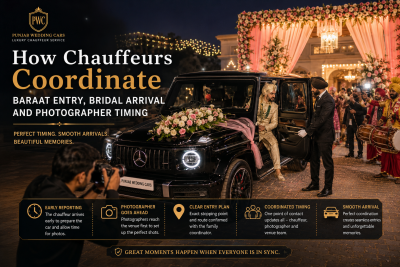
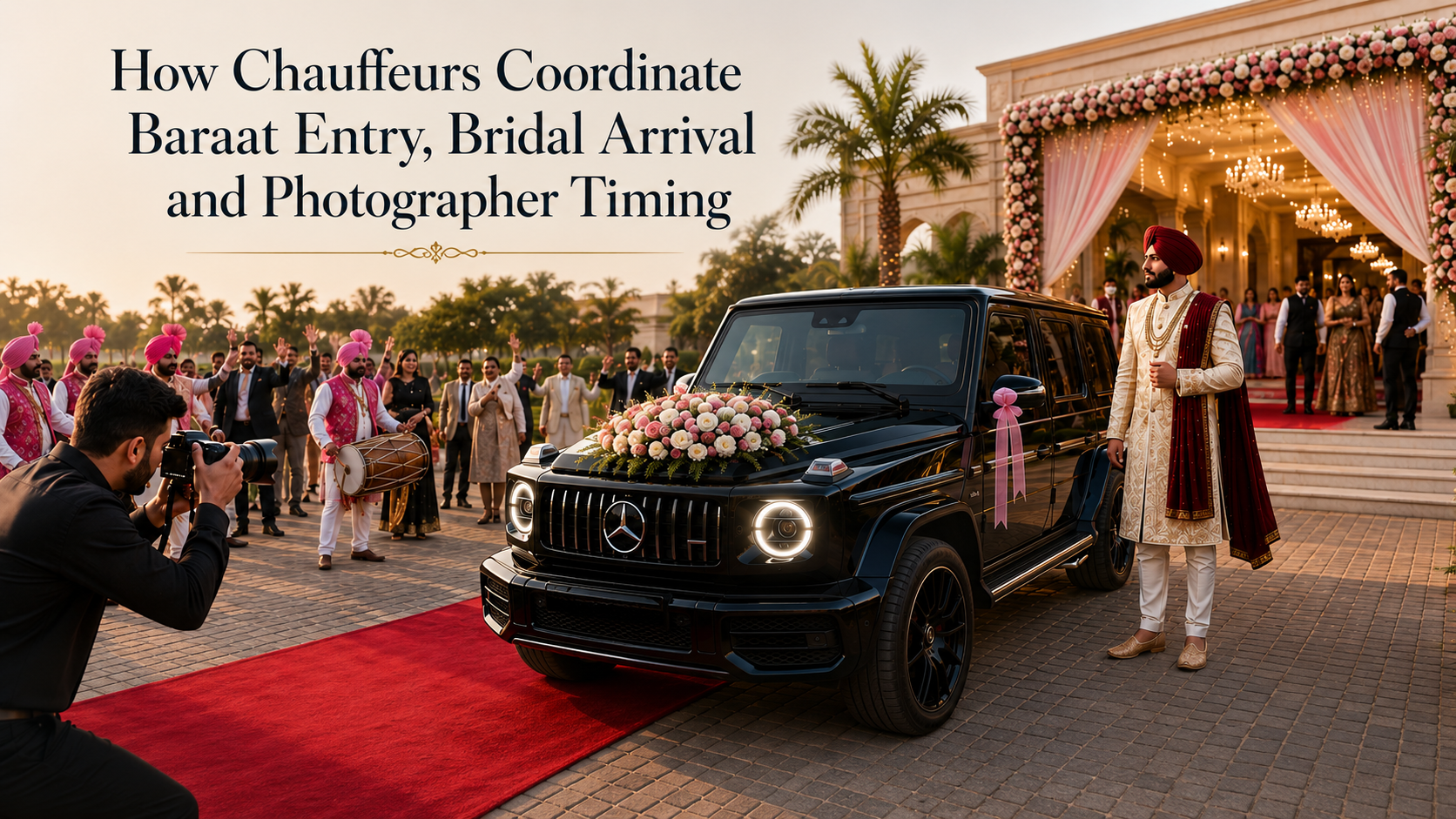
A luxury wedding-car arrival may last less than a minute in the final wedding film, but the chauffeur, photographer and family coordinator may have been preparing for that moment for more than an hour. The groom's car has to report before departure, the vehicle needs to be positioned for photographs at home, the photographer needs enough time to capture those images and still reach the next location before the groom, while the chauffeur needs a confirmed route and a clear stopping point at the venue. If any one of those elements is left until the car is already moving, a visually impressive G Wagon, Range Rover or Rolls-Royce can end up waiting outside the venue while everybody decides what should happen next.
The bride's arrival creates a different kind of coordination. She may be leaving a hotel, salon or family home and may need more time than expected because makeup, clothing or family photography runs late. Her chauffeur should remain ready without creating pressure, while the photographer needs to know when to move ahead towards Gurudwara Sahib or the reception venue. Later, the same bridal car may need to be repositioned for doli, when the photography becomes more emotional and the exact departure time is difficult to predict.
Professional chauffeur coordination is therefore not about the driver controlling the wedding. It is about the driver understanding how the car fits into a larger timing system. The photographer controls the visual sequence, the family coordinator controls the family timetable, the venue team controls access, and the chauffeur controls the vehicle. When those responsibilities remain clear, the bride and groom can experience the arrival rather than manage it.
The Car Should Report Before the Photography Starts
One of the most important timing decisions is separating chauffeur reporting time from passenger departure time. If the groom is expected to leave at 9:00 AM, the luxury wedding car should not necessarily be arriving at the gate at 9:00 AM. The family may want photographs beside the car, floral decoration may need a final visual check and the photographer may need several different angles before the groom actually gets inside.
Punjab Wedding Cars' existing guide on what time the wedding car should arrive makes the same distinction between reporting and departure. The current PWC timing guidance specifically allows preparation time for checking the vehicle, decoration, photography and passenger organisation before the journey begins.
This buffer protects the road journey later. When photography is given its own time at the pickup point, the family is less likely to suddenly ask the chauffeur to drive faster because twenty minutes of travel time were spent taking photographs outside the house.
The Chauffeur Should Position the Groom Car Before the Groom Comes Outside
A statement groom car such as the Mercedes G Wagon G63 AMG should ideally be positioned before the groom approaches it. The current Punjab Wedding Cars G63 listing describes it specifically as a major baraat and groom-entry vehicle, and its wider body and upright profile are exactly the reasons photographers want enough space around it.
If the groom is already waiting outside when the vehicle arrives, the family immediately becomes part of the positioning process. Relatives begin suggesting where the car should face, the photographer may ask for another angle and other family vehicles may already be occupying the cleanest background. What should have been a calm preparation stage begins consuming the wedding schedule.
When the chauffeur arrives earlier, the photographer can assess the available light and background while the groom is still inside. The car can be turned once, parked correctly and visually checked before the main portraits begin. The groom then walks into a scene that has already been prepared for him.
Photographer and Chauffeur Need Clear, Simple Communication
A photographer may understand exactly what image they want but still need to communicate that movement clearly to the chauffeur. Asking the driver to move “a little more” several times can become confusing, particularly in a crowded home driveway or marriage-palace entrance.
A much stronger approach is for the photographer to decide whether the vehicle needs to face the house, angle towards the entrance or remain parallel to the road before asking the chauffeur to move it. The chauffeur can then make one controlled adjustment and stop the car in a position that works both visually and operationally.
The photographer should never expect the chauffeur to perform unsafe movements simply for a photograph, while the chauffeur should reasonably cooperate with normal positioning requests where the space allows it. The strongest wedding photography happens when the camera works around a properly controlled vehicle rather than when the vehicle is repeatedly moved around the camera.
Baraat Departure Needs a Real Starting Point
A Punjabi groom departure can become crowded before the car moves even one metre. Friends begin dancing near the G Wagon, dhol starts, family members gather for videos and another luxury SUV may be positioned directly behind the principal vehicle. If nobody has decided where the actual road journey begins, the chauffeur may find that the baraat has completely surrounded the car while the family is still expecting it to move forward.
The solution is to treat the home photography position and the real departure position as two stages of the same sequence. The groom can complete portraits with the stationary vehicle, family members can gather around for photographs and the chauffeur can wait until the designated coordinator confirms that everybody is ready to begin moving.
Once the car starts, the chauffeur should have enough clear road ahead to leave normally. The baraat energy can continue around the groom without making the principal wedding car responsible for pushing slowly through an unplanned crowd.
One Family Coordinator Should Give the Final Departure Instruction
The chauffeur should not be receiving different departure instructions from several relatives. The photographer may say the photographs are complete, the groom's father may still be waiting for another family member and the groom's friends may already want the car to move. All three perspectives can be reasonable, but somebody still has to make the final decision.
One designated family coordinator should connect those pieces. Once photography is complete and the family is genuinely ready, that person confirms the departure with the chauffeur.
This system protects the groom from becoming the transport manager during his own wedding. It also protects the chauffeur from contradictory instructions and prevents a situation where the car moves because one relative said “go” while another important family member believed everybody was still waiting.
The Photographer Usually Needs to Reach the Venue Before the Groom
This is one of the simplest rules for successful baraat photography. If the important photograph shows the groom's car arriving, the photographer needs to be at the venue before that arrival happens.
Following the G Wagon from the groom's house all the way to the palace may produce attractive road footage, but it creates a practical problem when both vehicles reach the venue together. The groom car is ready to enter while the photography team is still parking and unloading equipment.
A better sequence allows the photographer to capture the groom leaving home and then travel ahead at the appropriate stage. On larger photography teams, one camera operator can remain with the groom while another reaches the venue earlier. On smaller teams, the photographer may choose to sacrifice part of the road footage in order to capture the more important arrival properly.
The chauffeur should not have to circle the venue because the photographer did not arrive first.
Photography Delays Should Not Become Driving Pressure
Wedding photography sometimes takes longer than planned because the family decides that another portrait or group photograph is worth taking. That is completely normal, but the time used for those photographs has genuinely been used.
The chauffeur should not be expected to recover that delay by driving more aggressively on the way to Gurudwara Sahib or the marriage palace. If the original plan allowed forty minutes for travel and photography consumes another fifteen minutes, the correct response is to accept the adjusted arrival rather than treating the road as a place where lost time can automatically be recovered.
This is one of the main reasons a professional chauffeur should receive realistic timings in advance. Wedding transportation works best when photography, preparation and road time each have their own space inside the schedule.
A Small Convoy Is Easier to Photograph Than a Traffic Jam
A G Wagon may be leading Range Rovers, BMWs or other family cars as part of the baraat. A coordinated convoy can create an impressive entrance, but only when the lead vehicle remains visually clear.
The Punjab Wedding Cars article on Single Wedding Car vs Luxury Car Convoy explains why one hero vehicle or a smaller purposeful convoy can sometimes produce stronger photography and simpler timing than a long line of unrelated premium cars.
The groom's car should remain the visual anchor. Supporting vehicles can follow with a sensible gap while general guest vehicles travel independently towards parking. This gives the photographer enough space to capture the groom car without several SUVs unloading passengers around the same frame.
A convoy should add scale to the wedding, not create congestion around the principal vehicle.
Every Chauffeur Should Know the Venue Independently
A coordinated convoy does not mean every driver should blindly follow the vehicle ahead. Traffic lights, junctions and normal road conditions can separate the cars.
Every chauffeur should already have the correct Gurudwara and venue pins. If the family wants the cars to regroup before a formal entrance, a suitable staging point can be agreed near the venue.
This protects the principal car from unnecessary pressure. The groom's chauffeur can follow the correct route rather than slowing excessively because another family vehicle has fallen several junctions behind.
Professional convoy coordination is about everybody understanding the same plan, not about keeping the bumpers physically together throughout the journey.
The Venue Entrance Should Be Confirmed Before the Car Leaves
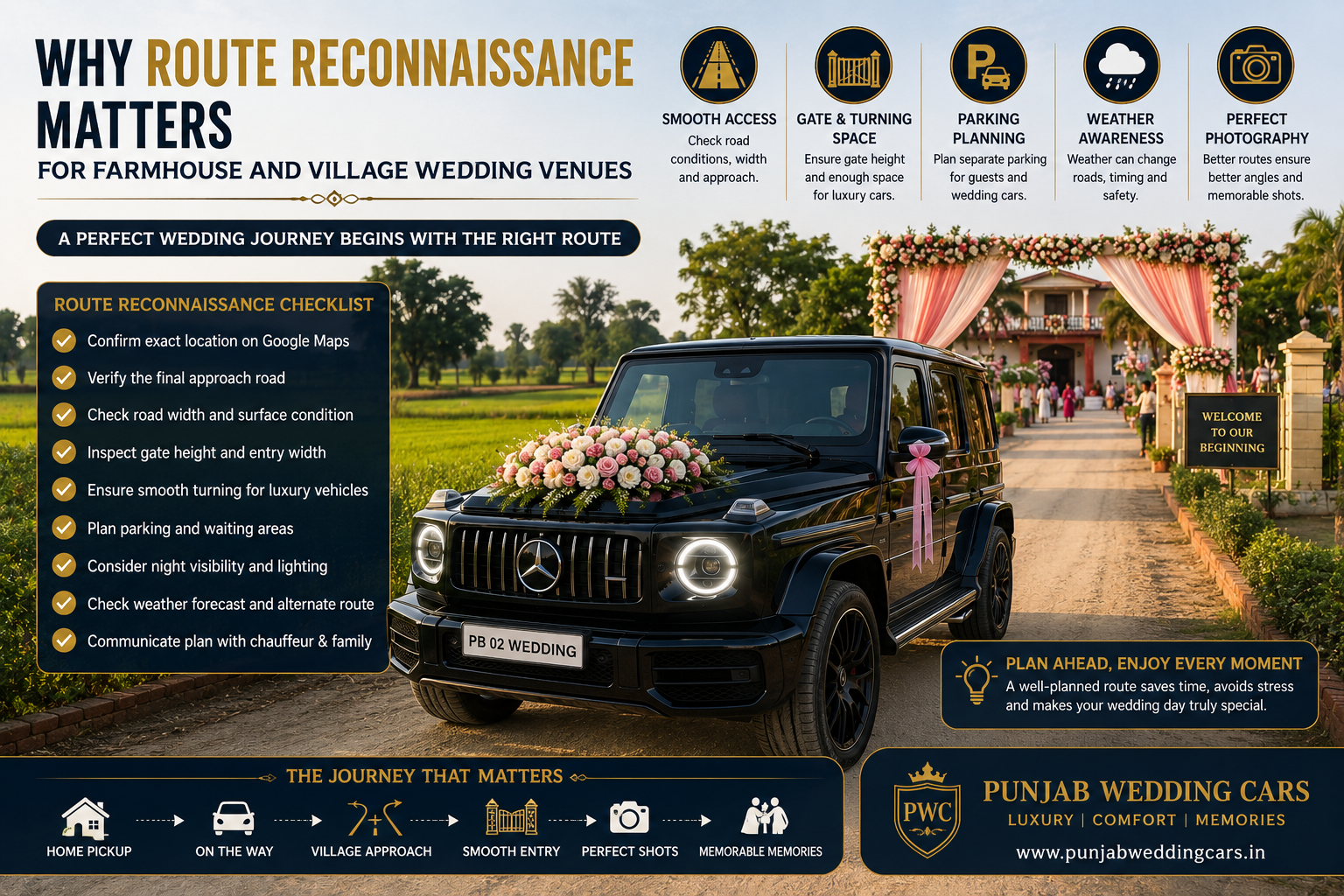
A marriage palace, resort or farmhouse may have several gates. The normal guest entrance may be different from the ceremonial groom entrance, while another road may lead towards parking or service areas.
The chauffeur should know which gate matters before leaving the groom's home. If the family expects a G Wagon or Range Rover to enter through a decorated arch and stop at a specific point for photography, that information should already be part of the transport plan.
This is particularly important at farmhouse venues where the property entrance and actual photography location may be separated by a long internal driveway.
The chauffeur should not reach the venue and then ask the groom which gate the family wants to use.
A Staging Point Can Transform a Baraat Arrival
Some of the cleanest luxury-car entries are created by using a short staging point near the venue. The groom car reaches a safe area before the main entrance while the photographer, dhol team and family coordinator prepare for the final movement.
Once the entrance is ready, the coordinator tells the chauffeur to proceed. The car approaches once, stops at the predetermined position and the groom exits naturally.
This method is particularly useful at large resorts and farmhouses where the final driveway is part of the wedding presentation. It prevents the vehicle from arriving unexpectedly while photographers are still moving equipment or guests are still crossing the entrance.
A staging point does not need elaborate infrastructure. It simply needs to be safe, practical and close enough that the final approach remains smooth.
The Baraat Should Gather After the Car Is Positioned
When the groom reaches the final entry point, friends and relatives naturally want to surround him. The visual result is much stronger when the chauffeur is allowed to complete the vehicle movement first.
A photographer also benefits from this order. They can capture the full G Wagon or Range Rover approaching the entrance before the frame becomes filled with guests. Once the car stops, the dhol and larger baraat can move around the groom and create the energetic photographs the family wants.
This balance gives the wedding both styles of image. The vehicle gets its clean arrival photograph, while the groom still receives the full Punjabi baraat atmosphere once he steps out.
Range Rover Entries Can Be More Subtle Than G Wagon Entries
A Range Rover Sport can support a different arrival style from the G Wagon. The G63 is often selected because the groom wants the SUV itself to dominate the entry, while the Range Rover can create a more modern and refined visual effect.
This can be particularly useful at luxury hotels, contemporary resorts and receptions where the groom or couple wants a strong vehicle without a highly theatrical arrival.
The chauffeur and photographer can therefore plan the Range Rover around a cleaner composition, perhaps using the venue façade, entrance lighting and groom styling rather than a large crowd around the SUV.
The same coordination principles apply, but the visual objective can be different.
Bridal Arrival Requires More Flexibility Than Baraat Entry
The bride's transport schedule is usually less predictable because preparation can move according to makeup, clothing and family photography. A professional bridal chauffeur should report according to the confirmed booking and remain prepared without turning the car into another source of pressure.
The bride-side coordinator can communicate meaningful timing changes while the photographer works around the actual preparation status. The bride herself should not receive repeated calls asking whether she is ready.
Once the bride is ready to travel, the vehicle should already be positioned where she can enter comfortably. Her family may need time to arrange the lehenga inside the rear cabin, and photographers may want a few controlled images before the door closes.
The chauffeur should allow this to happen naturally rather than treating the scheduled minute as more important than the passenger.
Maybach Bridal Arrivals Should Emphasise Calmness and Space
The Mercedes-Maybach is especially suited to bridal travel because its extended wheelbase and rear-cabin emphasis give the bride more space. Punjab Wedding Cars' current Maybach listing specifically highlights rear legroom as useful for a bride wearing a heavy lehenga.
That comfort can be undermined if the photography process becomes rushed. The photographer should ideally capture the stationary car and bridal entry without repeatedly asking the bride to climb in and out for different angles.
The chauffeur can open the rear door and give the bride and her family enough space to arrange the outfit. Once the bride is seated comfortably, the photographer can take the final departure images and allow the actual journey to begin.
The premium experience comes from making the process feel calm, not from forcing as many photographs as possible into the last few minutes before departure.
Bridal Privacy Should Shape the Arrival Plan
Not every bridal arrival needs a crowd. Some brides prefer to reach Gurudwara Sahib or the wedding venue through a quieter entrance where close family and the photographer can assist without hundreds of guests gathering around the vehicle.
The chauffeur should know that entry point in advance. The photographer can reach it first and the bride-side coordinator can keep unnecessary people away from the rear door.
This creates more space for the bride's outfit and allows the vehicle to be used as an elegant part of the photographs without turning the arrival into a public performance.
Luxury bridal transport should protect comfort and privacy as much as it creates visual impact.
The Bride and Groom Cars Should Follow Separate Timelines
One of the easiest coordination mistakes is assuming that because the bride and groom are attending the same Anand Karaj, their vehicles should operate on one shared schedule.
The groom may need home photography, Sehra Bandi and a baraat journey. The bride may have a quieter departure from a hotel or family home and may be ready earlier or later.
Their cars should therefore be coordinated independently until the ceremony brings both sides together.
If the groom is delayed by photography, the bride's chauffeur should not automatically delay the bridal departure without a genuine reason. Likewise, if the bride's preparation takes longer, the groom's convoy should not necessarily remain waiting somewhere on the road.
Separate transport timelines create much more resilience.
Gurudwara Arrivals Should Remain Respectful
Wedding-car photography should adapt to the Gurudwara rather than treating the sacred location as a film set.
The chauffeur should follow the confirmed access and stopping arrangements, while the photographer should work around real family movement and other visitors. The principal car should not repeatedly block an entrance because another photograph is wanted.
The family can create more elaborate vehicle photography at the groom's home or reception venue where there is usually more room and less disruption.
At Gurudwara Sahib, the priority should remain the Anand Karaj and respectful family movement.
The Reception Is Often the Best Place for the Hero Arrival
After the ceremony, the reception venue may provide the strongest opportunity for a dramatic luxury-car entrance. Farmhouses, marriage palaces and resorts often have larger driveways, decorative gates and controlled lighting that allow the photographer to use the vehicle more creatively.
The photographer should confirm the reception setup before the principal car begins that journey. If one member of the photography team can reach the venue first, the chauffeur does not need to wait unnecessarily with the bride and groom in the car.
The family coordinator can also confirm that guest cars or valet vehicles have not occupied the main entry position.
When those details are handled before the couple arrives, the vehicle can enter once and the photographs look natural.
Photographers Should Never Stand in the Chauffeur's Blind Area
Arrival photography often requires the photographer to work close to the car, but the vehicle should be fully stopped before anyone begins positioning themselves immediately around it.
Photographers can become highly focused on the frame and may move backwards while looking through the camera. The chauffeur needs predictable space to manoeuvre.
A clear stopping point helps both professionals. The chauffeur brings the vehicle into the agreed position and stops completely, after which the photographer can move closer for door-opening images and portraits.
The car should never be moving simply because a photographer wants a more dramatic angle.
Live Location Can Reduce Unnecessary Calls
A simple live-location system can make photographer timing considerably easier. A trusted groom-side or couple representative can share the principal vehicle's live location with the transport coordinator, who can then update the photography and venue teams when the car is genuinely approaching.
This avoids the repeated “where have you reached?” calls that can distract the family and chauffeur during the road journey.
The photographer does not need to watch the car every second. They simply need enough notice to be ready before the vehicle arrives.
Good technology reduces communication rather than creating more of it.
Weather Can Change the Photography Plan Without Changing the Chauffeur Standard
Punjab weddings may involve fog, rain, intense summer heat or low winter light. Those conditions can affect how photographers use the wedding car and how much road time the chauffeur needs.
If winter fog reduces visibility, the car should be allowed more travel time rather than being expected to maintain the original arrival minute at all costs. If rain affects the outdoor reception entry, the photographer may need to shift the car closer to a covered area or use another angle.
The chauffeur remains responsible for a smooth journey regardless of the weather. The photography plan should adapt around the conditions rather than pushing the driver to compensate for them.
Doli Photography Needs a Different Kind of Timing
Doli is much harder to time precisely than a groom entry. The formal wedding programme may suggest one departure time, while photographs, family traditions and emotional farewells move the real departure later.
The bridal vehicle should therefore be positioned before the final farewell becomes crowded. The chauffeur can check the car, confirm the route and make sure the rear cabin is ready while the bride is still inside the venue.
When the emotional doli sequence begins, the car should already be waiting where it belongs.
This prevents the family from pausing the farewell because the vehicle still needs to be brought out of parking.
Doli Should Not Become a Repeated Photography Take
A bridal farewell is a real family moment. The photographer should document it rather than repeatedly asking the bride to enter and leave the vehicle because a particular shot was missed.
Any staged bridal-car photographs can be completed earlier while the atmosphere is calmer. Once the genuine farewell begins, the chauffeur should remain ready and allow the family to complete it naturally.
When the authorised family coordinator confirms that the bride and groom are ready to leave, the chauffeur can begin the journey without trying to recreate the departure several times.
The emotional authenticity of doli is usually more valuable than a perfectly repeated cinematic shot.
Late Photography Should Never Mean Faster Doli Driving
If the wedding has run late and doli begins several hours after the expected time, the final journey should remain controlled. The chauffeur should not attempt to recover the wedding delay on the road.
This matters especially when the couple is travelling between districts or towards a village late at night. The final destination should already be confirmed, and a receiving family contact should be available if local guidance is needed.
Once the photographer has captured the car leaving the venue, the visual part of the wedding-car story may be finished, but the chauffeur still has the responsibility of delivering the bride and groom comfortably to their destination.
The Best Coordination Makes the Arrival Look Completely Natural
Guests usually do not see the preparation behind a polished wedding-car entry. They see the G Wagon reach the palace, the groom step out and the photographer capture the moment. They see the Maybach arrive with the bride and the chauffeur open the rear door while the family assists her comfortably.
What they do not see is that the chauffeur reported earlier, the photographer completed home photographs before leaving ahead, the family coordinator confirmed the venue entrance and the reception team kept the stopping position clear.
That hidden preparation is exactly what allows the final arrival to feel effortless.
Punjab Wedding Cars provides chauffeur-driven wedding vehicles across its luxury wedding-car fleet, including the G Wagon G63 AMG, Mercedes-Maybach, Range Rover, Rolls-Royce and other premium models used for groom arrivals, bridal travel, convoys and receptions across Punjab.
The car can create the visual statement, but timing determines whether that statement actually works. When the chauffeur, photographer and family coordinator understand their separate responsibilities, the groom does not have to manage the entry, the bride is not rushed into the car and the photographer does not need to chase a moving vehicle.
The arrival happens once, in the right place, with the camera already waiting for it.