Why Route Reconnaissance Matters for Farmhouse and Village Wedding Venues
A wedding journey can be completely straightforward for fifty kilometres and become complicated during the final five hundred metres. This happens more often with farmhouse and village venues than families sometimes expect because the main highway is rarely the part that creates the wedding-car problem. The challenge usually begins when the chauffeur leaves the major road and starts approaching the actual farmhouse, village home, Gurudwara or reception entrance.
A map can show that the destination is only twelve minutes from the highway, but it cannot always explain whether guest vehicles will reduce the usable road width on the wedding day, whether a temporary decorative gate will make the entrance tighter, whether a large SUV can make the final turn comfortably or whether an unpaved parking area will still be suitable after overnight rain. These are small details when discussed several days before the wedding, but they become much larger problems when the groom is already sitting inside a decorated G Wagon and hundreds of guests are waiting for the entry.
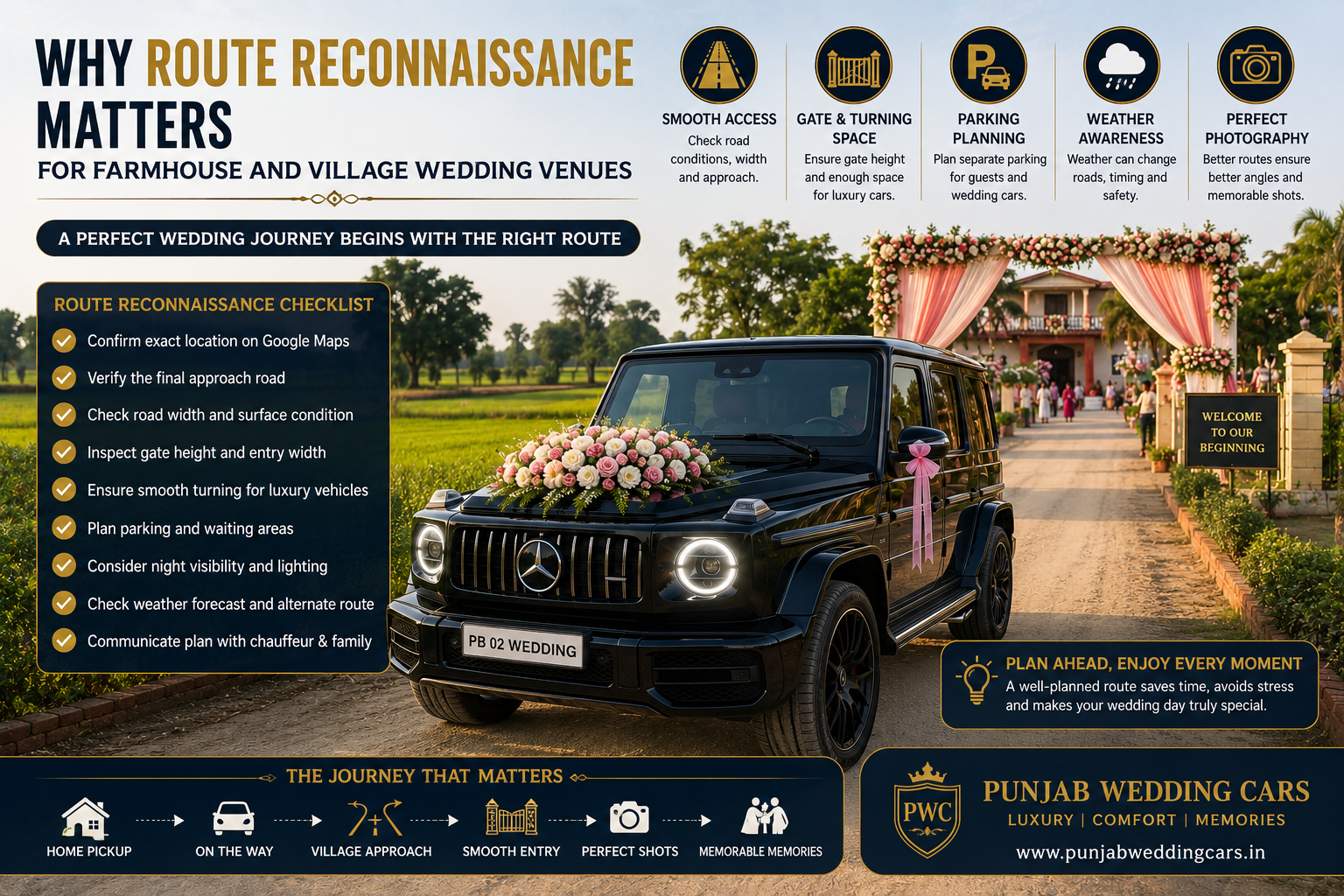
That is why route reconnaissance matters. It means checking the uncertain part of the wedding journey before the main vehicle is required to use it. For some venues, this may simply involve a recent video from a family member. For others, it may mean confirming the entrance with the venue manager or asking a chauffeur familiar with the area about the best approach. When access is genuinely uncertain, physically checking the final road can be worthwhile.
Punjab Wedding Cars already recommends considering entrance width, gate height, road surface, parking position and turnaround space when selecting luxury cars for farmhouse weddings in Punjab. That advice becomes even more important when the family has chosen a premium vehicle specifically because they want it to be part of the groom entry, bridal arrival or doli photography.
The Last Part of the Route Often Matters More Than the Highway
Families naturally spend most of their planning time thinking about the longest road section. If the groom is travelling from Jalandhar towards a farmhouse near Ludhiana, the conversation usually focuses on the intercity journey. If the bride is travelling from Amritsar towards another district, the family thinks about how long the highway drive will take. Those timings are important, but the wedding car may lose more time at the final venue approach than it loses anywhere on the main road.
A luxury vehicle can reach the correct village according to navigation and still discover that the most obvious route is not the best entrance for the wedding. Another road may provide a wider approach, better turning space or easier access to the groom-entry area. A farmhouse may have a service gate that is practical for catering vehicles but unsuitable for wedding photography, while the ceremonial entrance may be ideal visually but harder for a long limousine or large SUV to use.
Route reconnaissance helps separate the physical destination from the wedding destination. The map tells the chauffeur where the property is located, while reconnaissance establishes how the wedding car should actually enter it.
A Google Maps Pin Is Essential, but It Is Not the Whole Plan
Exact map pins are far better than vague instructions such as “the farmhouse is after the petrol pump” or “ask someone once you enter the village.” Every chauffeur should receive the correct location in advance, especially when the wedding involves guests or NRI relatives who may not know the area well.
However, a pin cannot always tell the family what the road will look like at the actual wedding time. Satellite imagery may be older than recent construction. A road that appears clear may be partially occupied by wedding-season parking. The venue may have created a new entrance since the imagery was captured, and a rural road that works perfectly in dry weather may become less suitable after heavy rain.
The right approach is therefore not to choose between technology and local knowledge. Use both. Navigation gets the chauffeur to the correct area, while current local information helps the family choose the best final approach.
Farmhouse Entrances Can Change After Decoration
One of the easiest route problems to prevent is created by the wedding itself. A farmhouse gate may be wide enough under normal conditions, but decorators can unintentionally reduce its usable height or width by adding floral pillars, fabric structures, hanging lights or temporary arches.
A family may have visited the venue several weeks earlier and confirmed that a G Wagon or Range Rover can enter easily. On the wedding day, the decorated opening can be considerably smaller than the original gate.
If the groom is expected to drive through the main wedding arch, the decorator should know which vehicle is coming. A large luxury SUV should not become the tool used to test whether the finished arch is high or wide enough.
The same applies to doli. A bridal car that entered successfully in the afternoon still needs a clear exit late at night. Decorative installations, guest vehicles and temporary barriers should not turn the return path into a completely different route.
Turning Space Matters as Much as Gate Width
Families often ask whether the car can fit through the gate but forget to ask what happens immediately after the gate.
A vehicle may pass through comfortably and then discover there is not enough space to turn into the intended photography position. This becomes particularly relevant with longer luxury saloons, limousines and large SUVs.
A Mercedes G Wagon G63 AMG may have strong road presence and excellent visual impact for a groom entry, but the chauffeur still needs enough usable space to position it. The same is true of a Range Rover or Maybach. Vehicle capability does not replace basic geometry.
Checking the turning area beforehand allows the family to decide where the car should enter, whether it should drive forward or reverse into position and where photographers and guests should stand while the manoeuvre happens.
This is much easier to solve in advance than while dhol players, photographers and relatives are already surrounding the vehicle.
Guest Parking Can Destroy an Otherwise Perfect Entry
Many farmhouse venues have large parking areas, but large weddings also bring large numbers of vehicles. The principal wedding car may therefore arrive at a property with plenty of total parking and still find the groom-entry lane blocked.
This is one of the reasons reconnaissance should include the parking plan rather than only the road. The family or venue coordinator should know where general guests will leave their vehicles and where the hero wedding car needs temporary space for its arrival.
A G Wagon, Range Rover or Rolls-Royce looks strongest when the photographer can see the vehicle clearly. If family cars are parked along both sides of the arrival lane, the same expensive wedding car may appear squeezed into a narrow gap.
The solution is not complicated. The venue simply needs to protect the important entry space around the time the principal vehicle arrives.
A Village Pickup Can Be More Difficult Than the Venue
Not all route problems happen at the reception. Groom pickups from village homes can require equal planning.
A village street may normally be wide enough for the wedding car, but the wedding morning changes the environment. Catering vans arrive, family cars park near the house, relatives gather outside, tractors remain on the road and photographers place equipment where the vehicle needs to move.
By the time the groom car reports, a perfectly usable road may have lost half of its width.
A short local check can identify where the chauffeur should approach and which section should remain clear. The family may only need to tell relatives not to park along one part of the road for thirty minutes before the principal car arrives.
That small decision can completely change the groom's pickup experience.
The G Wagon Needs Space to Look Like a G Wagon
The Mercedes G Wagon G63 AMG is often chosen precisely because of its shape and visual presence. At an open farmhouse, that can create a very strong groom arrival.
The vehicle needs enough room around it for the photographer to capture the full SUV rather than only the front grille and groom. If the chauffeur is forced to stop inside a crowded lane or directly beside parked vehicles, much of the reason for choosing the G Wagon is lost in the photographs.
The best route plan therefore considers not only whether the vehicle can reach the venue, but whether it can reach the point where it will actually look best.
This is a useful distinction because the most convenient parking location and the strongest photography location are not always the same place.
Range Rover Sport Can Suit Mixed City and Rural Journeys
The New Range Rover Sport can be especially useful when the wedding route combines city roads with an outer farmhouse or village setting. It provides SUV ground clearance and a premium appearance without requiring the family to create an extremely theatrical groom entry.
If the final approach is paved and spacious, the Range Rover can be positioned close to the main venue entrance for a modern, clean arrival. If the route includes narrower local roads, the chauffeur still benefits from knowing which approach offers the best width and turning space.
The Range Rover's versatility does not remove the need for reconnaissance, but it can make the vehicle easier to use across several different wedding environments during the same day.
Defender Makes Sense for Some Rural Venues, but It Does Not Solve Every Access Problem
A Land Rover Defender naturally fits certain farmhouse and rural wedding settings. Its higher ground clearance and SUV character can make it attractive when the route includes rougher approaches or the visual style of the wedding is intentionally outdoorsy.
However, ground clearance is only one part of route suitability. A Defender still needs enough lane width, gate space and turning room. It cannot solve a low decorative arch or a road blocked by parked guest vehicles.
This is why vehicle choice should follow the actual route rather than assumptions about the word “village.” Some village venues have excellent paved access where a Maybach can travel comfortably. Some farmhouses have narrower approaches where the physical width of a large SUV needs more consideration.
The road itself should decide the level of concern.
Maybach Can Work Perfectly at a Farmhouse When the Road Is Good
Families sometimes assume that an elegant luxury saloon such as the Mercedes-Maybach is automatically unsuitable for a farmhouse wedding.
That is not necessarily true.
If the farmhouse has a paved approach, sensible speed breakers, a good entrance and enough turning space, the Maybach can create an excellent bridal or couple arrival. Its rear-seat comfort may be particularly valuable for a bride who will later travel a long distance after doli.
This is another reason reconnaissance is useful. Instead of automatically choosing an SUV because the venue is outside the city, the family can check the real road and make the decision based on evidence.
A good paved farmhouse route may allow the bride to choose the saloon she actually prefers.
Road Surface Is More Important Than the Word “Rural”
Punjab farmhouse venues vary enormously. Some are located directly beside major roads. Others use fully paved private driveways, while some final approaches include older village roads, temporary surfaces or unpaved shoulders.
The family should therefore avoid treating all rural venues as one category.
What matters is the specific road surface the wedding car will use. A low luxury saloon may travel perfectly well on a smooth village road, while a large SUV can still be inconvenient on a deeply rutted or extremely narrow lane.
A route check replaces assumptions with practical information.
Rain Can Change the Route Overnight
A farmhouse approach that works beautifully during a dry venue visit can change quickly after rain. An overflow parking field may become soft. Water can collect near the entrance, and an unpaved shoulder that guests normally use for passing may no longer be suitable.
The family does not need to become responsible for monitoring weather conditions continuously. What matters is recognising which parts of the venue access are sensitive to rain.
If the main entrance is fully paved, the plan may remain unchanged. If the wedding car is expected to cross temporary ground, somebody at the venue should inspect that area before the groom or bride arrives.
The luxury car should not be sent forward simply to find out whether the surface is usable.
Dry Weather Creates a Different Problem: Dust
The absence of rain does not mean road condition stops affecting the wedding car. A dry rural approach can produce substantial dust, particularly when many guest cars are travelling along the same road.
This matters because the principal car may be part of the photography. A black G Wagon that leaves the groom's home spotless can reach the farmhouse covered in a visible layer of road dust after following dozens of guest vehicles down an unpaved approach.
Route reconnaissance can identify that risk. The family may decide to send the principal vehicle before the main guest traffic, use another available entrance or plan a quick presentation check before the final groom photography.
The objective is not to demand urban road conditions from every farmhouse. It is to understand how the existing road affects the visual plan.
Night Access Should Be Considered Separately From Daytime Access
A route that looks obvious at 2:00 PM may become much harder to identify at midnight.
Village junctions may have limited lighting, temporary wedding signs may be difficult to see and a farmhouse entrance that was clearly visible during daylight can blend into the surrounding road after the wedding lighting changes.
This becomes particularly important for bridal doli.
The PWC Wedding Car Safety Checklist for Night and Intercity Travel emphasises confirming the complete route and final destination before a late wedding journey begins. The same preparation should include the actual route out of the venue.
If the doli is expected after midnight, the chauffeur should not be discovering the correct exit direction while the bride and groom are already sitting in the car.
The Photographer Needs to Understand the Final Approach Too
Route reconnaissance is not only for the chauffeur. It can improve wedding photography significantly.
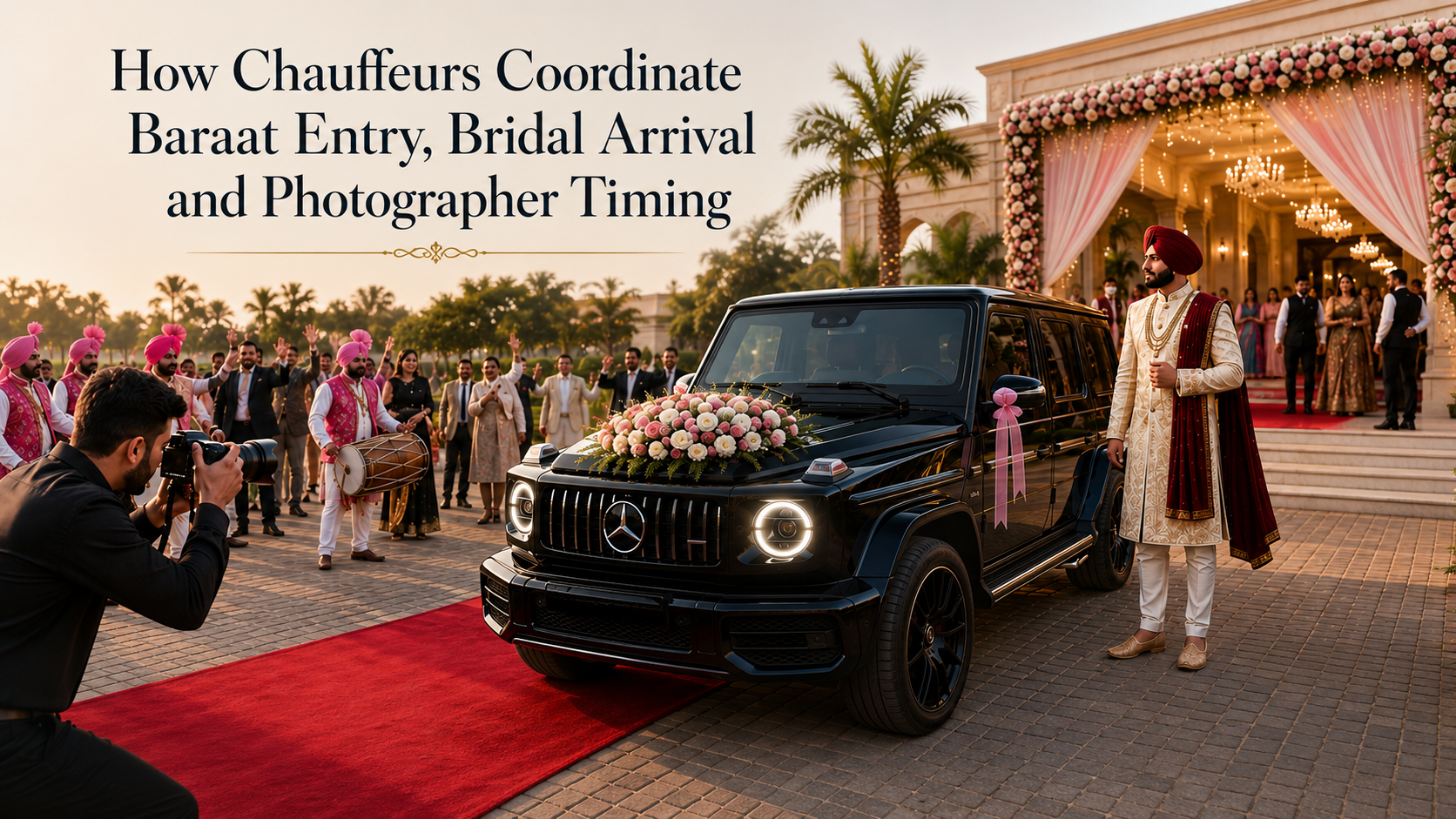
If the photographer knows which direction the groom car will approach from, they can choose the correct side of the entrance before the vehicle arrives. They can see whether the background includes the farmhouse façade, lawn or a line of parked cars, and they can decide where the groom should eventually step out.
The photographer can also avoid standing in the area the chauffeur needs for turning.
This reduces the need for repeated vehicle movements and helps the arrival happen naturally.
A good photographer does not need the car to perform several takes. They need enough information to position themselves for the real arrival.
A Route Video Can Be Extremely Useful for NRI Families
Families planning a Punjab wedding from the UK, Canada, Australia or the United States may not personally visit the farmhouse until very close to the wedding date.
A trusted relative in Punjab can still provide useful route reconnaissance by recording a short video from the main road to the venue entrance.
The video should show the actual approach rather than only the beautiful lawn once inside the property. Seeing the final turn, road width, gate and parking area can help the family understand whether the selected wedding car is suitable.
This simple video can be more useful for transportation planning than a professionally edited venue reel because wedding venue marketing naturally focuses on décor, stage setups and lawns rather than vehicle access.
One Local Contact Can Solve the Last Hundred Metres
Village and farmhouse routes often become easiest when one person who genuinely knows the property remains available to the chauffeur.
The driver already has the correct map pin, but the local contact can confirm the best entrance if there are two roads into the venue or if temporary wedding traffic has changed normal access.
This person should be the transport coordinator or venue contact rather than several relatives calling the chauffeur with different directions.
The objective is to make the last hundred metres simpler, not noisier.
Reconnaissance Can Prevent a Convoy From Following the Wrong Road
A large wedding convoy can magnify one route mistake very quickly.
If the groom's car takes an unsuitable shortcut and twenty other vehicles follow it, turning the convoy around can become far more difficult than correcting one car.
This is why the principal chauffeur should have a confirmed route rather than simply following a relative who says they know a shorter way.
The Hidden Wedding Car Route Costs guide makes a similar point about the difference between the shortest-looking route and the route that actually supports the wedding schedule.
For a convoy, the safest practical approach is often more useful than the shortest kilometre count.
Farmhouse Parking Should Include a Plan for the Principal Car
The groom or bridal car may remain at the venue for several hours after arrival. Where it waits matters.
A luxury vehicle reserved for doli should not disappear into a distant overflow parking field where it becomes difficult to retrieve once the farewell starts.
The venue coordinator should know where the principal vehicle will remain and how the chauffeur can bring it back to the exit without getting trapped behind guest buses or catering vehicles.
This becomes even more important when the wedding runs late and large numbers of guests start leaving at the same time.
A good waiting position protects both the vehicle and the final doli schedule.
The Bridal Exit Deserves the Same Attention as the Groom Entry
Farmhouse planning often concentrates heavily on groom arrival because that is the most visible use of the wedding car.
The bridal departure may be operationally more demanding.
By doli, the venue layout has changed. Guest cars have moved, some lighting may be switched off and family members may gather around the exit. The chauffeur may need to position the bridal car while photographers and relatives are already preparing for the farewell.
If the route out of the farmhouse has been considered beforehand, the vehicle can be positioned earlier and the bride can approach a car that is ready to leave.
The Bridal Doli Transport Checklist is particularly useful for these rural and intercity departures because the final destination and support-car arrangement should already be known before the emotional farewell begins.
The Best Route Check Does Not Need to Be Complicated
Not every wedding requires a chauffeur to physically drive the full route days in advance.
A well-known venue with a paved driveway, clear entrance and experienced wedding transport staff may only require confirmation of the final gate and reporting point.
A newer farmhouse, unfamiliar village venue or property with an uncertain final approach deserves more attention.
Reconnaissance can therefore be proportional to the uncertainty. Current photos, a video, venue confirmation, local chauffeur knowledge and a physical pre-drive are all different ways of answering the same question: is the wedding car going to reach the intended location smoothly?
The family should use the simplest method that provides a reliable answer.
Route Reconnaissance Can Influence the Car Choice in a Good Way
Families sometimes worry that checking the route will complicate the wedding-car decision. In reality, it often makes the decision easier.
If the road is excellent, the bride may feel confident booking the Maybach she prefers. If the final approach is rougher, a Range Rover or Defender may make more sense. If the entrance provides exceptional open space, the G Wagon may become the obvious groom-entry choice.
The purpose of reconnaissance is not to eliminate vehicle options unnecessarily. It is to match the car with the environment where it will actually be used.
The current Punjab Wedding Cars farmhouse guide already connects vehicle choice with entrance width, road condition, parking and photography. Route reconnaissance simply gives the family better information before making that decision. citeturn300039search3
Better Route Information Also Produces Better Wedding-Car Quotes
Route reconnaissance can improve pricing accuracy because it reveals how the vehicle will genuinely be used.
A groom may say the booking is from Jalandhar to a Ludhiana farmhouse, but the actual assignment could begin at a village outside Jalandhar, include a Gurudwara stop, use an indirect venue entrance and require the car to wait several hours before another movement.
The same principle appears in PWC's current guide to hidden wedding-car route costs, which explains that the real route includes actual pickup locations, detours, stops, parking and waiting rather than only the two city names. citeturn300039search0
The more accurately the family describes the route, the easier it becomes for the booking to reflect the actual wedding duty.
The Best Wedding-Car Arrival Should Feel Predictable to the Professionals
A groom entry may look spontaneous to the guests, but it should not feel spontaneous to the chauffeur, photographer and family coordinator.
The chauffeur should already know which road to use. The venue should know where the car will stop. The photographer should know which direction the vehicle will approach from, while the family coordinator should know when the principal car is expected to arrive.
When those details are clear, the vehicle reaches the farmhouse without hesitation. The groom does not sit inside while people move parked cars. The photographer does not ask the chauffeur to reverse and repeat the entry. The baraat can gather after the vehicle has been positioned, and the wedding continues naturally.
That is what route reconnaissance is really protecting.
It is not simply protecting the car from a poor road. It protects the timing, arrival, photography, passenger comfort and confidence of the people managing the wedding.
For farmhouse and village wedding venues across Punjab, the most important kilometres are often not the longest ones. They are the final few kilometres where the highway disappears, the local road begins and the wedding car finally enters the environment the family has spent months planning.
Check those kilometres properly, and the luxury car can do exactly what it was booked to do: arrive smoothly, look exceptional and become part of the wedding without becoming another problem the family needs to solve.