Winter Fog and Morning Anand Karaj: How to Plan Wedding Car Timing in Punjab
At 5:30 on a winter morning, the wedding car may be polished, decorated and ready outside the groom’s home. The family may also be ready on time. Yet the road to the Gurudwara can still take longer than expected because visibility changes within a few kilometres.
That is the challenge of planning a morning Anand Karaj in Punjab during winter.
Fog cannot be handled by asking the chauffeur to drive faster. It must be managed through earlier reporting, realistic journey buffers, route checks and clear coordination between the family, photographer and Gurudwara.
A successful winter wedding schedule begins with one principle: plan according to road conditions, not the normal journey time shown on a map.
Why Morning Anand Karaj Timing Needs a Different Plan
A daytime reception or evening palace entry usually allows the family to observe traffic and weather conditions before leaving. An early Anand Karaj may require the groom, bride and guests to begin travelling before sunrise.
During winter, fog can reduce visibility and affect road movement, particularly on village roads, open highways, canal-side stretches and routes surrounded by fields. The India Meteorological Department recognises dense fog as a serious disruption to road transport.
The journey may feel clear near a city home but become slower after entering an open rural section. Families should therefore avoid calculating the schedule from a normal clear-weather drive completed during the afternoon.
Work Backward from the Gurudwara Arrival Time
Do not begin with the car’s reporting time. Begin with the time the family should be seated inside the Gurudwara.
Suppose the family wants the groom and close relatives inside by 8:00 AM. The plan should include time for:
- Parking the wedding car and guest vehicles
- Helping elderly relatives exit
- Walking from the parking area
- Removing shoes and covering heads
- Greeting the other family
- Organising the milni or entrance
- Seating guests before the ceremony
The target should therefore be to reach the Gurudwara before 8:00 AM, not at 8:00 AM.
After deciding the safe arrival time, calculate the fog-adjusted road journey, baraat departure preparation, groom photography and vehicle reporting time.
A Sample Winter Morning Schedule
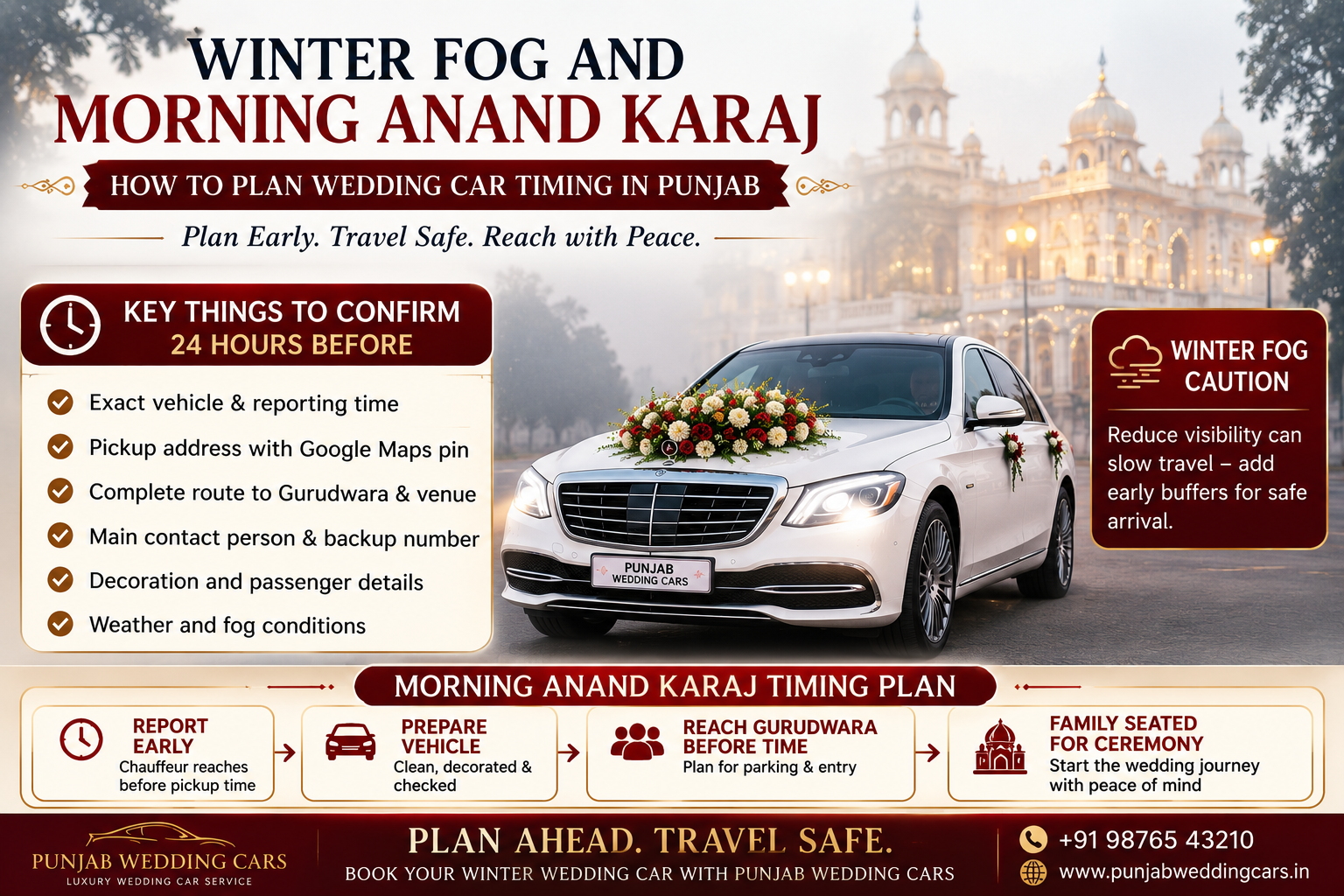
For a Gurudwara approximately 30 to 40 minutes away in clear conditions, a winter schedule could look like this:
5:30 AM: Chauffeur reports at the groom’s home
5:40 AM: Vehicle and decoration are inspected
5:50 AM: Groom and family photographs begin
6:20 AM: Immediate family prepares for departure
6:30 AM: Wedding car and essential family vehicles leave
7:20 AM: Planned arrival near the Gurudwara
7:20–7:45 AM: Parking, guest movement and entrance coordination
8:00 AM: Family seated and ready for the ceremony
This is an example, not a fixed formula. A longer route, dense fog warning, village pickup or large baraat may require an earlier departure.
The groom-pickup-to-doli timing guide explains why a car should report before the family’s planned departure rather than at the exact leaving time.
Add Two Separate Buffers
One general buffer is often not enough. Plan two.
Preparation Buffer
This covers activities before the car moves:
- Decoration inspection
- Groom portraits
- Sehra and family rituals
- Loading personal belongings
- Organising close relatives
- Coordinating the photographer
- Positioning the baraat vehicles
Road and Weather Buffer
This covers slower driving, reduced visibility, railway crossings, village-road movement, unexpected diversions and careful entry into the Gurudwara parking area.
Keeping these buffers separate prevents photography or family preparations from using the time reserved for safe driving.
Check the Weather Twice
The transport coordinator should check the official weather forecast on the evening before the wedding and again before the chauffeur begins the journey.
The morning check matters because visibility can differ from what was expected the previous night.
The chauffeur should also be contacted before reporting to confirm:
- Current visibility near the vehicle’s starting point
- Estimated travel time to the pickup address
- Any known road closure or diversion
- Whether the selected route remains suitable
- Whether the reporting time needs to move earlier
A professional transport provider should never promise an exact road speed during dense fog. The schedule must allow the chauffeur to travel according to actual conditions.
Keep the Bride’s Timing Separate
The bride and groom may be attending the same Anand Karaj, but their transport plans should not depend on one another.
The bridal car may need to report at a hotel, salon or family home. Time is also required for bridal portraits, outfit adjustment, luggage placement and private entry into the car.
A Mercedes Maybach offers generous rear-cabin space for bridal clothing, while the New Range Rover Sport can be practical where the route includes uneven village or farmhouse approaches.
The bride’s chauffeur should receive a separate reporting time, contact person, route and Gurudwara entrance. The groom’s delay should not automatically delay the bridal journey.
Do Not Move the Entire Baraat as One Block
A large convoy moves more slowly in fog than one wedding car.
Vehicles may become separated at junctions, traffic lights, toll points or village turns. Asking every driver to remain bumper-to-bumper is unsafe and unnecessary.
A better approach is to divide the transport:
- The groom’s main car and immediate family leave first.
- Elderly relatives use a dedicated car or SUV.
- General guests travel in coaches or tempo travellers.
- A transport coordinator remains connected with each driver.
- Every driver receives the same Gurudwara map pin.
The groom’s hero car can still create a coordinated arrival without requiring every guest vehicle to remain attached throughout the journey.
Share the Exact Entrance, Not Only the Gurudwara Name
Some Gurudwaras have separate entrances, parking areas or narrow connecting roads. A map search may direct the chauffeur to a rear lane that is unsuitable for a long luxury saloon.
Send:
- The correct entrance pin
- A nearby landmark
- The designated wedding-car stopping point
- Coach or guest parking information
- The name of the person meeting the vehicle
- An alternative entrance where available
The full route should be included in the booking confirmation. These Punjab wedding car booking checks can help families record the exact vehicle, timing and journey before paying an advance.
Prepare the Car for Winter Conditions
Twenty-four hours before the event, the vehicle and chauffeur should be ready for cold, low-visibility travel.
Important checks include:
- Clean windscreen, mirrors and lights
- Working heater and demister
- Correct tyre condition and pressure
- Sufficient fuel
- Secure flower and ribbon decoration
- Clear number plate and lamps
- Charged phone and working navigation
- Complete pickup and venue details
Decoration should never obstruct the windscreen, mirrors, headlights or sensors. Loose ribbons should also be secured before the car travels on a highway.
Plan the Gurudwara-to-Palace Journey Too
Fog planning should not end when the family reaches the Anand Karaj.
After the ceremony, guests may travel to a marriage palace, hotel, family home or photography location. Some vehicles may have remained outside for several hours, while others may need to collect passengers from different entrances.
Use the Punjabi wedding transportation planning guide to connect the Gurudwara departure with the palace arrival, bridal movement and later doli.
The main wedding car should remain assigned to its confirmed role instead of becoming an unplanned guest shuttle.
Confirm Changes in Writing
When fog leads to an earlier reporting time or a different route, update the booking record and the main family contact.
The written plan should confirm:
- Vehicle and passenger assignment
- Revised reporting time
- Pickup address
- Gurudwara entrance
- Complete route
- Waiting duration
- Palace or photography stop
- Final bridal or groom drop
Punjab Wedding Cars uses the confirmed reporting point, route, ceremony timing, waiting period and final destination to prepare the wedding journey.
The Safest Winter Timing Formula
For a morning Anand Karaj, first decide when the family must be inside the Gurudwara. Add time for parking and entry. Add a fog-adjusted road buffer. Add the baraat and photography preparation time. The result becomes the chauffeur’s reporting time.
Punjab Wedding Cars provides chauffeur-driven wedding cars across Punjab and Chandigarh for early Anand Karaj ceremonies, groom travel, bridal arrivals, marriage palace transfers and doli journeys.
Fog may change the speed of the journey, but it should not create panic. When the car reports early, the route is verified and every family group knows its departure time, the wedding can begin calmly—even on a cold Punjab morning.