
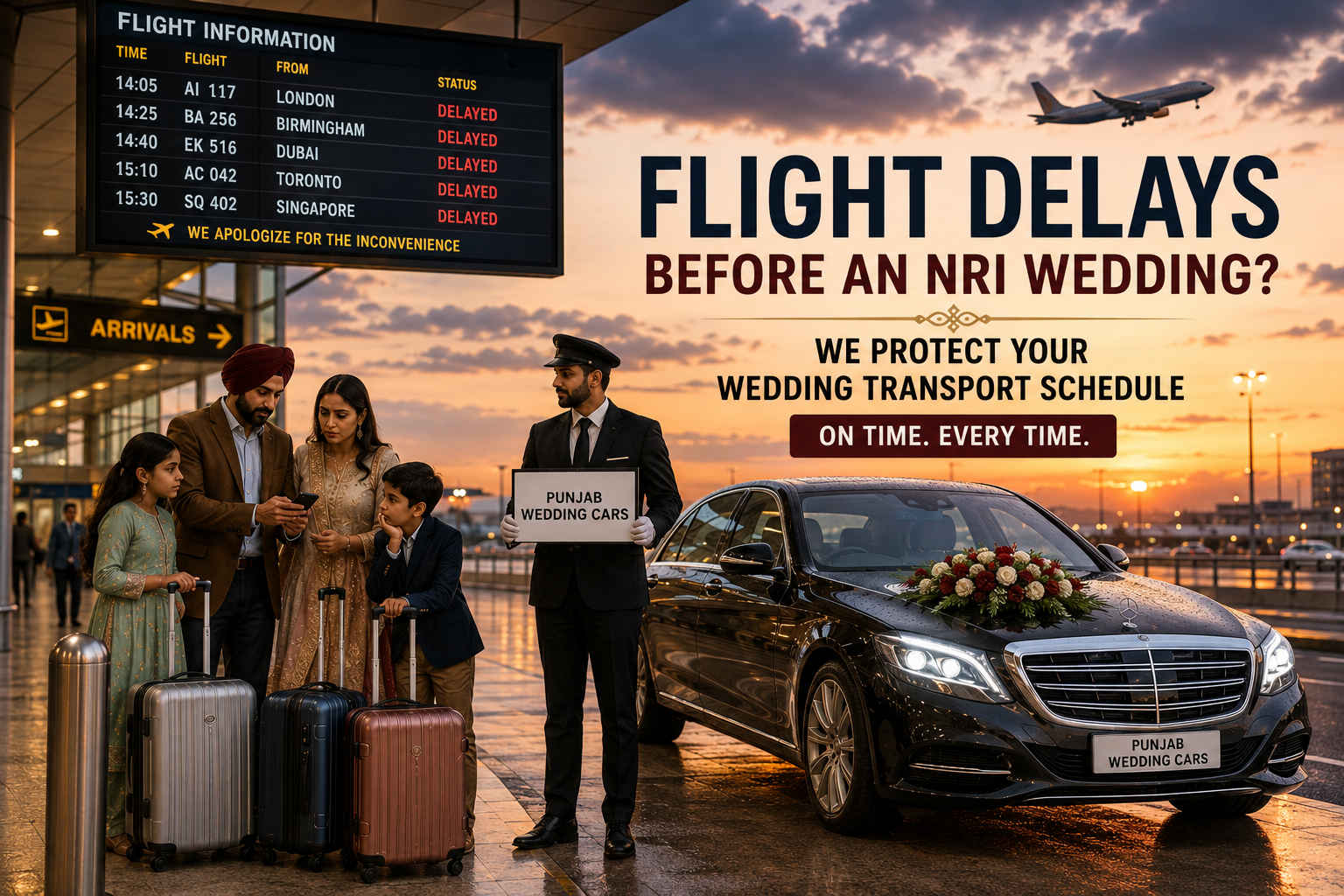
Flight Delays Before an NRI Wedding: How to Protect the Transport Schedule
A delayed flight should inconvenience the passenger who is travelling. It should not be allowed to delay the groom's baraat, the bride's doli car, the Anand Karaj or half of the family's wedding transportation.
That sounds obvious, but NRI Punjabi weddings frequently connect airport arrivals too closely with the main wedding schedule. An uncle is expected at Amritsar Airport in the afternoon and is supposed to attend Jaggo that evening. Parents land in Chandigarh the day before the Anand Karaj. A family arrives at Delhi Airport and still has several hours of road travel before reaching Punjab. Another relative is carrying wedding outfits or jewellery that somebody expects to use at the function later that day.
When the aircraft is on time, the plan can appear perfectly organised.
Then the flight slips by three hours.
Baggage takes longer than expected. The road journey starts later. The driver who was supposed to complete another wedding duty is still at the airport. A family member begins suggesting that the groom's luxury car should be sent instead. The wedding transport schedule, which had nothing to do with the delayed flight, suddenly becomes dependent on it.
The better approach is to design the airport transport so the rest of the wedding survives even when the flight does not operate according to plan.
Punjab Wedding Cars already provides chauffeur-driven airport movement connected with Amritsar, Chandigarh and Delhi, alongside separate wedding-car services for brides, grooms and family transportation. (punjabweddingcars.in) For an NRI family, those responsibilities should remain separate wherever possible.
In Short
The safest NRI wedding transport plan assumes that an incoming flight might be late. Airport vehicles should therefore have one clearly defined passenger group and destination, while the groom's G Wagon, bride's Maybach, Rolls-Royce, Jaguar or other ceremonial car remains protected from airport delays.
If a flight slips by a small amount, adjust only that airport transfer. If the delay becomes several hours, reconsider hotel check-in, shopping or pre-wedding functions attached to those passengers rather than trying to force the original schedule. If the arrival moves into the night before the Anand Karaj, protect sleep and the next morning's Gurudwara transportation instead of trying to recover every missed activity.
A delayed flight should change one branch of the transport plan, not the entire wedding.
The Problem Usually Starts When One Car Has Too Many Jobs
The most fragile wedding transport schedule is one where the same vehicle has been given several unrelated responsibilities.
A luxury SUV is scheduled to collect an NRI couple from Amritsar Airport, drop them at a Jalandhar hotel, return to the groom's home, get decorated and then take the groom to an evening function.
That can work if everything happens exactly on time.
International travel rarely gives families that guarantee.
A two-hour flight delay does not only change the airport pickup. It now affects the hotel transfer, vehicle return, cleaning, decoration and groom reporting time.
The problem is not really the flight.
The problem is that one delay was allowed to control several separate wedding movements.
This is why the Punjab Wedding Cars guide to VIP guest transport from airport pickup to venue entry recommends treating the VIP guest journey separately from the bride's and groom's principal cars.
A dedicated airport vehicle creates a firewall around the wedding schedule.
Never Make the Groom Car Responsible for an Incoming Flight
If the groom has specifically booked the Mercedes G Wagon G63 AMG for home photography, Sehra Bandi and baraat entry, its wedding-day schedule should be built around the groom.
It should not be somewhere on an airport road because an important relative's flight happened to arrive that morning.
The same applies if the groom is using a Range Rover Sport, Defender or another signature vehicle.
A premium groom car may need to report well before departure. The photographer may want photographs with the vehicle at the family home. Floral decoration may need to be checked. The chauffeur may need to position the car while relatives gather around the property.
Those requirements cannot be compressed safely simply because a flight landed later than planned.
An airport guest can use another luxury chauffeur-driven car and still receive premium treatment.
The groom only gets one groom-entry schedule.
Protect it.
The Bridal Car Should Be Even More Protected
A bride's principal wedding vehicle should be one of the least flexible cars in the entire transport plan.
A Mercedes-Maybach, Rolls-Royce Ghost or Jaguar XJL may be needed later for bridal photography, doli and a substantial journey to the final family home.
If that car is sent to an airport beforehand and the flight is delayed, the problem extends far beyond presentation.
The chauffeur may now have less time to return, prepare the vehicle and reach the bride's venue.
A doli can also move later than expected on its own because wedding functions frequently run beyond the original programme. Adding an airport delay on top of that creates unnecessary risk.
The bridal vehicle should remain focused on the bride.
Luggage and airport relatives belong in another vehicle.
A Two-Hour Delay Is Usually an Airport Problem, Not a Wedding Problem
Not every delay requires a complete new plan.
If a flight that was expected in the afternoon arrives two hours later and the passengers are only travelling to their hotel, the solution may be very simple.
Adjust the airport pickup.
Update the family coordinator.
Keep the hotel informed if necessary.
Leave the rest of the wedding schedule alone.
The mistake is allowing family anxiety to turn a manageable delay into a wider transport change.
A cousin does not need to redirect another wedding car to the airport simply because the original passenger is late.
The airport chauffeur's duty moves with the airport arrival.
Everyone else continues with their existing responsibilities.
This is why every airport group should have one assigned vehicle or transport arrangement rather than depending on whichever family car happens to be available at the time.
A Six-Hour Delay May Require Changing the Guest's Evening
Once the delay becomes significant, the wedding schedule attached to the arriving passenger may need to change.
Imagine relatives were expected to reach Amritsar Airport at noon, travel to Jalandhar, check into the hotel and attend Jaggo that evening.
If the flight now arrives at 6:00 PM, trying to preserve the entire original programme can create an exhausting and unnecessary rush.
The chauffeur can still collect the family and take them to Jalandhar.
What may need to disappear is the expectation that they will check in, change into wedding clothes and immediately attend the evening function.
Transport planning should recognise this rather than pretending the original schedule still exists.
The family in Punjab can continue with Jaggo.
The arriving guests can reach their hotel safely.
They can join the wedding at the next appropriate function.
The airport delay has affected the passenger.
It has not affected the wedding.
That is a successful contingency plan.
A Twelve-Hour Delay Can Become a Next-Day Problem
Long delays require a more decisive response.
If parents were expected to arrive the afternoon before an Anand Karaj but now reach Punjab late at night, the priority should become getting them to their accommodation and protecting the next morning.
Do not automatically insist on late-night family visits because “everybody is waiting.”
Do not schedule shopping.
Do not send them through another social obligation if they have already spent hours travelling.
They may still need to wake early, dress for the wedding and reach Gurudwara Sahib.
The transport plan should now support rest.
Airport to hotel.
Hotel to Gurudwara in the morning.
Everything else becomes secondary.
This is especially important for grandparents and older relatives, whose wedding experience can deteriorate quickly when international travel, late-night road movement and an early ceremony are placed back-to-back.
Amritsar Airport Delays Should Not Disrupt Jalandhar Wedding Cars
Amritsar is a major arrival point for NRI families connected with Jalandhar and the wider Doaba region.
The Amritsar to Jalandhar wedding-car route is therefore frequently relevant to guest and wedding movement between the two cities. Punjab Wedding Cars' live route page specifically identifies airport arrivals and NRI guest transportation as common uses of intercity luxury cars. (punjabweddingcars.in)
The important planning principle is that the airport transfer should finish at the hotel or family home.
Once relatives reach Jalandhar, their next movement should be handled through the local Wedding Car Hire in Jalandhar plan or the family's guest transportation.
That means a late Amritsar arrival only postpones their journey into Jalandhar.
It does not need to change the cars already assigned to the groom, bride, parents or hotel guests.
Chandigarh Arrivals Need the Same Separation
The same principle applies when overseas guests arrive through Chandigarh and continue to a Punjab wedding.
The Chandigarh to Jalandhar wedding-car route is currently positioned for NRI arrivals, Tricity hotels, Chandigarh Airport movement and Jalandhar wedding functions. (punjabweddingcars.in)
If that flight is late, the Chandigarh-to-Jalandhar transfer changes.
The Jalandhar wedding should not.
This distinction sounds simple, but families often blur the two because the same relatives are part of the wedding party.
Think of the airport journey as a feeder route.
Its job is to deliver the passengers into the wedding system.
The wedding system should be strong enough to continue while it waits for them.
Delhi Airport Needs the Largest Time Buffer
A Delhi Airport arrival is especially vulnerable to timing problems because the flight landing is only the beginning.
The passenger still has a long onward journey into Punjab.
A two-hour delayed arrival in Amritsar may shift a hotel check-in by a couple of hours.
A two-hour delayed arrival in Delhi shifts the start of a long road journey by the same amount.
That can move a planned early-evening arrival in Punjab into late night.
Families should therefore avoid attaching rigid functions to a Delhi arrival day.
If the guest must attend something important, build far more margin into the schedule than feels necessary when the flight is first booked.
If no margin exists, accept that the function may need to be missed.
Trying to “make up the time” on the road is not the solution.
The driver should provide a comfortable and responsible journey.
The wedding programme can adapt around the guest.
The Driver Should Never Be Pressured to Recover Lost Flight Time
This is one of the most important safety principles.
A plane arrives late.
The family is waiting.
The Jaggo has started.
The natural emotional response is to tell the chauffeur, “Please reach quickly.”
But the driver did not create the delay.
Road travel should not become the place where the family tries to recover time lost in aviation.
The passenger has already spent hours travelling.
A smooth road journey is more valuable than an anxious attempt to reach the venue at the original time.
If the guest now misses part of a function, that is unfortunate.
It is still better than making the road transfer unnecessarily stressful.
The existing PWC guide on wedding-car safety for night and intercity travel is particularly relevant when a flight delay pushes the onward road journey into late evening or night.
Do Not Keep an Airport Chauffeur Waiting Without Updating the Plan
Flight delays are not all the same.
Some are announced while the passenger is still abroad.
Others happen after boarding.
Another flight may divert or change its estimated arrival repeatedly.
The family coordinator should pass meaningful changes to the transport provider rather than assuming the chauffeur will simply remain at the airport indefinitely under the original plan.
The important information is the latest expected arrival and whether the pickup is still proceeding.
This is one of the advantages of having one transport coordinator.
The airline updates the passenger.
The passenger or overseas family informs the coordinator.
The coordinator updates the airport transport.
The rest of the wedding family does not need to become involved.
Do Not Build the Airport Pickup Around a Screenshot Sent Six Hours Earlier
Flight information changes.
An NRI relative may send a screenshot before boarding in London, Toronto or Vancouver showing the original arrival time.
That should not become the only information used on airport day.
Closer to the expected arrival, the family coordinator should check the latest flight status through the airline or relevant airport information source and update the transport plan where necessary.
The objective is not to constantly monitor every aircraft.
It is simply to avoid sending drivers according to outdated information when a known substantial delay has already occurred.
The chauffeur's reporting arrangement can then be coordinated around the latest reasonable expectation.
One Local Contact Should Make the Decision When the Delay Becomes Serious
A flight delay is exactly the kind of situation where too many family decision-makers become a problem.
The passenger says they are still coming to Jaggo.
The groom's cousin says they should go to the hotel.
An uncle tells the driver to stop at the family home.
Someone else says luggage needs to be dropped elsewhere first.
The chauffeur now has four destinations.
One Punjab coordinator should decide.
That person should understand the wider wedding schedule and the passenger's condition.
If the family has already followed the NRI booking strategy of using one overseas decision-maker and one Punjab coordinator, this decision becomes much easier.
The overseas contact can provide the latest flight information.
The Punjab contact protects the local wedding schedule.
Hotel Transfer Should Usually Become the Default Recovery Plan
When a flight is significantly late, the simplest recovery option is normally accommodation.
Get the guest to the hotel or family home.
Let them settle.
Then reassess.
This is particularly useful for overseas relatives unfamiliar with current Punjab roads. They should not leave the airport after a major delay and immediately become responsible for deciding whether they can still reach a function in another district.
The chauffeur already has the hotel pin.
The family already knows where they are staying.
Complete that movement first.
A late passenger reaching the hotel comfortably is a much better outcome than a late passenger being driven from function to function with luggage still in the car.
Keep International Luggage Away From the Wedding Venue
Flight delays make families more likely to take shortcuts.
“The function has started, so bring them directly from the airport.”
That can result in several large international suitcases arriving at the marriage palace.
Now the family needs somewhere to store them.
The guest needs wedding clothes.
Somebody has to remember which car the luggage is in later that night.
The simpler solution is hotel first.
If arriving guests absolutely must go directly to the event, consider sending the luggage separately to the hotel or family home rather than filling the wedding venue with airport baggage.
The same principle appears throughout PWC's NRI transport guidance: airport and guest transport should serve the guest without interfering with ceremonial vehicles and wedding logistics.
Important Wedding Clothing Should Not Travel on the Last Possible Flight
Transport planning cannot control airline operations, but families can reduce how much damage a delay can cause.
If the groom's sherwani, bride's secondary outfit, jewellery needed for a ceremony or another irreplaceable wedding item is travelling internationally, do not create a plan where it is scheduled to arrive only a few hours before it is required.
That is not primarily a car problem.
It is a dependency problem.
The chauffeur can wait for the flight.
The car cannot make the aircraft arrive earlier.
Critical wedding items should ideally reach Punjab with enough time that a flight disruption does not immediately become a wedding emergency.
This same principle applies to important people where possible.
Parents who have a major role in the Anand Karaj are safer arriving with some margin rather than on a schedule that only works if every flight and road transfer is perfect.
Separate “Must Attend” Guests From “Nice to Attend” Functions
Every NRI relative does not have the same role.
Parents may need to be present.
Grandparents may be central to family photographs.
The best man's absence may affect the groom's preparation.
Another cousin may simply hope to attend Jaggo after landing.
When a delay happens, these differences matter.
If the passenger is essential to the following morning's ceremony, protect their rest and next-day transport.
If they were only planning to attend a casual evening function, allow them to miss it.
A good contingency plan knows which parts of the wedding are flexible.
Transport cannot solve every delay.
It can stop that delay from spreading.
The Morning Anand Karaj Schedule Should Be Protected the Night Before
The night before an Anand Karaj is where flight delays can create the most anxiety.
A close family member is still on the road from Delhi or Chandigarh.
Everyone wants to stay awake and wait.
But the groom car still needs to report early.
Hotel guests still need their Gurudwara pickup.
Parents may have ceremonial responsibilities.
The photographer has a schedule.
Those plans should remain intact.
The arriving guest can have another vehicle waiting for them.
The rest of the family should not shift its morning reporting times simply because somebody reached Punjab later than expected.
The PWC guide on what time wedding cars should arrive from groom pickup through doli is useful here because the groom's reporting buffer exists for a reason.
Do not sacrifice it to recover time lost somewhere else.
Airport Guests Should Join the Wedding Schedule at the Next Logical Point
A family member who misses Jaggo because of a flight delay does not need a special transport programme for the rest of the wedding.
Once they have reached their accommodation, join them to the next normal transport group.
If they are staying at the same Jalandhar hotel as twelve other NRI relatives, they now use the same hotel-to-Gurudwara plan.
It no longer matters that they arrived six hours later than everybody else.
This is the moment when the airport delay ends.
The passenger has entered the wedding transport system.
That is an important operational mindset because families sometimes keep making separate arrangements for late arrivals long after the airport problem has actually finished.
Large NRI Weddings Should Have a Backup Vehicle Strategy
A backup does not necessarily mean keeping an unused Rolls-Royce parked somewhere all week.
It means knowing what happens if one transport duty changes.
If an airport arrival shifts by several hours, is another suitable car available for the later transfer?
If an elderly relative needs to leave the reception early, do they have independent transportation?
If a guest transfer overlaps with another duty, is the bride's or groom's hero vehicle protected?
The family does not need to predict every problem.
It needs enough separation between responsibilities that one change does not collapse the whole schedule.
Punjab Wedding Cars' broader Punjab luxury wedding-car fleet allows families to assign different vehicle types to airports, parents, VIP guests, groom entry and bridal doli according to the actual requirement.
Local City Cars Should Take Over Once the Airport Transfer Ends
Suppose a Canadian family lands late in Amritsar but eventually reaches its hotel in Jalandhar.
The following morning, there is no reason to keep treating them as an Amritsar-airport transfer group.
Their next journey is a Jalandhar wedding movement.
The family can use Wedding Car Hire in Jalandhar or the planned guest vehicles from the hotel.
The same applies when guests reach Amritsar, Mohali, Ludhiana or another wedding city.
Airport transport feeds the local transport.
It should not remain tangled with it.
Flight Delays Should Not Automatically Create Extra Wedding-Car Waiting
Another potential source of confusion is waiting time.
The chauffeur waiting at an airport because a flight is delayed and a luxury wedding car waiting outside a marriage palace because the ceremony has run late are different operational situations.
Families should explain the changing airport situation rather than assuming every delay is automatically covered within the original expectations.
The same principle applies when comparing quotations.
The PWC guide on how to compare wedding-car quotations without choosing only the lowest price recommends comparing the actual duty, including waiting and route requirements, rather than only the vehicle name.
Airport contingencies are another reason that complete service detail matters.
Do Not Make Last-Minute Car Upgrades Because the Guest Is Upset
A delayed flight is frustrating.
Families sometimes try to compensate by suddenly upgrading the airport transfer.
The guest was supposed to have an executive saloon, but now somebody wants to send the Maybach because they have been waiting for hours.
That may feel hospitable.
It can also disturb the actual wedding schedule.
Comfort the guest through good service, reliable communication and an appropriate vehicle.
Do not create another logistics problem in an attempt to apologise for an airline delay that the wedding transport provider did not cause.
A clean, comfortable airport car with a professional chauffeur is more useful than a ceremonial car that is needed elsewhere.
If the Flight Is Cancelled, Cancel the Passenger's Day — Not the Wedding's
Cancellation is the clearest example of the principle.
The guest is not arriving today.
That means their airport transfer changes.
Their hotel arrival changes.
Their expected participation in today's functions changes.
The groom's wedding plan does not.
The bride's plan does not.
The reception does not.
The transport coordinator can work with the passenger on the replacement flight and then create a new airport-transfer plan when the revised arrival is known.
The family should resist the temptation to keep several cars and people “on standby” indefinitely without a confirmed new journey.
Focus on what is known.
The wedding continues.
The arriving guest joins when they can.
Return Flights Need the Same Protection in Reverse
Flight disruption is not only an arrival problem.
At the end of an NRI wedding, relatives may be departing through Amritsar, Chandigarh or Delhi.
Wedding functions regularly run later than planned.
The flight still has its own schedule.
A guest who needs to leave for Delhi Airport should not wait for the doli simply because the family hoped they could do both.
Their airport transfer should depart at the appropriate time.
Likewise, the bride's principal car should not be used for an airport drop immediately after doli merely because another relative has a flight.
Keep departures in the same master airport plan used for arrivals.
A reliable wedding transport system should survive both late flights and late weddings.
Protect the Schedule by Building Around Independent Journeys
The most important idea is simple.
The airport transfer is one journey.
The groom's baraat is another.
The bride's doli is another.
The hotel guest pickup is another.
The parents' car is another.
They belong to the same wedding, but they should not depend on each other unnecessarily.
Punjab Wedding Cars already supports both airport transportation and chauffeur-driven wedding vehicles across Punjab, with intercity route coverage such as Amritsar to Jalandhar and Chandigarh to Jalandhar alongside local service-area coverage. (punjabweddingcars.in)
That separation is what gives an NRI family resilience when travel changes.
A Delayed Flight Should Stay a Delayed Flight
No transport company can control when an aircraft arrives.
What a family can control is how much of the wedding depends on that aircraft.
Build margin around important people arriving from overseas. Keep the airport cars away from the principal ceremonial fleet. Give every passenger group a clear hotel or family-home destination. Let one coordinator communicate meaningful flight changes. If an arrival becomes seriously late, remove optional activities rather than compressing the road journey.
Protect the following morning.
Protect the groom car.
Protect the bridal car.
Protect the hotel guest schedule.
And once the delayed passenger finally reaches accommodation, place them into the next normal wedding movement and move on.
That is the difference between a flight delay becoming an inconvenience and becoming a wedding transport crisis.
The best contingency plan is not one that somehow prevents delays.
It is one that allows the wedding to continue normally when they happen.