Child and Elderly Passenger Safety in Luxury Wedding Cars
A Mercedes-Maybach, Range Rover, Jaguar or other luxury wedding car can provide a beautifully comfortable journey, but the badge on the bonnet does not decide whether the trip is suitable for a four-year-old child or an eighty-year-old grandparent.
The passenger does.
Punjabi weddings routinely involve several generations travelling between homes, hotels, Gurudwaras, marriage palaces and reception venues. Young children may travel with parents or grandparents. Elderly relatives may attend the Anand Karaj early in the morning and then continue to a reception several hours later. NRI grandparents may arrive after a long international journey and still have multiple wedding functions ahead of them.
These passengers should not simply be placed into whichever luxury car is available.
Their vehicle, seating position, restraint requirements, boarding needs, journey length and timing deserve specific consideration.
This does not mean making the wedding transport complicated. In many cases, a few sensible decisions before the wedding are enough to make the journey significantly more comfortable and safer.
In Short
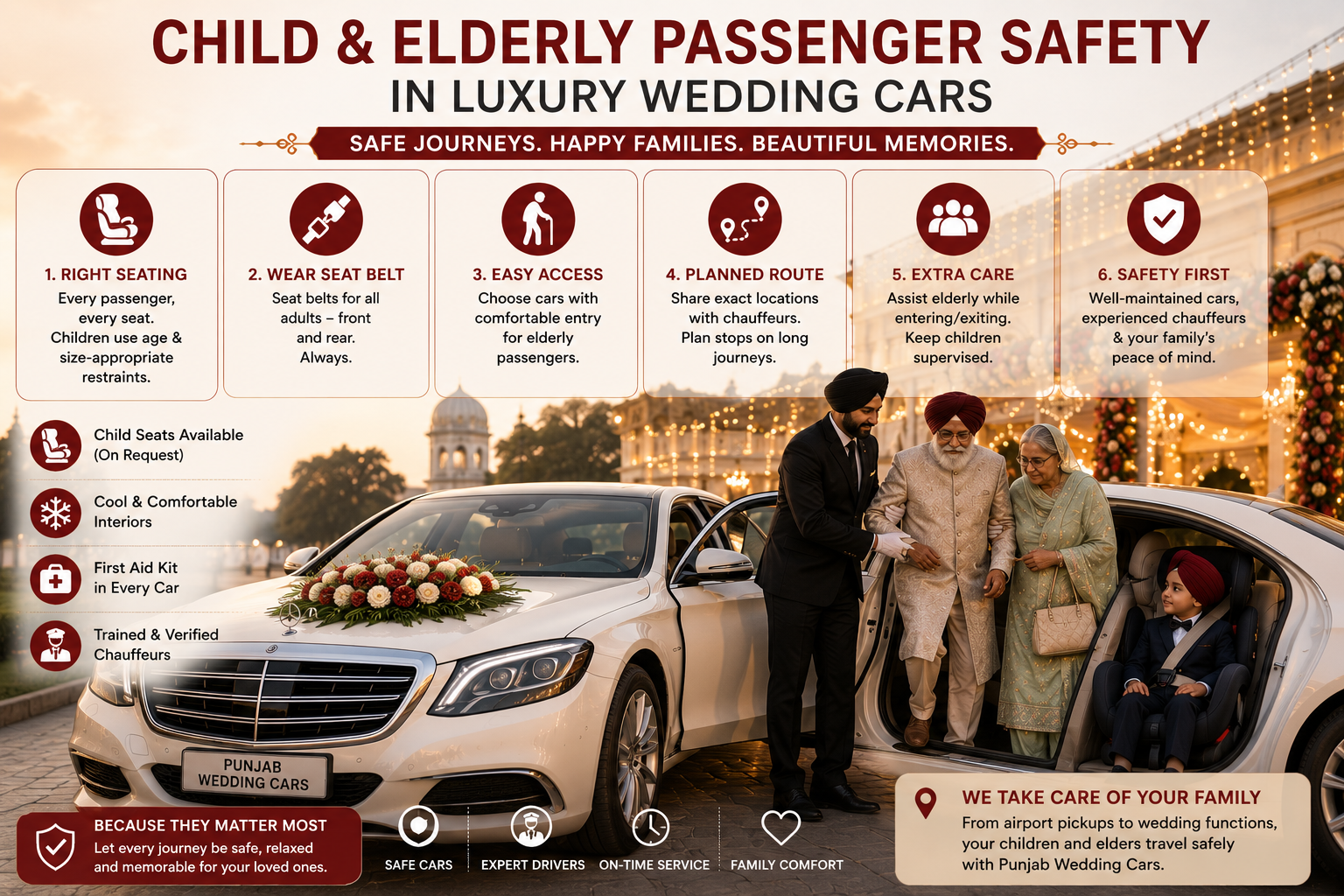
Children and elderly passengers should have their own planned seats rather than being fitted into a wedding car after everybody else has been allocated. Children should travel using an appropriate restraint for their age, size and the vehicle, while adult passengers should use their seat belts even when sitting in the rear.
For grandparents and elderly relatives, vehicle access matters as much as luxury. A very tall SUV may look impressive but can be harder to enter than a comfortable luxury saloon. Allow additional boarding time, avoid repeatedly moving elderly guests between cars and give their chauffeur a direct route and exact venue pin.
Most importantly, do not sacrifice passenger safety simply because a photograph, convoy formation or crowded family journey appears more convenient.
A Luxury Car Is Still a Road Vehicle
Wedding cars sometimes get treated differently from normal cars because they are part of a celebration.
People sit differently for photographs.
Relatives squeeze together for a short journey.
A child is placed on a parent's lap because the venue is “only ten minutes away.”
Someone avoids wearing a seat belt because it might crease a sherwani or bridal outfit.
But the vehicle is still travelling on a public road.
The World Health Organization identifies seat belts and appropriate child restraints as fundamental occupant-safety measures. WHO says wearing a seat belt can reduce the risk of death among vehicle occupants by up to 50%, while correctly used child restraints offer substantial additional protection for younger passengers. citeturn461469search0turn461469search1
The wedding context does not change those principles.
If anything, wedding travel deserves additional attention because passengers may be distracted, tired and travelling on unfamiliar routes.
A Child Should Not Become the “Extra Passenger”
One of the most common planning mistakes is counting adults first and assuming a small child can simply fit in afterwards.
Four adults are allocated to a car.
Then someone says, “The child can sit with the mother.”
That approach treats the child as luggage rather than as another passenger who requires their own safe seating arrangement.
A young child should not be expected to travel unrestrained on an adult's lap simply because the journey is short.
If the child requires an age- and size-appropriate child restraint, that restraint also occupies real seating space.
That means child passengers should be included when the vehicle plan is created, not added on the wedding morning.
Confirm Child-Seat Requirements Before Booking the Car
Families travelling from the UK, Canada, Australia, the United States or elsewhere may already be accustomed to using a particular child seat or booster.
If that child will travel in a Punjab wedding car, discuss it before the wedding.
The important question is not only, “Can we carry a child seat?”
It is whether the specific restraint can be installed correctly in the selected vehicle according to the restraint and vehicle manufacturers' instructions.
Different cars can have different seat shapes, belt arrangements and anchorage systems.
Do not assume every luxury car, limousine or SUV provides exactly the same child-seat installation options.
If the family is bringing its own child seat, say so when arranging the vehicle.
If the family expects another arrangement, confirm that explicitly rather than discovering the issue when the chauffeur arrives.
Do Not Assume a Limousine Is Automatically Best for Children
A limousine can look like the obvious family solution because it provides more cabin space.
But more interior space does not automatically mean a particular seat position is appropriate for a specific child restraint.
The Punjab Wedding Cars fleet includes luxury saloons, SUVs and limousine options designed for different wedding requirements.
Choose the vehicle according to the passengers as well as the visual style.
If small children are travelling, first establish how they will be properly seated and restrained.
Then choose the vehicle.
The same principle applies to adults.
Passenger count on paper is not the only measure of suitability.
Rear-Seat Luxury Does Not Mean Seat Belts Are Optional
One of the attractions of a Mercedes-Maybach is its rear-seat-focused luxury.
That makes it especially appealing for brides, couples, parents and VIP wedding guests.
But premium leather, extra legroom and a smooth chauffeur-driven ride do not make restraint use unnecessary.
Rear-seat passengers should use the available seat belts properly.
WHO road-safety guidance treats rear-seat restraint use as an important part of effective seat-belt policy and occupant protection. citeturn461469search4
The same should be part of the family's wedding transport culture.
Buckle first.
Then enjoy the car.
Wedding Clothes Should Work Around the Seat Belt
Punjabi wedding clothing can be elaborate.
A groom may be wearing a sherwani and large turban.
Women may be travelling in heavily embroidered suits or lehengas.
Elderly relatives may have shawls.
Children may be wearing formal clothes that are bulkier than their everyday outfits.
That should be considered before departure.
A passenger should be seated comfortably enough for the restraint to be used as designed rather than placing thick objects or unsuitable accessories between the passenger and the belt.
If an outfit makes entering or fastening the belt difficult, allow more time.
Do not solve the problem by simply leaving the belt unfastened.
Grandparents Need the Right Car, Not Necessarily the Most Expensive Car
Families naturally want to honour grandparents with a premium vehicle.
That is a thoughtful idea.
But the best car for an elderly passenger is not automatically the most expensive model available.
Access matters.
Seat height matters.
Door opening matters.
Cabin space matters.
Journey length matters.
A grandparent with reduced mobility may find a luxury saloon easier to enter than a very high SUV. Another passenger may appreciate the higher seating position of an SUV because they dislike lowering themselves into a low car.
There is no single correct model for every elderly passenger.
The family should think about the person who will actually use the vehicle.
The existing Punjab Wedding Cars guide on cars for parents and grandparents explores this issue in more detail and places comfort, easy access and independent transport ahead of simply putting older relatives into the main baraat convoy.
Jaguar XJL Can Suit Passengers Who Prefer a Luxury Saloon
A long-wheelbase luxury saloon such as the Jaguar XJL can make sense when rear-seat comfort and a conventional saloon entry height are priorities.
It may suit parents, grandparents or a bride who wants an elegant journey without stepping into a tall SUV.
The important point is not that every elderly passenger should use a Jaguar.
It is that body style deserves attention.
A family that only compares prestige and photographs may overlook one of the most practical considerations: how comfortably the passenger can get in and out.
Range Rover and G Wagon Access Should Be Considered Individually
The Range Rover Sport and Mercedes G Wagon create a strong wedding presence.
They can be excellent groom vehicles and work particularly well for certain farmhouse, rural and grand-arrival settings.
For a mobile adult passenger, their higher seating position may be perfectly comfortable.
For an elderly relative with difficulty lifting a leg or stepping upwards, however, the entry height may deserve consideration.
Do not assume Grandpa will prefer the G Wagon just because everybody else does.
If the vehicle is being booked specifically for older relatives, think through the actual boarding process.
A beautiful SUV is only a successful choice if the passenger can use it comfortably.
Allow Grandparents to Enter the Car Before the Family Rush Begins
Wedding departures can become crowded quickly.
The photographer is taking pictures.
Children are running around.
The groom's friends are arriving.
Bags are being placed into cars.
Somebody is looking for a missing relative.
That is not the best moment to rush an eighty-year-old passenger into a vehicle.
If parents or grandparents have a dedicated car, allow them to board calmly.
The chauffeur can position the vehicle somewhere practical.
A family member can help them reach it.
Walking sticks or other personal mobility aids should be handled carefully and kept accessible if needed at the destination.
Give the process a few extra minutes.
It will normally save time rather than create delay.
Do Not Make Elderly Relatives Constantly Change Cars
Another common wedding-day mistake is transferring grandparents between several vehicles.
They leave home in one car.
At Gurudwara Sahib somebody puts them into another car.
After lunch they travel with a cousin.
At reception they cannot remember which vehicle contains their belongings.
By the end of the day, the family is trying to locate their shawl, medication bag or walking stick.
Where practical, keeping the same vehicle and chauffeur assigned to elderly parents or grandparents makes the entire day easier.
The chauffeur already understands their pace.
Their belongings remain in one place.
The family coordinator knows which vehicle they are using.
The passenger does not repeatedly have to enter unfamiliar cars.
Parents and Grandparents Should Not Be Forced to Follow the Baraat Convoy
A dedicated parents' car should have the exact Gurudwara and venue pins.
It does not need to remain bumper-to-bumper behind the groom.
If grandparents are travelling in a comfortable Audi A6 or Jaguar while the groom's friends are moving in a lively convoy around a G Wagon, the older passengers should be allowed to travel independently.
Their chauffeur can use the appropriate road and reach the destination calmly.
The single wedding car versus luxury convoy guide explains why larger convoys require more coordination and can create additional movement around the principal wedding vehicle.
Older passengers do not need to become part of that complexity.
Children Should Not Move Between Cars While the Convoy Is Travelling
Wedding convoys often contain relatives, cousins and friends who know one another.
This can create casual passenger swapping between stops.
A child starts in the parents' car.
Then wants to sit with cousins.
Then another relative offers to take them.
If the child requires a restraint that is installed in one particular vehicle, moving them casually to another car can remove the very safety arrangement the family planned.
Keep younger children's transport consistent.
If their child restraint is installed in the family vehicle, keep that vehicle assigned to them for the relevant journey.
Wedding excitement should not undo good planning.
Never Leave a Child Unattended in a Wedding Car
Wedding functions create distractions.
Someone thinks the child is with an aunt.
The aunt thinks the child stayed with a parent.
Everybody has gone inside the venue.
The car is parked.
This is exactly why one adult should remain clearly responsible for each young child during transfers.
Children should not be left unattended in or around vehicles.
NHTSA's current child-safety guidance similarly stresses that children should be properly restrained and should not be allowed to play unsupervised in or around cars. citeturn461469search3
At a wedding, responsibility should be explicit rather than assumed.
A Child's Car Seat Should Not Become a Luggage Shelf
Airport and NRI wedding travel produces significant luggage.
Suitcases, lehenga bags, makeup cases, gifts and children's belongings can quickly fill the vehicle.
A child restraint should remain available for the child.
Do not bury it under shopping bags for the airport-to-hotel journey and then decide the child can travel without it because retrieving the seat is inconvenient.
This is another reason airport transport should be matched to passenger and luggage requirements.
The PWC VIP Guest Transport guide recommends selecting airport vehicles according to the real number of passengers and luggage rather than using ceremonial wedding cars as general baggage carriers.
Children make that planning even more important.
Airport Travel and Wedding-Day Travel Are Different
An NRI family may arrive with two small children, grandparents and six large suitcases.
That does not mean the same vehicle arrangement should be used for the Anand Karaj.
Airport day needs luggage capacity.
Wedding morning needs passengers to reach Gurudwara Sahib comfortably.
Reception night may require another arrangement.
Separate the jobs.
Punjab Wedding Cars provides airport pickup and drop services connected with Amritsar, Chandigarh and Delhi alongside separate luxury wedding-car services.
For a multi-generational NRI family, treating those as distinct transport stages can make the entire wedding week easier.
Long-Distance Journeys Deserve More Planning
A ten-minute journey from a Jalandhar hotel to a nearby venue is different from a long intercity trip after doli.
Children may become tired or restless.
Grandparents may need a more comfortable pace.
Families may require sensible breaks on longer journeys.
The Wedding Car Safety Checklist for Night and Intercity Travel is particularly relevant when the bride, family or older relatives will be travelling between districts after a long wedding day.
Do not plan a demanding late-night journey as though passengers are starting fresh.
By that stage they may already have been awake since early morning.
Late-Night Doli Needs Special Attention
Doli can happen much later than the printed wedding programme suggests.
The Anand Karaj may be on time but lunch takes longer.
Photography takes longer.
Family traditions extend the farewell.
Suddenly the bridal car begins an intercity journey well after dark.
If grandparents or young children are travelling in supporting family vehicles, their transport should not be improvised at that point.
The Bridal Doli Transport Checklist recommends planning the final destination, luggage, support vehicle and late-night journey in advance.
Families with children or elderly relatives should go one step further and decide whether those passengers actually need to remain at the venue until the final doli.
Sometimes they do.
Sometimes allowing them to leave earlier is the much better plan.
Children Do Not Need to Stay Until the Last Wedding Photograph
A five-year-old may enjoy the morning wedding enormously.
By 10:30 PM, the same child may be exhausted.
Families sometimes keep children at a reception simply because the parents are staying.
If practical, organise a responsible adult and suitable transport that allows younger children to return to the hotel or family home earlier.
That does not mean separating children casually.
It means planning the option properly.
A dedicated family car can provide far more flexibility than depending on the bride or groom's vehicle.
The Same Applies to Elderly Guests
Grandparents should not have to remain at a reception until midnight simply because everybody came in one convoy.
Giving them an independent chauffeur-driven car creates choice.
If they feel comfortable, they can stay.
If they become tired, the chauffeur can take them to the hotel or family home.
That is genuine luxury.
Luxury is not only the model of car waiting outside.
It is the ability to travel according to the passenger's needs.
Keep Children Away From the Hero-Car Arrival Zone
Groom entries and reception arrivals attract crowds.
People gather around the vehicle.
Photographers move backwards while taking pictures.
Guests stand near the doors.
Friends may surround the groom's G Wagon or Range Rover.
Young children should not be allowed to wander through this vehicle movement area without close adult supervision.
The entrance needs enough space for the chauffeur to position the vehicle safely and for passengers to get out.
The same applies when the bridal car approaches for doli.
Create the photograph after the car is properly positioned.
Do not create unnecessary movement around a vehicle that is still manoeuvring.
Flower Decoration Should Not Interfere With Visibility or Safety Equipment
Wedding-car decoration should complement the vehicle rather than interfere with its operation.
Large floral arrangements should not obstruct the chauffeur's view, mirrors, lights, registration requirements or vehicle controls.
Inside the car, decorative material should not interfere with seat belts or child-restraint installation.
This is another reason excessive decoration can be less practical than restrained decoration.
A Rolls-Royce Ghost, Maybach or luxury SUV already has visual presence.
It does not need decoration that compromises how the vehicle is used.
Keep Loose Wedding Items Secure
Punjabi wedding cars can accumulate surprising amounts of loose material.
Gift bags.
Shoes.
Water bottles.
Handbags.
Photography equipment.
Children's toys.
Flower baskets.
Shawls.
On a longer journey, these items should be stored sensibly rather than scattered around passenger footwells and seats.
Elderly passengers need clear space to place their feet when entering and exiting.
Children should not be surrounded by heavy or unsuitable loose objects.
The passenger cabin should remain a passenger cabin.
Chauffeur Instructions Should Mention Vulnerable Passengers
The chauffeur does not need private medical information about family members.
But useful transport information should be shared.
If grandparents require extra time to board, say so.
If a young child will be using a child restraint, discuss the setup beforehand.
If an elderly passenger needs the vehicle positioned as close as practically possible to the Gurudwara entrance, tell the coordinator.
If the group needs a calm direct journey rather than travelling in the main convoy, establish that before departure.
A professional chauffeur can plan better when they understand the transport requirement.
One Family Member Should Be Responsible for Grandparents
The same coordination principle that works for children also works for elderly relatives.
Choose somebody.
That person knows which car the grandparents are using.
They know where the car will collect them after Anand Karaj.
They check that belongings have come out of the vehicle when required.
They know whether the grandparents are continuing to the reception.
They have the chauffeur's contact if necessary.
This avoids the common situation where ten relatives care about the grandparents but nobody is actually responsible for their transport.
The Most Photogenic Seating Arrangement Is Not Always the Right One
Wedding photography can occasionally encourage unusual car arrangements.
A bride sits at an angle for a photograph.
Children gather inside the vehicle.
Friends lean through windows.
The groom stands through an opening.
There is an important distinction between a stationary photograph and road travel.
A photograph can be staged safely while the vehicle is parked and controlled.
Once the car is moving on the road, passengers should return to their normal seats and appropriate restraints.
The photograph lasts a minute.
The road journey needs a different standard.
Safety Should Be Part of Luxury Wedding-Car Planning
Families often compare wedding cars by exterior design, colour, prestige, interior quality and photography.
Those things matter.
But a truly premium transport plan asks another set of questions.
Can the passenger enter comfortably?
Does every passenger have an appropriate seat?
How will the child travel?
Will grandparents have to change vehicles?
Is the journey short or intercity?
Are older relatives expected to remain until late-night doli?
Does the chauffeur have a direct route?
Are airport luggage and ceremonial cars being kept separate?
These questions do not reduce the luxury experience.
They improve it.
Punjab Wedding Cars Can Match Different Cars to Different Family Roles
A wedding does not need one vehicle type for everybody.
The groom may want the visual presence of a G Wagon G63.
The bride may prefer the rear-seat comfort of a Mercedes-Maybach or Jaguar XJL.
Parents may prefer an Audi A6.
Another family may find a Range Rover more practical for a particular route.
Airport guests may need luggage capacity rather than a ceremonial vehicle.
The Punjab Wedding Cars fleet gives families different luxury options so the transport plan can be built around the actual wedding roles instead of forcing every passenger into the same style of car.
That flexibility becomes particularly valuable in multi-generational weddings.
The Safest Wedding Transport Usually Looks Effortless
The best arrangements are often invisible to the guests.
The child seat was checked before the wedding.
Grandparents had the right car waiting.
Their chauffeur knew the Gurudwara pin.
They did not have to climb into an unsuitable vehicle.
The groom's convoy left without expecting the parents' car to remain directly behind it.
The children had responsible adults assigned to them.
Elderly relatives could leave the reception early if they became tired.
Nobody had to solve these problems while standing outside the venue.
That is the real objective.
Wedding transport should not merely create a grand entrance for the bride and groom.
It should move the whole family thoughtfully.
For children, that means proper seating and restraint planning rather than treating them as extra passengers.
For parents and grandparents, it means comfort, easy access, sufficient time and independence from a hectic convoy.
And for the family arranging the wedding, it means choosing the vehicle around the person who will actually sit inside it.
A beautiful car can create an unforgettable arrival.
A properly planned car creates a better journey too.