How Chauffeurs Coordinate Baraat Entry, Bridal Arrival and Photographer Timing
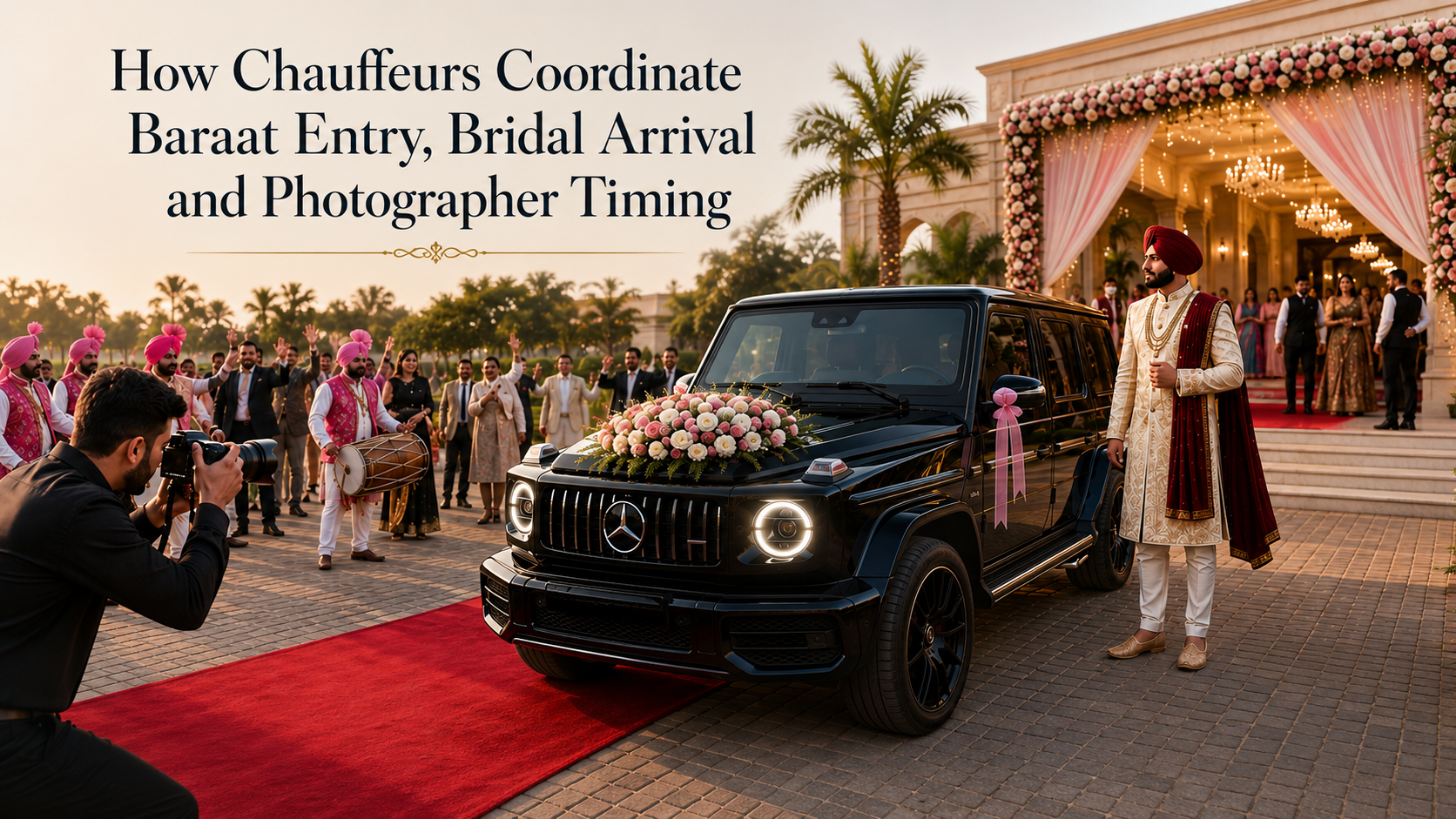
A photographer may see the groom's arrival as a thirty-second sequence. The family may see it as the moment the baraat reaches the venue. For the chauffeur, however, that same arrival may have started an hour earlier when the wedding car reported at the groom's home.
The vehicle has to be clean and correctly positioned before photography begins. The groom needs enough time to enter without being rushed. The route has to be followed at a realistic pace. The photographer may need to reach the venue before the groom. The family coordinator needs to know when the baraat is approaching. The venue entrance has to remain clear, and the chauffeur needs to know exactly where the car should stop.
The bridal side has its own timing chain. The bride may not be ready at the exact scheduled minute. Her outfit can require additional time when entering the car. The photographer may want portraits before departure. Gurudwara or reception access may differ from the groom's route, and doli later in the day can move significantly beyond the printed programme.
This is why chauffeur coordination at a Punjabi wedding is not simply a matter of driving from one location to another.
The best arrivals are usually the result of several people doing different jobs at the correct time. The photographer handles the visual sequence, the family coordinator manages the timetable, the venue prepares the entrance and the professional chauffeur makes sure the wedding car is where it needs to be without turning the journey into a rushed performance.
In Short
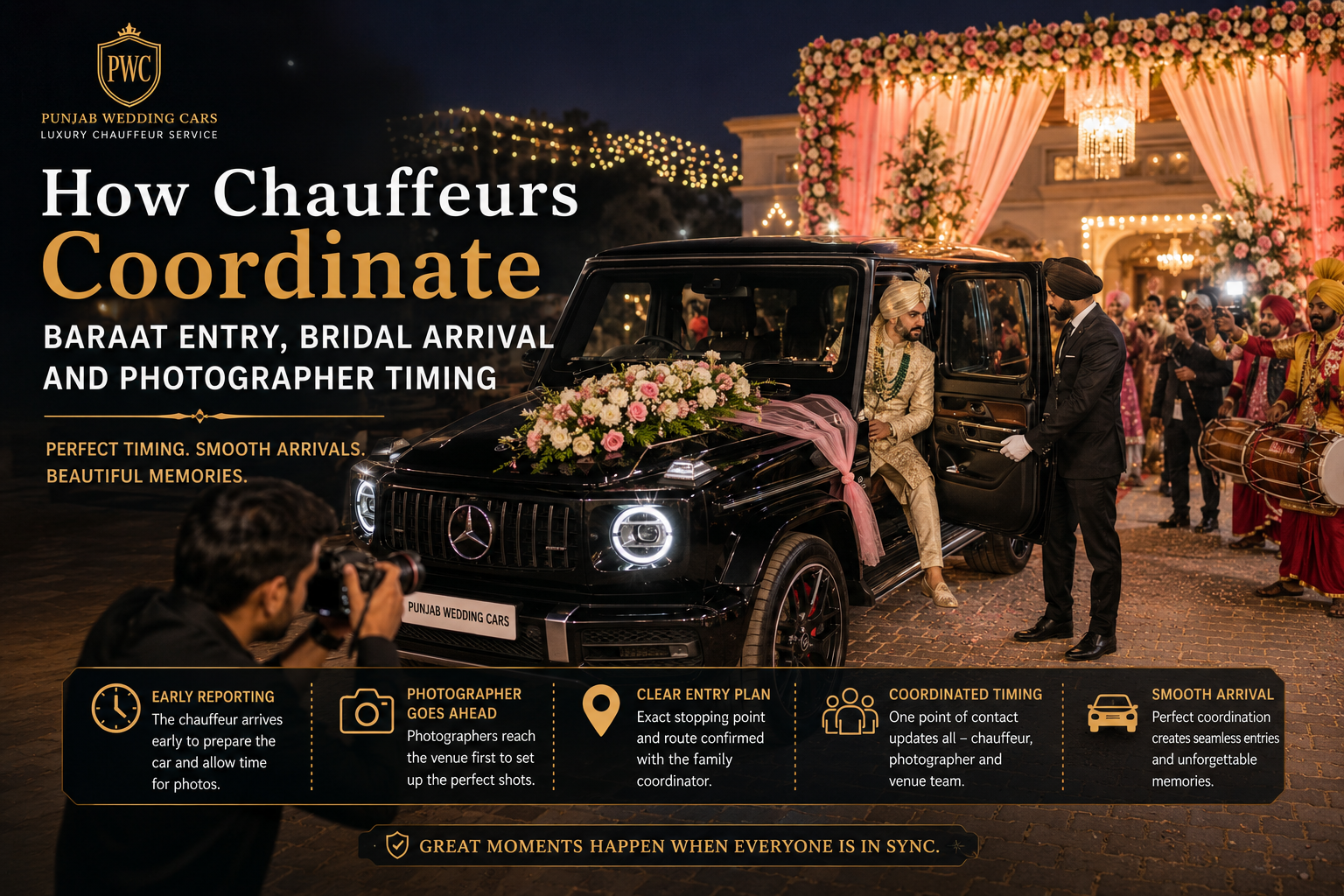
The chauffeur, photographer and family coordinator should agree on the movement of the principal wedding car before the arrival begins. The chauffeur needs the exact pickup, destination, reporting time and intended stopping point. The photographer should normally travel ahead of the groom or couple when an entrance photograph is important, while one family coordinator updates the venue when the car is approaching.
For bridal transport, the same principle applies with greater emphasis on privacy and flexibility. The vehicle should report before the bride is expected to leave, photography should be completed before departure where practical and the chauffeur should never pressure the bride because another part of the schedule is running late.
The photographer controls the frame, but the chauffeur controls the vehicle. Neither should attempt to do the other's job.
Reporting Time Comes Before Entry Timing
The first mistake in wedding-car coordination is treating departure time as chauffeur reporting time.
If the groom is supposed to leave home at 8:00 AM, the wedding car should not necessarily reach the property at 8:00 AM. The family may want photographs with the car before departure. Floral decoration may need a final check. The groom may still be completing Sehra Bandi. Parents and siblings may want photographs beside the vehicle, and the photographer may need enough time to create those images without delaying the actual journey.
The Punjab Wedding Cars guide on what time a wedding car should arrive from groom pickup through doli explains why reporting time and departure time should be treated separately.
That distinction is the foundation of good chauffeur and photographer coordination.
If the car reports early enough, photography has its own time.
If the car reports at the departure time, photography begins consuming road time.
The family then starts telling the chauffeur to hurry because twenty minutes reserved for travel disappeared before the car even moved.
The Groom Car Should Be Positioned for Photography Before the Groom Comes Outside
A luxury groom car should ideally be positioned before the groom is ready to approach it.
This is especially important with a statement vehicle such as the Mercedes G Wagon G63 AMG, New Range Rover Sport or Rolls-Royce.
If the chauffeur arrives while the groom is already standing outside with the photographer, everyone begins improvising. The car may be facing the wrong direction. Family vehicles may be blocking the background. Flower decoration may still need adjustment. The photographer may ask the chauffeur to reverse, move forward and turn several times while the family waits.
Early positioning avoids that.
The photographer can see the available light and background. The chauffeur can position the vehicle where it is practical and safe. Once the car is ready, the groom can come outside and the photography begins around a stationary vehicle rather than around an arrival that is still being organised.
This usually creates better photographs and a calmer departure.
The Photographer Should Explain the Shot Before Asking the Chauffeur to Move
Photographers and chauffeurs work much better together when instructions are specific.
“Move the car a little” can mean almost anything.
A more useful instruction explains whether the photographer wants the front of the vehicle facing the house, whether the groom will stand beside the driver's side, whether the car needs to move forward for the final departure shot or whether the photographer simply needs the chauffeur to clear the frame.
The chauffeur can then make one deliberate movement rather than repeatedly repositioning an expensive wedding car.
This matters particularly in busy family homes where children, relatives, catering vehicles and other cars may be moving around the same space.
Photography should fit around safe vehicle positioning.
The chauffeur should cooperate with the photographer, but the car should never be moved blindly simply because someone holding a camera asks for it.
Baraat Departure Should Have a Defined Start Point
A Punjabi baraat can become visually impressive very quickly, but it can also surround the groom's car before the vehicle has actually begun its journey.
Friends gather around the G Wagon.
Dhol starts.
Relatives begin recording videos.
Another luxury SUV is positioned directly behind the groom.
The chauffeur now has very little room to move.
A better system establishes where the car will be stationary for groom photography and where the actual road movement begins.
The groom can complete photographs at the first point. Once the family coordinator confirms that the baraat is ready, the chauffeur begins the journey from a clear path.
This small distinction protects the timing of the entire entry.
The family can still create all the energy and celebration it wants around the groom, but the chauffeur does not have to manoeuvre through a crowd that was unintentionally created around the car.
One Family Coordinator Should Communicate the Departure
The photographer should not decide when the baraat leaves.
The chauffeur should not decide.
Ten different relatives should not decide.
One family coordinator should confirm that the groom is ready and that the journey can begin.
The photographer may say that the photographs are complete. The groom's family may confirm that Sehra Bandi and other preparations are finished. The chauffeur may confirm the vehicle is ready.
The coordinator joins those pieces together and gives the final movement instruction.
This protects the chauffeur from contradictory directions and prevents the groom from being repeatedly asked whether he wants to leave.
The groom should be the principal passenger.
He should not be the person dispatching his own car.
Photographer Timing Should Be Built Into the Road Plan
One of the biggest coordination mistakes occurs when the photographer travels directly behind the groom's car all the way to the venue.
If the photographer needs to capture the groom arriving, somebody has to reach the destination first.
Following the groom's car may produce excellent road footage, but it can leave the photographer arriving at the venue at almost the same moment as the groom.
The photographer then jumps out, collects equipment and rushes towards the entrance while the chauffeur is already waiting.
A better plan divides the journey.
The photographer can capture departure and selected road footage, then move ahead when necessary so the team is ready at the final entrance.
The groom's car should not need to circle the venue because the photographer was travelling behind it.
A Second Photographer Makes Luxury-Car Arrivals Easier
Larger photography teams have a natural advantage when wedding-car movement is important.
One photographer or videographer can remain with the groom's side while another team member reaches the Gurudwara or reception earlier.
This allows both parts of the journey to be captured without asking the chauffeur to artificially delay the car.
Smaller photography teams can still achieve the same result by deciding which part of the sequence matters most.
They may photograph the groom leaving home and then depart ahead.
They may skip some road footage so they can prepare for the arrival.
The important point is that this decision should be made before the car begins moving.
The chauffeur should not be told halfway through the journey that the photographer needs twenty minutes to reach the destination first.
Do Not Ask the Chauffeur to Recover Photography Delays on the Road
If the groom photographs take fifteen minutes longer than planned, those fifteen minutes have been used.
The road journey should not suddenly become fifteen minutes faster.
This is one of the most important boundaries between photography and chauffeur service.
The photographer may need an additional shot.
The family may decide it is worthwhile.
That is completely reasonable.
The resulting delay should be absorbed into the wedding timetable rather than transferred into driving pressure.
A professional chauffeur should follow the route at an appropriate pace regardless of how long the photography took.
Good wedding scheduling protects enough road time that a beautiful portrait does not later produce an unsafe instruction to “reach quickly.”
Convoys Should Not Control the Principal Wedding Car
The single wedding car versus luxury convoy guide explains why a smaller, intentionally coordinated convoy can often work better than a large collection of unrelated vehicles.
This becomes particularly clear when photography is involved.
The groom's principal car needs room.
If six vehicles are positioned directly around a G Wagon because everybody wants to be visible in the arrival, the photographer may struggle to produce a clean frame.
The chauffeur may also lose the space needed to approach the intended stopping point.
Supporting cars can travel behind the groom without competing with the hero vehicle.
General guests can use the same destination independently.
The goal is not to keep every wedding car visible in every photograph.
The goal is to make the principal arrival look intentional.
The Chauffeur Should Know the Exact Baraat Stopping Point
“Reach the palace” is not enough for a planned groom entry.
The chauffeur should know whether the groom car is expected to stop outside the main gate, drive through a floral entrance, continue to a courtyard or wait at a staging point until dhol and photography are ready.
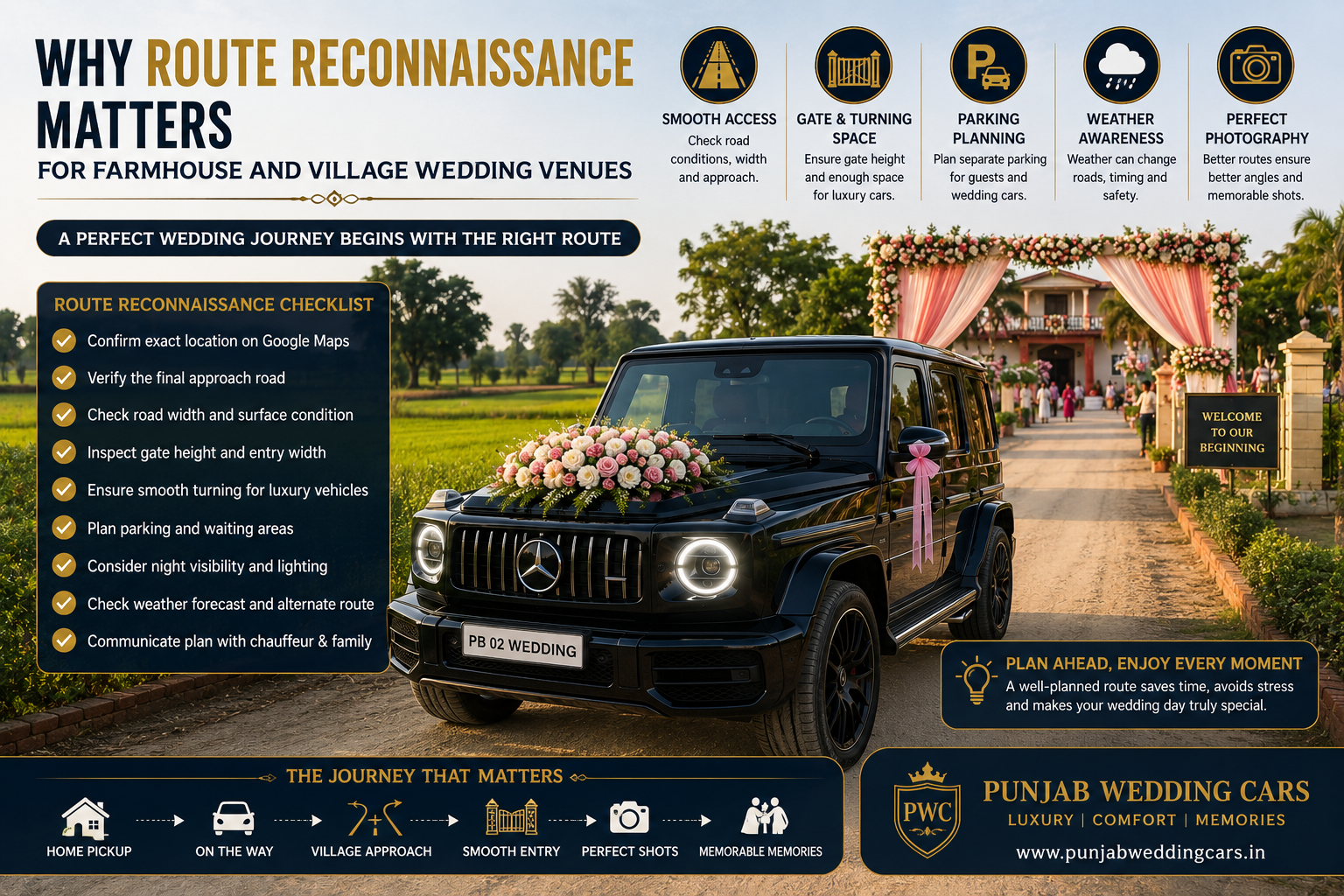
This becomes especially important at farmhouses and resorts where the main gate may be some distance from the actual ceremonial entrance.
If the stopping position matters for photography, a venue coordinator should confirm it before the car arrives.
A screenshot, map pin or simple message can be enough.
What matters is that the chauffeur does not discover the plan while the groom is sitting in the vehicle and hundreds of guests are watching.
A Staging Area Can Make a Dramatic Entry Much Easier
Large venues sometimes provide an opportunity for the groom car to wait briefly away from the main entrance.
That can be very useful.
The chauffeur reaches the staging area.
The family coordinator confirms the baraat is organised.
The photographer moves to the entrance.
Venue lighting is checked.
Dhol players are positioned.
The coordinator then tells the chauffeur to proceed.
The car enters once.
The photograph happens naturally.
The groom exits.
This is much stronger than the vehicle arriving unexpectedly, reversing out and trying the entrance again because nobody was ready.
A staging point does not need to be formal. It can simply be a safe area near the venue where the principal car can wait for a few minutes without blocking normal traffic.
The Chauffeur Should Not Be Asked to Repeat an Unsafe Entry
Photographers may occasionally want another take.
If the vehicle can be repositioned safely and the family genuinely wants to repeat a stationary movement, that can sometimes be discussed.
But a chauffeur should never be pressured to repeat a difficult road manoeuvre, reverse through a crowd or recreate an entrance where people have already surrounded the vehicle.
Wedding photography should document the arrival rather than turn a live road movement into a film set.
Planning creates the shot.
Repeating risky manoeuvres does not.
Bridal Arrival Needs a Different Type of Coordination
The bridal car usually requires less spectacle and more flexibility.
A bride may be leaving a family home, hotel, salon or makeup location. Her preparation may run later than expected, and entering the vehicle can take additional time because of her outfit.
The chauffeur should report before the expected departure and keep the car ready without making the bride feel she is holding everybody up.
The bride-side coordinator can communicate progress.
The photographer can plan portraits around the actual preparation status.
The chauffeur remains available.
This is very different from repeatedly calling the bride to ask whether she is ready.
A luxury bridal service should remove pressure from the bride, not create another countdown around her.
Maybach and Jaguar Bridal Photography Need Cabin Space Considered
A Mercedes-Maybach or Jaguar XJL can create elegant bridal photographs, but the photographer should remember that the bride's comfort comes first.
The rear door may be opened for a portrait.
The bride may sit briefly for photographs before departure.
Her lehenga or dupatta may need adjustment.
A family member may need to assist.
The chauffeur can help by keeping the vehicle correctly positioned and the door controlled, but the photography team should allow enough time for the bride to settle naturally.
The strongest photographs often come from a calm arrangement rather than repeatedly asking the bride to enter and exit the vehicle.
Bridal Privacy Should Influence Photographer Positioning
The bride's arrival is not automatically a public performance.
Some families want extensive coverage of the bride approaching Gurudwara Sahib.
Others prefer a quieter arrival.
The photographer, family coordinator and chauffeur should understand the intended style.
If privacy matters, the bridal vehicle can stop at a more controlled point rather than in the centre of a crowded entrance.
The photographer can already be waiting there.
The chauffeur opens the door.
The family assists the bride.
The photographs are taken without surrounding the vehicle with unnecessary people.
A beautiful arrival does not need a large audience.
Bride and Groom Cars Should Be Coordinated Separately
The bride and groom may be travelling to the same Anand Karaj, but their cars should not normally depend on one another.
The groom may require extensive home photography and a baraat entry.
The bride may have a quieter hotel or family-home departure.
One side may be ready earlier.
The other may be delayed.
The PWC guide to planning cars for Jaggo, Anand Karaj and reception recommends treating the bride's and groom's transport as separate timelines rather than expecting one vehicle movement to control the other.
Photographers should work the same way.
The groom car follows the groom schedule.
The bridal car follows the bride schedule.
They meet at the wedding because that is where the ceremony brings the two sides together.
Gurudwara Arrival Should Respect the Ceremony
Photographers naturally want the arrival, but the transport plan must also respect the Gurudwara environment and actual ceremony timing.
The groom's car should not remain blocking an active entrance simply because the photography team wants more shots.
The bridal vehicle should not be repeatedly repositioned around other families arriving for worship.
The chauffeur should use the confirmed parking and stopping arrangements.
Photographs can be created around those real movements.
Good wedding photography and respectful transport planning are compatible when everybody understands the location before the cars arrive.
The Photographer Should Know When the Car Will Move Again
After Anand Karaj, another timing decision begins.
Will the principal wedding car remain outside?
Will the groom use the same car to reach the reception?
Will the couple travel together?
Is the bridal car being held for doli later?
The photographer needs to know this because the next vehicle sequence may begin as soon as the ceremony finishes.
A common mistake is allowing the photography team to believe the car will remain indefinitely while the chauffeur has been instructed to reposition it.
One coordinator should keep everybody working from the same plan.
Reception Arrival Should Be Coordinated Before Leaving the Gurudwara
The reception is where photographer timing and chauffeur coordination become particularly visible.
The couple may be entering together in a Rolls-Royce, Maybach, G Wagon or Range Rover. Lighting may be prepared. Guests may gather around the entrance. The videographer may want the car arriving through a particular gate.
The time to organise that sequence is before the vehicle leaves for the reception.
The photographer or planner can confirm that somebody is already at the venue.
The chauffeur receives the correct entrance.
The family coordinator knows who is travelling in the car.
If a staging point will be used, that is also confirmed.
Then the vehicle begins the journey.
This avoids reaching the reception and having the couple sit inside the car while the entrance plan is discussed through the window.
Photographers Should Travel Ahead When the Reception Entry Matters
This rule is worth repeating because it solves so many wedding-car photography problems.
If the photograph is of the car arriving, the photographer needs to be there before the car.
The chauffeur should not need to slow dramatically on the final road simply because the photographer has not arrived.
The couple should not have to wait unnecessarily in a side street.
The photography team can leave earlier or send one person ahead.
A carefully timed entrance looks spontaneous precisely because the planning happened beforehand.
Venue Staff Should Keep the Arrival Lane Clear
Chauffeur coordination cannot solve a blocked entrance on its own.
The venue also has a role.
Guest cars, buses, valet vehicles and catering movement should not occupy the exact point where the principal wedding car is supposed to stop.
This matters more with large luxury vehicles and limousines that require additional manoeuvring space.
A family coordinator or planner should speak with the venue before the hero car approaches.
If the photographer wants the car centred under an entrance arch, that physical space has to exist when the vehicle reaches it.
The chauffeur cannot create space by simply arriving more confidently.
The Photographer Should Never Stand Where the Chauffeur Cannot See Them
Vehicle photography creates another simple safety issue.
Photographers frequently move backwards while concentrating through the camera.
At a wedding entrance, they may also crouch near the front or side of the vehicle.
The chauffeur needs to know where the photographer is.
The photographer should never assume that because the car is moving slowly, they can stand anywhere around it.
The safest arrangement is a clearly understood stopping point.
The chauffeur moves the vehicle into position.
The vehicle stops.
The photographer then takes the closer photographs.
Wedding cars look impressive standing still too.
Live Location Can Help the Photographer Prepare
The family's simple live-location system can be very useful for photographers.
A designated person travelling with the groom or couple can share the principal vehicle's live location with the transport coordinator. The coordinator can then tell the photography or venue team when the car is approaching.
This reduces repeated calls to the chauffeur.
The photographer does not need an exact second-by-second estimate.
They simply need enough warning to move into position.
If the groom car is still twenty minutes away, the photographer can continue working.
When it is approaching the final road, the entrance team gets ready.
Technology should make the coordination quieter.
Farmhouse Arrivals Need More Advance Planning
Farmhouses provide some of the strongest wedding-car photography opportunities in Punjab because the entrances can be large, landscaped and dramatically illuminated.
They can also create timing problems when everybody assumes the space will organise itself.
The correct gate needs to be known.
Guest parking needs to remain away from the principal entry.
The photographer needs to understand the final approach.
The chauffeur needs enough room to turn and position the vehicle.
If the route includes a narrow village approach, the car should not be delayed simply because the photography team expected it to reach the venue faster than the road allows.
Venue access should be included in the timing rather than treated as something that begins after arrival.
Weather Changes Photographer Timing Too
Winter fog, heavy rain or difficult road conditions affect more than the chauffeur.
They affect the photography plan.
The PWC guide to winter fog and morning Anand Karaj car timing recommends protecting separate preparation and road buffers so photography does not consume the time needed for careful driving.
That is exactly the correct approach.
If visibility requires slower travel, the photographer should not expect the car to maintain the original arrival minute regardless of conditions.
Likewise, rain may change where outdoor arrival photographs can be taken.
A flexible photography plan protects the journey.
Doli Photography Requires Patience From Everyone
Doli has one important characteristic: its exact time is often difficult to predict.
The printed programme may suggest one departure time, but family traditions, photographs and emotional farewells can move that time considerably.
The bridal vehicle should therefore report according to the agreed booking plan and remain properly positioned without becoming a source of pressure.
The photographer may want final family photographs with the car.
The family may need several minutes around the bride.
The chauffeur should stay ready.
The Bridal Doli Transport Checklist explains why the bridal reporting time and expected doli time should be considered separately.
That distinction allows the photography to happen without pretending the car will begin moving the moment it reaches the venue.
The Doli Car Should Be Positioned Before the Emotional Farewell Peaks
If possible, the bridal car should already be where it needs to be before the final doli sequence becomes crowded.
This means the chauffeur does not need to drive slowly through crying relatives and photographers while everybody is emotionally focused on the bride.
The vehicle can be checked, positioned and ready.
The photographer already knows its location.
The family then brings the bride to the car when the farewell reaches that stage.
This creates a much more controlled environment.
The bride can enter comfortably, the family can say goodbye and the chauffeur only begins moving when the coordinator confirms the journey should start.
Do Not Turn Doli Into a Repeated Film Take
A doli is a real family moment.
The bride should not repeatedly get in and out of the vehicle because somebody missed a shot.
Photographers can stage certain portraits before the emotional farewell begins, while the car is stationary and the bride is comfortable.
Once the real doli begins, the photography should document it.
The chauffeur should not be asked to pull away, reverse and repeat the departure through the family simply to recreate the scene.
There are moments where documentary photography is more appropriate than choreography.
Doli is one of them.
Late Doli Should Never Lead to Faster Driving
If the photography runs late and the doli finally begins well after the planned time, the chauffeur should still drive according to the actual road conditions.
A late departure changes the arrival time.
It does not change the safe speed of the journey.
This becomes particularly important when the couple is travelling between cities or towards a village after midnight.
The family should provide the final destination and receiving contact before departure so the chauffeur does not lose additional time asking for directions later.
The photographer's work ends when the car leaves.
The chauffeur's most important responsibility may only be beginning.
The Best Photographer-Chauffeur Relationship Is Cooperative, Not Competitive
Both professionals contribute to the wedding experience in different ways.
The photographer wants strong images.
The chauffeur wants a smooth, correctly timed and safe vehicle movement.
Those goals normally support each other.
A clean, well-positioned car creates a better photograph. A photographer who reaches the destination first prevents unnecessary waiting. A chauffeur who understands the intended stopping point makes the entrance easier to capture. A family coordinator who keeps both sides informed prevents conflicting instructions.
Problems appear when one person tries to control everything.
The photographer should not control driving decisions.
The chauffeur should not decide the photography schedule.
The bride and groom should not be forced to coordinate either professional.
One family or wedding coordinator should connect the two.
Good Coordination Makes the Arrival Look Effortless
The strongest groom entries often appear surprisingly simple.
The G Wagon reaches the entrance.
The photographer is already there.
The baraat has enough space.
The chauffeur stops at exactly the right point.
The groom steps out.
The cameras capture the moment.
Guests see a confident arrival.
What they do not see is that the car reported earlier for home photography, the photographer moved ahead during the journey, the family coordinator warned the venue that the groom was approaching and the chauffeur already knew where the vehicle needed to stop.
The same applies to bridal arrival.
The Maybach reaches the agreed point. The photographer is prepared. The chauffeur opens the door. The bride is given time to adjust her outfit, and the family helps her out without a crowd forcing the process.
Good coordination disappears into the final result.
The Car Creates the Scene, but Timing Creates the Photograph
Punjab Wedding Cars offers chauffeur-driven options through its luxury wedding-car fleet, including vehicles suited to dramatic groom arrivals, refined bridal travel and premium couple entries.
But even the most impressive wedding car cannot create a polished arrival if the people around it are working on different schedules.
The chauffeur needs the route and stopping point. The photographer needs enough time to get ahead. The venue needs to keep the entrance usable. The family coordinator needs to communicate when the car is moving, and the bride or groom needs to remain free from managing those details personally.
When those responsibilities are clear, the photographer does not chase the car, the chauffeur does not wait for the photographer, the groom is not answering timing calls and the bride is not rushed into her vehicle.
The arrival happens once, at the right place, with the right people ready for it.
That is exactly how a wedding-car entrance should feel: natural to the couple, impressive to the guests and completely predictable to the professionals who coordinated it.