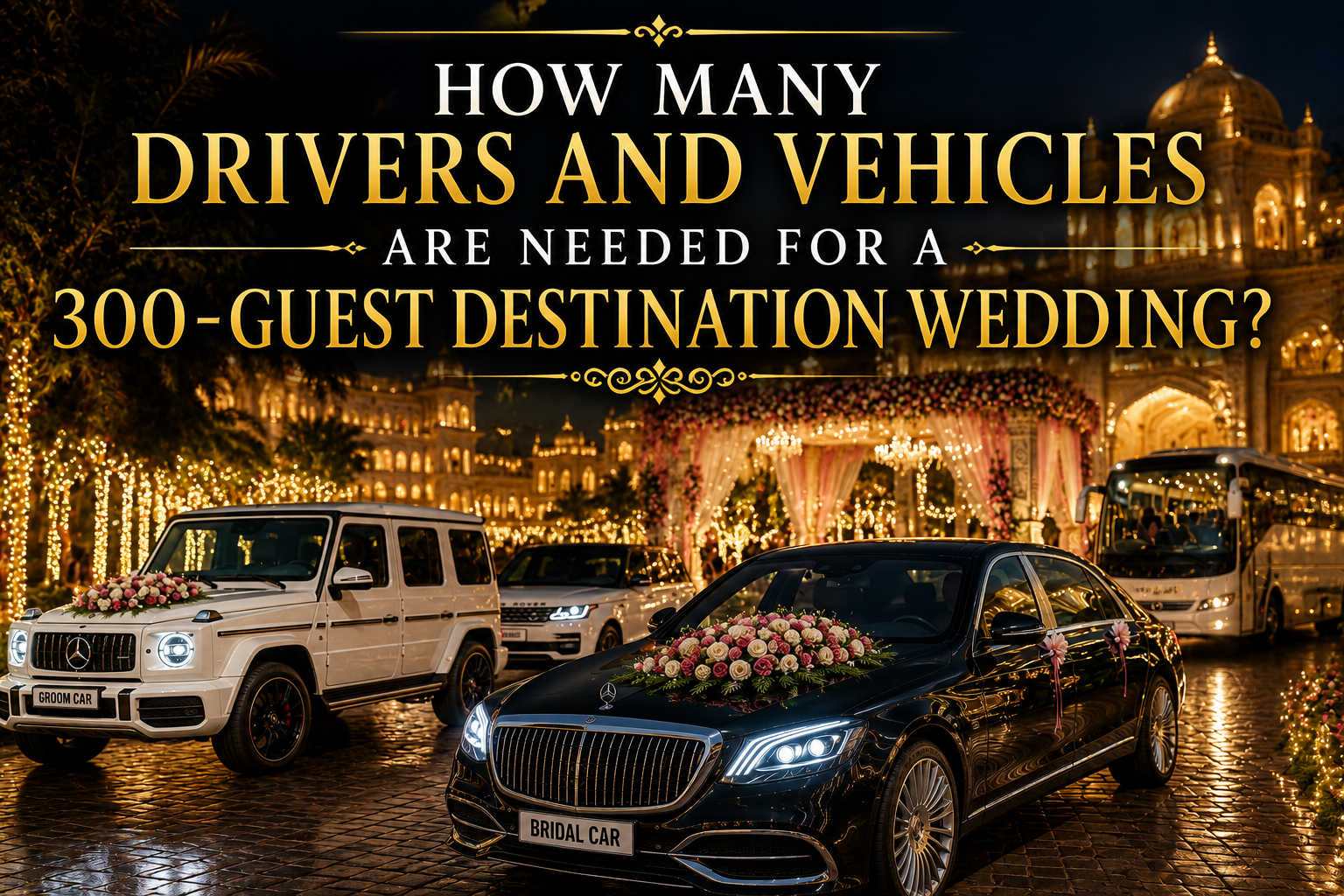
How Many Drivers and Vehicles Are Needed for a 300-Guest Destination Wedding?
A 300-guest destination wedding does not need 300 seats moving at the same time simply because 300 names appear on the guest list. Some relatives may arrive in their own cars, several guests may stay directly at the wedding resort, local family may travel independently, while overseas guests staying at hotels may require organised transportation for almost every function. The real vehicle requirement comes from understanding who actually needs transport, where they are staying, when they move and whether everyone is travelling at the same time.
This is why calculating destination-wedding transport by dividing 300 guests by four seats in a luxury car gives a completely unrealistic answer. Moving 300 people entirely in four-passenger cars would theoretically require around 75 vehicles for one simultaneous journey, before accounting for the bride, groom, chauffeurs, photographers or luggage. A sensible 300-guest wedding therefore uses a layered transport system. High-capacity shuttles or group vehicles handle the main guest movement, while chauffeur-driven luxury cars remain reserved for the bride, groom, parents, grandparents, VIP relatives and other passengers whose schedule or role genuinely justifies an individual vehicle.
Punjab Wedding Cars already treats NRI hotel movement as a separate transport system from the bride and groom's ceremonial cars. Its current hotel-shuttle guidance recommends planning from the hotel rather than from the wedding venue and keeping the couple's luxury vehicles separate from general guest movement. Punjab Wedding Cars' current fleet contains 20+ chauffeur-driven luxury vehicles, including Mercedes-Maybach, G Wagon G63 AMG, New Range Rover Sport, Rolls-Royce Ghost, Jaguar XJL and Audi A6, while the broader service covers airport transfers, bridal cars, baraat convoys and guest movement across Punjab.
For most 300-guest destination weddings, the practical answer is therefore not one exact number. A well-designed operation may need roughly 12 to 20 active vehicles during the main wedding movement, depending on how many guests require organised transport and the capacity of the shuttle vehicles being used. Each active vehicle normally needs its own driver, while larger weddings should also have spare driving capacity or a separate relief plan for airport transfers and late-night duties. The number becomes much clearer once the guest list is divided into transport groups.
Start With the Guests Who Actually Need Wedding Transport
The first useful calculation is not 300 guests. It is the number of guests who cannot reasonably reach the wedding functions on their own.
Imagine a 300-person Punjab destination wedding where 90 local relatives arrive independently, 30 family members are already staying at or very close to the resort, and the remaining 180 guests are staying across two hotels. The transport operation does not need to move all 300 people from the hotel. It needs to move approximately 180 guests during the main hotel-to-ceremony journey while separately handling the bride, groom, parents, senior family and other special movements.
That is already a very different planning problem.
Another 300-guest wedding may consist almost entirely of NRI relatives flying into Punjab and staying in one large hotel. In that case, perhaps 250 or more guests require organised movement. The number of shuttle vehicles rises considerably even though the guest count is identical.
This is why Punjab Wedding Cars' current NRI hotel-shuttle guidance recommends beginning with the hotel list and actual passenger groups rather than assuming every wedding guest requires the same transport.
A 300-Guest Wedding Should Use Transport Layers
The bride's Maybach should not be collecting six cousins from a hotel. The groom's G Wagon should not be making airport runs on the morning of the baraat. A Range Rover intended for grandparents should not become overflow transport because a guest shuttle was filled beyond its planned capacity.
A destination wedding works better when vehicles are assigned in layers according to their responsibility.
The main guest layer moves larger groups between hotels, Gurudwaras, resorts and receptions. A smaller premium guest layer handles elderly relatives, close family and VIP passengers who require more flexible timing. The ceremonial layer contains the bride and groom's cars. A separate operational layer may be needed for photographers, makeup teams, coordinators and bridal luggage.
Once these layers exist, the vehicle count becomes manageable.
Trying to make every car perform every job usually increases the number of movements without improving the wedding experience.
If 180 Guests Need Hotel Transport, How Many Shuttle Vehicles Are Required?
Consider the example of 180 hotel-based guests.
If a family uses vehicles with approximately forty usable passenger seats, five such vehicles provide roughly 200 seats and therefore enough capacity to move the entire group without filling every seat. If the available vehicles carry closer to thirty passengers each, six vehicles provide about 180 seats, although having absolutely no spare capacity is rarely ideal.
The better target is usually a little more seating capacity than the exact passenger count.
Guests change vehicles. Somebody brings a child unexpectedly. An elderly relative needs a different seat. A family group decides at the last minute that it wants to travel together. Building exactly 180 seats for 180 passengers can therefore create unnecessary pressure.
For roughly 180 organised guests, around five to seven group shuttle vehicles can be a practical starting range depending on vehicle size. These would normally require the same number of dedicated drivers during the main hotel movement.
That number does not include the bride, groom or luxury family cars.
If All 300 Guests Need Organised Transport, the Operation Changes Completely
A destination wedding where nearly all 300 guests are staying away from the ceremony venue should be treated as a substantial guest-movement operation.
Using forty-seat group vehicles, approximately eight vehicles can theoretically move 320 passengers. Using smaller thirty-seat vehicles could require around ten or eleven vehicles once some reserve capacity is included.
The exact capacity should be confirmed with the actual shuttle supplier because advertised seating and comfortable wedding seating are not always the same thing, especially when guests are carrying handbags, shawls, children's items or small pieces of luggage.
The most important planning principle is that the luxury wedding fleet should not be expected to replace this high-capacity system.
Punjab Wedding Cars' premium fleet is much better used for the principal wedding passengers. Its current fleet has 20+ chauffeur-driven luxury vehicles, and the company's own guest-shuttle guidance recommends selecting vehicles according to the passenger group rather than using ceremonial wedding cars for every movement.
For a 300-person wedding where almost everybody needs transportation, the complete operation may therefore contain approximately eight to eleven group shuttles plus another six to ten premium and operational vehicles.
That brings the active vehicle requirement into roughly the 14-to-21-vehicle range for the busiest movement.
The Bride and Groom Should Still Have Dedicated Cars
The bride and groom should remain outside the main guest-transport calculation.
A Mercedes G Wagon G63 AMG may be selected for the groom's photography, baraat departure and resort entry, while the Mercedes-Maybach remains dedicated to the bride and later becomes the principal couple car.
These vehicles should have their own chauffeurs and schedules.
If a 300-guest hotel shuttle leaves fifteen minutes late because several guests are still coming downstairs, that should not automatically make the groom's G Wagon late. Likewise, a delayed guest departure should not cause the bride's Maybach to be diverted to another hotel.
The two hero vehicles should be treated as protected assignments.
This adds at least two vehicles and two professional chauffeurs to the transport count.
Parents Usually Need Their Own Cars
The bride's and groom's parents rarely follow exactly the same schedule as the couple.
The groom's parents may reach the Gurudwara before the baraat. The bride's parents may remain behind after doli. Grandparents may want to leave the reception earlier than younger relatives.
For a 300-guest destination wedding, it is sensible to consider at least two to four additional chauffeur-driven family cars around these senior passengers.
An Audi A6, Jaguar XJL, Range Rover or another premium vehicle can provide a much more useful family service than asking parents to follow the main shuttle schedule.
Punjab Wedding Cars' current NRI hotel-shuttle guide also recommends considering independent transport for parents and grandparents rather than assuming that every relative should travel with the main guest group.
A realistic 300-person wedding can therefore already have two hero cars and perhaps three parent or senior-family vehicles before the general guest shuttles are counted.
Elderly Guests Should Not Be Forced Into One Large Shuttle Schedule
A destination wedding guest list may contain twenty or thirty elderly relatives even though the overall guest count is much larger.
These passengers may require a different arrival time. Some want to reach Gurudwara Sahib early and avoid the larger hotel crowd. Others may need more time entering and leaving vehicles. Several may prefer to return to the hotel after dinner rather than remain through a 1:00 AM doli.
Giving selected elderly relatives dedicated cars or premium SUVs can reduce pressure on the main shuttle operation.
This does not necessarily mean one luxury car for every elderly couple. Several relatives with compatible schedules may travel together in an appropriately sized vehicle.
The objective is independence from the large guest schedule.
For a 300-person wedding, two or three additional vehicles dedicated to elderly or VIP relatives can often provide far more value than adding another ceremonial car that has no clear passenger.
Airport Transportation Is a Separate Driver Calculation
Destination weddings frequently create transport requirements several days before the main ceremony.
International guests may arrive through Sri Guru Ram Dass Jee International Airport in Amritsar, Shaheed Bhagat Singh International Airport serving Chandigarh and Mohali, or Delhi Airport. Punjab Wedding Cars currently provides airport and destination-wedding transfer services and specifically mentions airport coordination for NRI families.
The important point is that airport drivers should not simply be counted as wedding-day drivers.
A chauffeur who completed a long Delhi-to-Punjab transfer overnight should not automatically be treated as available for an early-morning wedding shuttle without proper duty planning. Similarly, an airport car delayed because an international flight arrived late should not be the vehicle the groom is expecting for his baraat.
A 300-guest destination wedding may therefore require another set of rotating airport-transfer vehicles during the days before the wedding.
These vehicles may not all be active during the main wedding ceremony, but the transport coordinator still needs to plan the drivers across the entire wedding week.
Do Not Use One Driver From Airport Pickup Until Late Doli
Driver count becomes more complicated once duty length is considered.
A vehicle may be physically available for eighteen hours, but that does not mean one chauffeur should be expected to operate the complete period from morning airport transfers through a late-night return.
Destination-wedding transport should account for chauffeur rest and duty structure, particularly when long intercity driving is involved.
For the principal wedding movement, the cleanest assumption is usually one dedicated driver per active vehicle. If fifteen vehicles are simultaneously moving passengers, plan for fifteen active drivers.
The larger operation should then have relief capacity rather than expecting every chauffeur to remain on duty for every stage of the wedding week.
For a 300-guest destination wedding using approximately fourteen to twenty active vehicles, having another two or three reserve, relief or operational drivers available within the wider transport plan can provide useful resilience, depending on the supplier mix and route lengths.
The exact staffing arrangement belongs with the transport providers, but families should verify that late-night movements are not being built around chauffeurs who have already completed excessive earlier duties.
Makeup Artists and Photographers Need Transport Too
A common counting mistake is putting all 300 guest names into the transport spreadsheet while forgetting the professionals working at the wedding.
The bride's makeup team may need to report before sunrise. Photographers can begin at the bride's and groom's hotels in different locations. Videographers may need to reach the reception before the couple. Wedding planners may move repeatedly between the ceremony venue and hotel.
These passengers are not guests, but they still use roads and vehicles.
The photographer should usually have independent transport if the team needs to move ahead of the bride or groom for arrival photographs. Putting the main photographer inside the Maybach makes it impossible for that person to photograph the Maybach arriving.
A 300-guest destination wedding can therefore justify one or two dedicated operational vehicles for the photography, planner or production team.
These vehicles should not be confused with guest shuttles.
Bridal Luggage Needs Capacity, Not Another Maybach
A destination wedding creates considerably more luggage than a normal local ceremony.
The bride may have several outfit bags, reception clothing, footwear, jewellery cases and personal belongings. NRI families may be moving large suitcases between hotels and the final home. Gifts can also accumulate through the wedding week.
The Mercedes-Maybach should not become the luggage vehicle simply because it is travelling towards the same destination.
A separate support SUV or luggage vehicle can travel with the bridal car, especially during the final doli. This protects the bride's rear-cabin space and prevents the chauffeur from spending twenty minutes reorganising suitcases while the farewell is already underway.
For a 300-guest destination wedding, luggage movement should be planned independently from passenger seating.
One Hotel Can Reduce the Number of Vehicles Dramatically
Where guests stay can be more important than the total guest count.
Imagine 180 transported guests split between four hotels. Even if the total number of seats remains the same, the shuttle fleet must now report to four starting points. Vehicles may leave at different times, coordination becomes harder and some routes may overlap inefficiently.
Put the same 180 guests into one large hotel and the transport becomes much simpler.
Five or six vehicles can line up at one entrance, passengers can be checked against one departure schedule, and every chauffeur receives the same first destination.
Punjab Wedding Cars' current NRI hotel-shuttle guide specifically recommends using hotels as clear transport hubs and treating each separate hotel as its own pickup point.
For destination weddings where transport efficiency matters, hotel concentration can reduce operational complexity more effectively than adding more cars.
Two Hotels Need Two Departure Captains
When guests are split between two major hotels, each property should have one person responsible for departures.
That person does not need to drive or manage the chauffeurs. Their job is to know which guest group belongs in which vehicle and whether everyone expected on that departure has reached the lobby.
Without this system, the driver receives questions that belong with the family. One guest says another cousin is still upstairs. Somebody wants the shuttle to wait. Another relative believes they were assigned to a different vehicle.
A chauffeur should be concentrating on the road and reporting schedule.
A destination wedding with 300 guests usually benefits from at least one transport coordinator at the central level and one pickup captain at every major hotel.
These people are not drivers, but the vehicle fleet works much better because of them.
The Ceremony Shuttle and Reception Shuttle May Need Different Counts
A family should not assume that the same number of guests attends every function.
Perhaps 250 people attend Anand Karaj, while the evening reception expands to all 300 guests because additional local relatives join later.
The hotel shuttle requirement therefore changes.
Some guests may also return to their rooms between the ceremony and reception, while others travel directly to the next venue.
The vehicles should be counted against each movement separately.
The largest movement of the day determines the maximum fleet required, but smaller movements can use fewer vehicles.
This is one of the biggest advantages of creating a detailed guest manifest rather than reserving ten shuttles for the entire day without understanding when they are actually needed.
Late-Night Returns Usually Require More Flexibility Than Morning Departures
Getting 180 guests from a hotel to Gurudwara Sahib in the morning can be relatively straightforward because everybody has one departure window.
Returning those guests after a reception is more complicated.
Grandparents may leave at 10:00 PM. Families with children may leave at 11:00 PM. Close relatives may remain through doli until 1:30 AM.
If the shuttle plan provides only one final departure, many guests become trapped at the venue longer than they want.
A better approach uses staged returns.
Some vehicles can leave earlier and return if the hotel is reasonably close, while others remain for the later group. When the distance is long, the family may need enough vehicles to cover different departure windows without relying on repeated round trips.
The late-night return plan can therefore require more careful driver allocation even if the total number of vehicles is unchanged.
Do Not Keep 300 Guests Waiting for One Bride or Groom Car
The main guest shuttles and hero wedding cars should operate independently.
If the bride's photographs run forty minutes late, there is no reason for six guest vehicles full of passengers to remain outside a hotel waiting for the Maybach.
If the groom's baraat departure is delayed, guests already travelling directly to the Gurudwara can continue according to their own schedule.
This is another reason to assign clear roles.
The guest fleet handles guests. The G Wagon handles the groom. The Maybach handles the bride or couple. Parent cars handle parents. The support vehicle handles luggage.
A destination wedding becomes manageable when each vehicle has one obvious responsibility.
A 300-Guest Wedding Does Not Need Twenty Luxury Cars
Large weddings can create pressure to make the car fleet look as large as the guest list.
That usually adds cost without improving logistics.
Punjab Wedding Cars' current service page says it can provide individual bridal vehicles as well as baraat convoys of multiple luxury cars, while the current fleet contains 20+ chauffeur-driven vehicles. A destination wedding can certainly use several premium cars when the family genuinely wants a convoy.
The transport requirement should still be distinguished from the visual requirement.
A five-car luxury convoy may be part of the groom's entrance, but those five cars do not replace high-capacity guest transportation for 180 hotel passengers.
Likewise, a large guest shuttle fleet does not replace the couple's Maybach or G Wagon.
Both systems solve different problems.
A Practical 300-Guest Example
Consider a destination wedding with 300 total guests. Around 100 are local and travelling independently. Another 20 stay directly at the resort, leaving approximately 180 people requiring hotel transportation from two properties.
The family might use approximately five or six high-capacity guest shuttles depending on their seating configuration. The groom has one G Wagon and the bride has one Maybach. Two premium cars are assigned to the parents, while another two vehicles serve grandparents and senior NRI relatives. One support SUV handles bridal luggage and another operational car supports photographers or planners.
This produces roughly thirteen to fifteen active vehicles around the important wedding movements, with approximately the same number of active drivers.
The transport operation may then maintain additional relief or reserve driving capacity for the longer wedding day and airport work.
That is far more realistic than trying to organise seventy-five individual cars for 300 passengers.
A Second 300-Guest Example With Nearly Everyone in Hotels
Now consider a full destination wedding where 270 of the 300 guests stay at hotels and almost everyone requires organised transportation.
The high-capacity side of the fleet might now require around seven to ten vehicles depending on actual seating. The couple still needs two principal cars before the ceremony, while parents, grandparents and VIPs may use another four to six premium vehicles. Add one or two support vehicles for photographers, planners and luggage.
The busiest movement can therefore involve approximately fifteen to twenty vehicles and fifteen to twenty active drivers.
The exact count could be lower if the general shuttles have greater capacity or if several VIP groups comfortably share premium vehicles. It could be higher if guests are divided across many hotels or if several functions occur simultaneously in different places.
This is why there is no credible fixed answer such as “300 guests need exactly 18 cars.”
The logistics determine the number.
Build a Small Reserve Into the Plan
A 300-guest wedding should not run at one hundred percent capacity everywhere.
If every guest shuttle is completely full and one vehicle develops an operational problem, the family has nowhere to redistribute the passengers.
Likewise, if every luxury car has exactly one critical movement with no schedule margin, one flight delay or venue change can affect several parts of the wedding.
Some reserve capacity should exist either through spare seating, an available backup vehicle or a provider contingency arrangement.
Punjab Wedding Cars' broad active fleet and chauffeur-driven model make contingency planning easier for luxury-car requirements because the company currently operates more than twenty vehicles across different categories. General guest-shuttle providers should be asked the same operational question: what happens if one vehicle cannot complete the duty?
Backup planning matters more as the guest count rises.
Drivers Should Receive Routes, Not Just Venue Names
Once the vehicle count reaches fifteen or more, the family cannot coordinate through verbal instructions given individually on the wedding morning.
Each driver should know the hotel or pickup, first destination, next destination, expected waiting requirement and final release point.
Punjab Wedding Cars' current NRI guidance stresses the use of exact hotel entrances, Gurudwara locations, marriage palaces and return points rather than descriptions such as “near the bypass.”
The same principle should apply across the entire transport fleet.
A driver receiving the complete route before departure is more useful than a driver receiving repeated phone calls from relatives after passengers are already inside.
One Master Transport Sheet Can Run the Whole Wedding
A 300-guest destination wedding benefits from one master transport schedule containing each vehicle's identifier, driver contact, capacity, hotel or pickup point, passenger group, reporting time, departure time, first destination, next responsibility and expected release.
This should remain an operational document rather than being shared with all 300 guests.
Guests need much simpler instructions. They should know which hotel pickup point they use and when they need to be there.
The wedding planner or transport coordinator uses the full sheet.
The driver receives the relevant route.
The guest receives the relevant departure.
Keeping those layers separate makes the operation feel far simpler than the number of vehicles suggests.
So How Many Drivers and Vehicles Should You Actually Plan?
For a typical 300-guest Punjab destination wedding where many local guests provide their own transportation and around 150 to 200 guests require organised hotel movement, a practical starting point can be approximately five to seven high-capacity guest shuttles plus seven to nine premium and operational vehicles. That produces roughly 12 to 16 active vehicles and drivers during the busiest movement.
For a wedding where nearly all 300 guests require organised transport, the requirement can move closer to eight to eleven high-capacity shuttles plus seven to ten premium, family and operational vehicles, producing approximately 15 to 21 active vehicles and drivers.
These figures should be treated as planning ranges rather than fixed formulas because the actual seating capacities, hotel locations, number of functions and passenger schedules can change the answer substantially.
The larger transport operation should also have relief or contingency capacity for long airport duties and late-night returns rather than expecting every driver to work every stage.
The Best 300-Guest Transport Plan Feels Smaller Than It Is
Good destination-wedding transportation should not feel like managing twenty vehicles even when twenty vehicles are operating.
The NRI guest only knows which shuttle collects them from the hotel. The groom sees his G Wagon already positioned for the baraat. The bride finds her Maybach prepared for her departure. Parents have their own chauffeur and do not depend on the hotel shuttle. Grandparents can return early when they are tired. The photographer has a vehicle that allows the camera team to reach the reception before the couple, while bridal luggage is already travelling separately.
Punjab Wedding Cars currently provides 20+ chauffeur-driven luxury vehicles across Punjab and offers bridal cars, groom and baraat vehicles, airport transfers and VIP guest transportation. Its current NRI hotel-shuttle guidance also recommends treating hotel guest movement as its own coordinated system rather than mixing those passengers into the bride and groom's ceremonial cars.
That is the principle that makes a 300-person destination wedding manageable.
Do not ask how many cars are required for 300 people until you know how many of those people genuinely need a ride.
Separate general guests from VIP passengers. Separate airport work from wedding-day movements. Keep the bride and groom's vehicles protected. Give parents and grandparents enough independence. Count photographers, planners and luggage. Plan late-night return waves rather than one final departure, and make sure each active vehicle has a dedicated driver whose duty has been planned realistically.
Once those pieces are separated, a 300-guest destination wedding stops looking like one enormous transport problem.
It becomes several smaller passenger groups, each with the correct vehicle, chauffeur, pickup point and time.