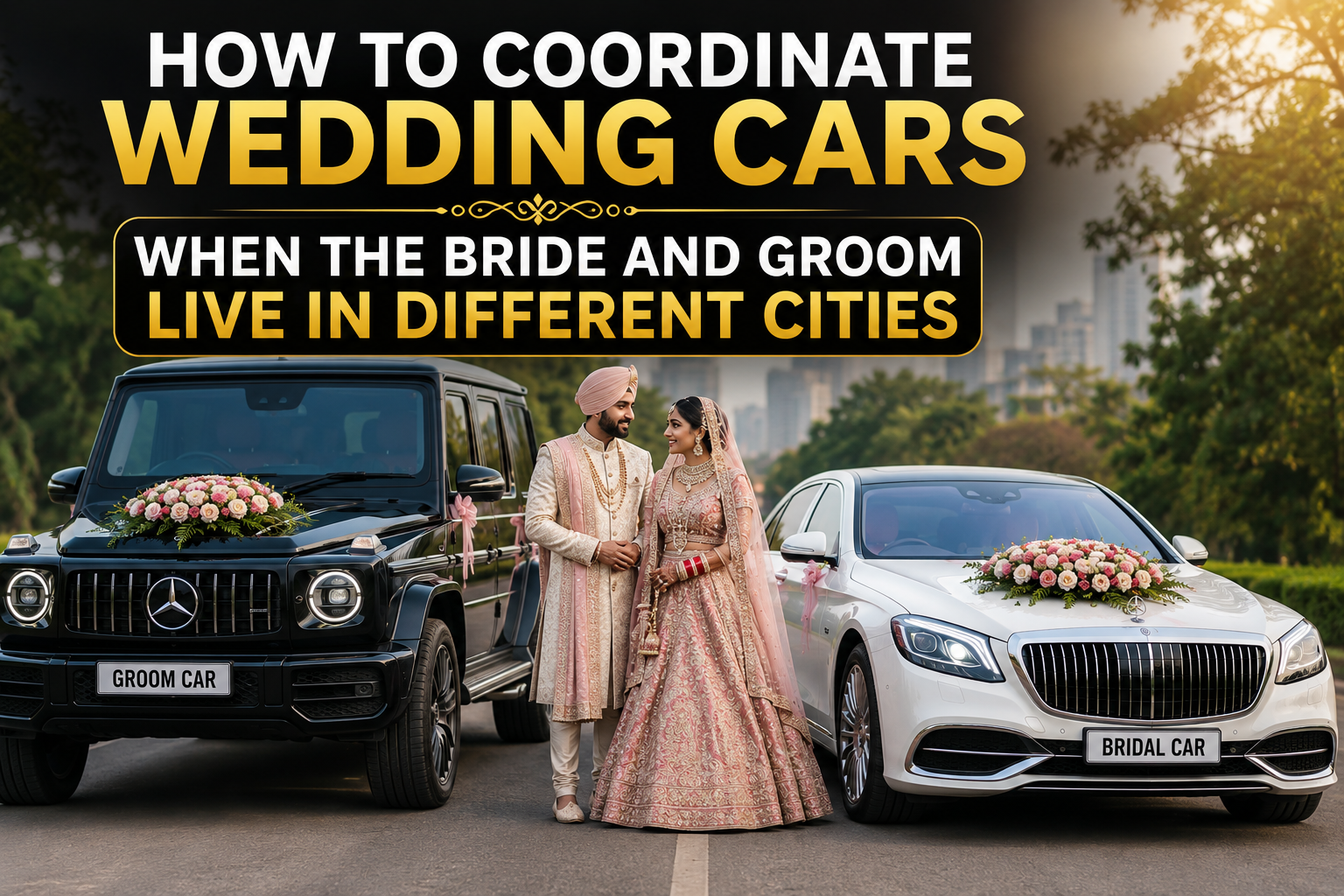
How to Coordinate Wedding Cars When the Bride and Groom Live in Different Cities
When the bride and groom live in different cities, wedding-car planning becomes much more than arranging one groom car and one bridal car. The groom may start in Jalandhar while the bride is getting ready in Ludhiana. The Anand Karaj may be held somewhere between the two families, the reception may be closer to one side, and the final doli may take the couple into another city or village altogether. Parents, photographers, bridesmaids, luggage and close relatives can all be moving at different times, which means the wedding transport has to be planned as one connected journey rather than as separate bookings made by each family.
Punjab weddings make this especially important because the bride and groom frequently begin the day in completely different districts. One side may be travelling from Amritsar towards Jalandhar, another from Phagwara towards Ludhiana, or the couple may be moving between Patiala, Mohali, Chandigarh and nearby towns. Punjab Wedding Cars' own inter-district planning guidance recommends mapping the couple's complete journey first because the movement between two family locations often becomes more complicated than either individual ceremony or reception.
The easiest way to keep such a wedding organised is to stop thinking of the bride's car and groom's car as two isolated reservations. Each vehicle should have a clear duty before the ceremony, the exact meeting point should be understood, and the family should know what happens to both cars once the bride and groom begin travelling together.
In Short
When the bride and groom live in different cities, the groom's car and bridal car should initially be planned independently because both sides have separate reporting times, routes, photography requirements and family schedules. The transport plan should then identify the first point where their journeys meet, usually the Gurudwara, ceremony venue or reception. Once the couple begins travelling to the same next destination, it is often simpler to choose one principal couple car and let the other hero vehicle complete its duty unless it has another genuine role. Exact pickup and final drop pins, realistic intercity travel time, separate support vehicles for luggage and relatives, and clear photographer movement are much more important than simply knowing the names of the two cities.
Start With Two Complete Wedding-Day Timelines
The bride's timeline and groom's timeline should be written separately before anybody decides how many cars are required. The groom may have sehra bandi at home, photography with the G Wagon, a baraat departure and an intercity drive towards the ceremony. At the same time, the bride may be travelling from a hotel to a makeup location, returning to her home, moving to Gurudwara Sahib in a Maybach and later continuing towards the reception.
Those journeys can look completely different even though they eventually end at the same ceremony. Punjab Wedding Cars' bridal-party transport guidance recommends mapping the bride's complete day before deciding who travels with her and which belongings require separate transport. The same principle works equally well for the groom.
Once both timelines are visible, the family can identify where the two sides actually overlap. That point may be the Gurudwara, a marriage palace or the couple's first shared journey after Anand Karaj. This is the point where the transport plan can begin becoming simpler.
The Exact Home Address Matters More Than the City Name
Saying that the groom is travelling from Jalandhar to Ludhiana may sound like enough information for a quotation, but it often is not. His home could be in central Jalandhar, on the outskirts, or in a village that adds a substantial local-road section before the intercity journey begins. The bride's destination may similarly be a hotel, farmhouse or village several kilometres beyond the city boundary.
Punjab Wedding Cars' current guidance on intercity quotations specifically explains that the real pickup and final drop can change the route significantly and that a city name alone does not describe the full duty.
This becomes even more important when both sides are coming from different directions. If the groom's chauffeur is given only “Ludhiana wedding” while the bride's side has an exact Gurudwara pin, one half of the transport plan is far more reliable than the other.
Both families should share the complete addresses and current map pins before the vehicles are assigned.
The Groom's Car Should Be Planned Around His Own City First
The groom's principal car has its own responsibilities before it ever meets the bride.
A Mercedes G Wagon G63 AMG may need to report early enough for portraits, be positioned before the baraat gathers and then travel across the intercity route. If the groom is leaving from Amritsar for a ceremony near Jalandhar, the booking should reflect the real pickup, photography time and road journey rather than only the ceremonial arrival.
The same applies if the groom chooses a New Range Rover Sport. The SUV may be visually important at the home and reception, but it still needs a realistic departure time between those moments.
The photographer should also know whether they are travelling with the groom's side or moving ahead separately. If the photography team reaches the ceremony at the same time as the groom, the G Wagon may end up waiting while cameras are unpacked and the entrance shot is organised.
A better plan sends at least one photographer ahead when the arrival itself matters.
The Bride's Car Should Remain Focused on the Bride
The bride's transport requirement is normally different from the groom's even when both are travelling similar distances.
A Mercedes-Maybach, Rolls-Royce Ghost or Jaguar XJL may be selected around bridal comfort rather than baraat presence. The bride may need more time entering and exiting because of her lehenga, while makeup and photography can create additional delays before departure.
The bridal car should therefore not be used to solve unrelated family movements simply because the groom's side is travelling from another city. Bridesmaids, makeup equipment and larger luggage can use separate support transportation rather than filling the bride's principal vehicle. Punjab Wedding Cars' current bridal-party guidance specifically recommends keeping the bridal car focused on the bride and arranging supporting passengers and equipment around it.
This becomes even more important in an intercity wedding because the bride may spend a significant amount of time in the rear cabin.
Do Not Try to Synchronise Two Cities Minute by Minute
Families sometimes create an extremely tight plan in which the groom leaves one city at exactly 7:15 AM, the bride leaves another at 7:25 AM and both are expected to reach Gurudwara Sahib at nearly the same minute.
That looks organised on a spreadsheet but can become fragile on the road.
Traffic, family photography, getting-ready delays and local pickup conditions can affect the two sides differently. The better objective is not perfect simultaneous arrival. It is creating appropriate arrival windows.
The groom may need to reach first because the baraat has its own sequence before the ceremony. The bride may have a quieter arrival later. The family should work backwards from the ceremony requirements rather than trying to make two chauffeurs race towards the same parking area.
Punjab Wedding Cars' current arrival-time guidance notes that reporting time should account for pickup location, route distance, photography, traffic, weather and other planned stops. That becomes especially important when the two passengers are beginning in different cities.
Decide Which Side Should Reach the Ceremony First
At many Punjabi weddings, the groom's side logically reaches Gurudwara Sahib first because the baraat needs to gather and the groom may have additional traditions before Anand Karaj.
That means the groom's intercity departure time should normally contain enough margin to avoid making the ceremony dependent on the final few kilometres of his journey.
The bride can then have a separate reporting plan based on the actual ceremony schedule.
If both cities are a considerable distance from the Gurudwara, the family should select the ceremony timing only after understanding realistic road travel. A morning Anand Karaj with the bride in Ludhiana and groom in Amritsar creates a very different transport plan from a wedding where both are within thirty minutes of the venue.
The ceremony should determine the car departure. The cars should not determine the ceremony.
The Meeting Point Should Be Explicitly Defined
Saying that both cars are going “to the wedding” can create unnecessary confusion at large venues.
A Gurudwara may have more than one parking area. A resort may have a main guest entrance and another ceremonial entrance. A large marriage palace may have separate points for the baraat, bridal car and general parking.
The groom chauffeur should know exactly where his G Wagon or Range Rover should stop. The bridal chauffeur should know where the bride can enter privately and comfortably.
The photographer should know both positions.
If the bride and groom later leave together, the family should already know where the couple vehicle will be waiting.
This prevents a situation in which two luxury cars reach the same property but spend several minutes searching for each other.
The Ceremony Is Usually the Best Point to Simplify the Fleet
Before Anand Karaj, separate cars usually make complete sense because the bride and groom are following separate journeys.
Afterwards, that can change.
If the couple is travelling to the same reception or beginning doli towards the same destination, one principal car may be enough. The groom's G Wagon can complete its hero role while the bride's Maybach becomes the couple car, or the Range Rover can continue as the shared vehicle if the family prefers SUV travel.
Punjab Wedding Cars' two-sided reception guidance recommends identifying one main couple car for inter-district movement rather than repeatedly transferring the bride and groom between multiple vehicles.
This is one of the easiest ways to reduce unnecessary car movement after the ceremony.
A G Wagon Can Finish Its Job Before the Wedding Finishes
The groom may have chosen the G Wagon specifically for sehra bandi photographs, baraat departure and a powerful arrival.
Once those moments are complete, keeping the G63 through every later stage may not be necessary.
If the bride has a Maybach waiting for the post-ceremony journey, the groom can simply join her. The G Wagon has completed the responsibility for which it was chosen.
This does not reduce the groom's experience. It actually gives each vehicle a clearer role.
The G Wagon remains the groom-entry car, while the Maybach becomes the couple's comfort-focused car.
For a wedding involving two different cities, this can also simplify chauffeur scheduling because one hero vehicle does not need to remain tied to an entire intercity doli it was never selected to perform.
One Couple Car Makes the Next Intercity Journey Easier
Once the bride and groom are travelling together, one principal vehicle becomes much easier to coordinate.
The photographer knows which car carries the couple. The reception venue knows which vehicle to prioritise. Family members know which chauffeur has the main route, while supporting cars can follow separately.
If the couple is travelling from Jalandhar towards Ludhiana for a reception, one Maybach or Range Rover creates a much cleaner convoy than the bride and groom travelling separately in two hero cars.
This approach also reduces unnecessary empty movement. Punjab Wedding Cars' current smarter-convoy guidance recommends mapping the entire wedding and looking for duplicate journeys that can be removed once passengers begin sharing the same route.
The couple can still have multiple luxury cars present at the wedding. They simply do not all need to travel every kilometre together.
Parents Should Keep Their Own Intercity Schedule
Bride and groom transport becomes complicated when parents are expected to travel inside the same timetable.
The groom's parents may need to reach the ceremony before the baraat. The bride's parents may remain behind longer after doli. Grandparents may want to leave the reception early rather than make a late-night intercity trip.
Giving parents their own chauffeur-driven Audi A6, Jaguar XJL or another suitable vehicle creates flexibility.
Punjab Wedding Cars' current two-sided reception guidance specifically notes that parents and grandparents often need different schedules from the couple during inter-district wedding travel.
The principal couple car should therefore not be the only reliable vehicle linking the two cities.
Bridal Luggage Needs Its Own City-to-City Plan
When the bride and groom live in different cities, bridal luggage can become one of the most overlooked transport requirements.
Suitcases, reception outfits, jewellery boxes, shoes, gifts and other belongings may need to move from the bride's city to the groom's city even though the couple is travelling in one luxury car.
The Bridal Doli Transport Checklist from Punjab Wedding Cars recommends deciding which vehicle carries larger bridal luggage before doli rather than loading everything into the main luxury car at the last moment.
This is particularly important with a Maybach or Rolls-Royce. The bride has selected that vehicle for rear-seat comfort. Filling the cabin and boot with unnecessary bags works against the reason it was booked.
A separate family SUV can carry the luggage and follow the couple towards the groom's city.
Bridesmaids and Makeup Teams Should Not Depend on the Bridal Car
The bride may begin in one city while her makeup team, bridesmaids or content creators have their own movements.
A makeup artist may need to reach the bride's hotel several hours before the ceremony and return home later. Bridesmaids may travel to Gurudwara Sahib with the bride but stay at the reception after the couple leaves.
These passengers should have a support plan rather than assuming the bridal car remains available to them throughout the day.
Punjab Wedding Cars' current bridal-party guidance explains that makeup equipment, bridesmaids, luggage and emergency kits often create more transport movement than families expect and recommends treating them as a coordinated support group around the main bridal vehicle.
This matters even more when another city is involved because one missed return journey can leave a passenger far from their hotel or home.
Photographers Need Their Own Intercity Movement
Photography teams are another reason the transport schedule should be built carefully.
A photographer may start with the groom in Jalandhar while another member of the team begins with the bride in Ludhiana. After the ceremony, somebody needs to reach the reception before the couple's luxury car if the arrival is being filmed.
If the photographer rides in the couple's Maybach, they cannot simultaneously photograph the car approaching the venue.
The photography plan should therefore identify when each team member changes location and which supporting vehicle they are using.
This can save significant wedding-car waiting because the couple does not need to stop outside the reception while the photography team catches up.
Additional Photography Stops Should Be Added to the Intercity Time
When two cities are already involved, a photography stop can have a larger schedule impact than families realise.
The couple may want roadside portraits between the ceremony and reception, or the photographer may suggest stopping at a farmhouse or scenic location.
Punjab Wedding Cars' current route-cost guidance specifically notes that photography stops, detours and additional planned movements can change the real intercity wedding-car duty even when the main city-to-city route remains the same.
If the family expects a forty-five-minute couple shoot, that time should be added deliberately.
It should not later become pressure on the chauffeur to make up the delay during the remaining intercity drive.
Wedding Delay in One City Should Not Become Speed Pressure Between Cities
This is particularly important in two-city weddings.
If the groom's photography takes thirty minutes longer in Jalandhar, the car will reach Ludhiana later. If the ceremony finishes an hour late, the reception arrival will move accordingly.
The road is not where lost wedding time should be recovered.
Punjab Wedding Cars' current night and intercity safety guidance recommends realistic travel time and specifically warns against turning a delayed wedding schedule into pressure for faster driving.
The family should build enough margin into the schedule that one late set of photographs does not make the entire next city feel like an emergency.
Winter Fog Makes Two-City Planning Even More Important
Punjab's winter wedding season can create another challenge when one or both intercity journeys happen after dark.
Fog can change travel time significantly, particularly when the final destination is outside the main city or includes a village approach.
A couple leaving a late reception in Ludhiana for a home near Jalandhar should not be promised the same arrival time they would achieve on a clear afternoon.
The chauffeur should already know the final route, and the receiving family should understand that actual visibility controls the journey.
The couple has spent the entire day following a schedule. Their final drive should not become the moment when everyone suddenly starts racing the clock.
The Final Doli Destination Must Be Exact
The doli is where the two-city transport plan finally becomes one journey.
The exact final destination should therefore be confirmed before the bride gets into the car.
Punjab Wedding Cars' intercity quotation guidance and bridal doli checklist both emphasise that the final drop address matters because the bride may leave a venue in one city and continue towards a village or another town where vague directions are not enough.
If the groom's family home is outside the main city, share the actual pin rather than only the city name.
One receiving family member can remain reachable for the final approach.
The bride should not be sitting in the rear seat after midnight calling relatives for directions.
Two Families Need One Transport Coordinator
When bride and groom live in separate cities, both families naturally have people organising their own side.
That can become a problem once the journeys begin overlapping.
The bride's cousin may tell the bridal chauffeur one reception entrance while the groom's uncle gives another instruction. One side may believe doli is at 10:30 PM while the other expects the couple after midnight.
One overall transport coordinator should therefore have the final itinerary for both sides.
This person does not replace individual family coordinators. They simply maintain the combined route: groom departure, bride departure, ceremony, reception, couple movement and final doli.
The chauffeurs then receive one reliable version of the wedding transport plan.
WhatsApp Live Locations Can Help During the Intercity Stage
Live location sharing can be useful when two family groups are moving towards the same ceremony from different cities.
The objective is not to track the chauffeur every minute. It is to help the family coordinator understand whether one side is significantly ahead or behind.
If the groom's side is delayed, the bride's family can adjust calmly rather than calling several drivers individually. If the photographer has moved ahead towards the reception, they can see when the couple is approaching without repeatedly calling the bridal car.
For NRI families in particular, simple shared-location coordination can reduce confusion because relatives may not know Punjab roads well enough to interpret verbal directions.
The technology is useful when it supports the transport plan rather than replacing one.
Do Not Send the Hero Cars on Airport or Guest Duties
Different-city weddings frequently overlap with NRI guest transportation.
A groom may live in Phagwara while relatives are arriving at Amritsar Airport. The bride may be based in Mohali while overseas guests are staying in Chandigarh.
Those movements should remain separate from the principal bride and groom cars.
The G Wagon should not be delayed because it was sent to collect airport guests before the baraat. The Maybach should not be moving hotel luggage shortly before the bride requires it.
Airport and guest transportation can use separate chauffeur-driven cars while the ceremonial vehicles remain protected for their scheduled duties.
This separation becomes particularly valuable when flights are delayed, because the bride and groom's wedding timeline is no longer tied to airport uncertainty.
One-Way and Round-Trip Thinking Can Be Misleading
An intercity groom movement may look like a simple one-way journey, but the vehicle could still remain at the wedding for several hours or return to another city afterwards.
The same applies to the bridal car.
Families should therefore explain the full duty instead of choosing a booking structure purely from the phrase “one way.”
Punjab Wedding Cars' existing intercity guidance repeatedly shows that actual wedding transport includes waiting, extra stops, different pickup points and final doli requirements beyond the simple distance between two cities.
The complete schedule is what determines the real requirement.
Pricing Should Be Built Around Both City Timelines
A quotation for a wedding where bride and groom live in different cities should account for each vehicle separately until the journeys merge.
The groom's G Wagon may report in Jalandhar at 5:30 AM and complete its main duty at the ceremony. The bride's Maybach may report in Ludhiana later, remain through the reception and finish with a late-night doli towards another district.
Those cars have different distances, different waiting durations and different responsibilities.
A simple statement such as “Jalandhar-Ludhiana wedding” cannot describe either booking accurately.
Families receive a much better quotation when they provide the actual pickup address, ceremony venue, reception venue, reporting times, likely waiting and final doli destination.
The transport plan then follows the wedding instead of forcing the wedding into one generic route price.
A Sample Two-City Wedding Can Become Surprisingly Simple
Consider a groom living in Jalandhar and a bride living in Ludhiana, with Anand Karaj near Phillaur and the evening reception in Ludhiana.
The groom's G Wagon can report in Jalandhar early enough for photography and baraat departure. The bride's Maybach can report separately in Ludhiana according to her preparation schedule. Both vehicles travel independently towards the ceremony, but the groom reaches first because his baraat requires additional time.
After Anand Karaj, the groom can join the bride in the Maybach if both are travelling towards the Ludhiana reception together. The G Wagon can either complete its groom-entry duty or travel separately if it has another planned reception role. Parents use their own vehicles, bridal luggage travels in a support SUV, and the photographer moves ahead towards the reception before the couple.
At the end of the night, the same Maybach can carry the couple on doli towards the groom's final home if that is the planned destination.
What began as two-city transport has now become a very clear sequence because each car had a defined responsibility.
Another Wedding May Need Both Hero Cars for Longer
Now consider a different wedding where the groom lives in Amritsar, the bride in Jalandhar and the reception is also in Amritsar.
The groom may want his G Wagon for the home departure and later for another formal reception entry. The bride may use a Rolls-Royce for her own arrival and remain in it until after the ceremony.
In this case, both hero cars have genuine responsibilities after the couple meets.
Keeping them separate longer can make sense.
The bride and groom may only consolidate into one vehicle after the reception or at doli.
The important point is that the cars remain separate because the wedding requires it, not because the families simply forgot to decide what happens after the ceremony.
The Best Two-City Wedding Transport Becomes Simpler as the Day Continues
A bride-and-groom wedding starting from different cities will always need more planning early in the day.
The groom has his home, photography, baraat and intercity route. The bride has her own preparation location, bridal party, car and ceremony timing. Parents and photographers may also be travelling independently.
Once everyone reaches the ceremony, however, the transport plan has an opportunity to simplify.
If the bride and groom are travelling towards the same reception, give them one principal couple car. If the groom's G Wagon has completed its hero role, allow it to finish rather than keeping it tied to the couple unnecessarily. If the bride's Maybach offers the better rear-seat journey, let that car become the main couple vehicle. If mixed roads and several venues make a Range Rover more suitable, use the SUV for the shared stage.
Punjab Wedding Cars provides a luxury wedding-car fleet across Punjab, including the Mercedes-Maybach, G Wagon G63 AMG, New Range Rover Sport, Rolls-Royce Ghost, Jaguar XJL and Audi A6. Its current blog guidance on inter-district receptions, bridal transport and route planning consistently recommends treating the complete wedding journey as one connected movement rather than arranging every stage independently.
The bride and groom living in different cities does not mean the wedding needs twice as many luxury cars or twice as much confusion. It simply means the first half of the day needs two properly coordinated transport plans.
Once those journeys meet, the vehicles can be simplified around the couple's real next destination.
That is the key to good intercity wedding-car planning in Punjab: two starting points, one shared schedule, and a clear understanding of exactly when the wedding transport becomes one journey.