Should the Bride and Groom Use the Same Wedding Car After the Ceremony?
Before a Punjabi wedding ceremony, separate cars usually make complete sense. The groom has his own pickup, baraat, family schedule and often a visually important groom-entry vehicle. The bride normally starts from a different home, hotel or preparation location and may have a completely separate bridal car. Once the ceremony is complete, however, the transport requirement changes. The couple may now be travelling to the same reception, the same family home or the same final destination, which raises a practical question: should the bride and groom continue using separate cars, or should they travel together in one luxury wedding car?
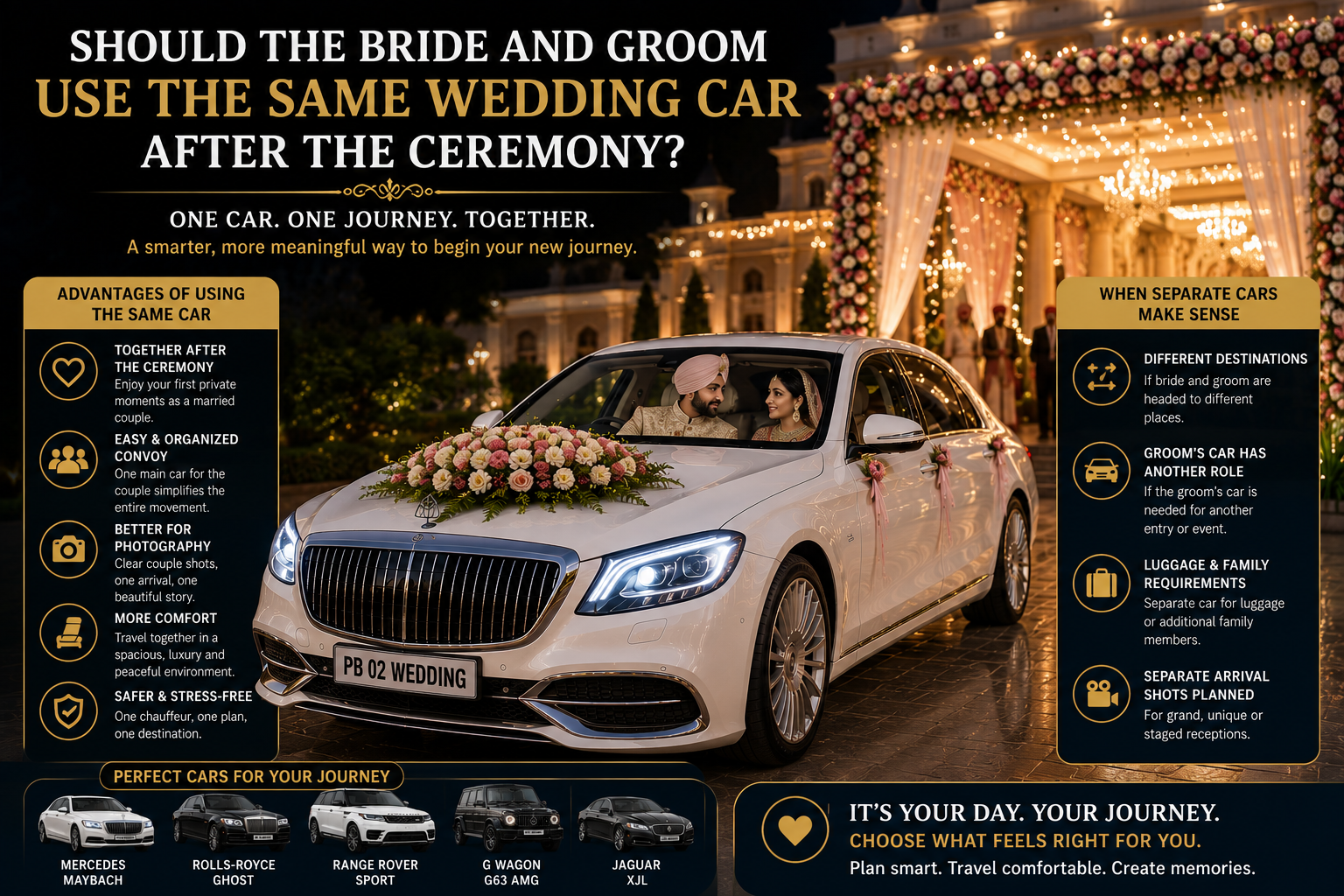
For many weddings, using the same car after the ceremony is the simpler and more meaningful arrangement. The couple gets some private time after hours of ceremonies and photography, the convoy becomes easier to coordinate, and the principal vehicle can become the clear bridal-and-groom car for the next stage of the wedding. This is particularly effective when the couple is leaving on doli together or travelling from Anand Karaj towards one reception venue.
That does not mean one-car travel is automatically correct for every wedding. A groom may still have another responsibility with his baraat, the bride may have significant luggage, the photographer may need one vehicle for a separate arrival sequence, or the couple may temporarily be travelling to different places. The right decision depends on what happens after the ceremony rather than what cars looked best before it.
Punjab Wedding Cars provides different chauffeur-driven vehicles for groom entry, bridal doli and couple travel, including the Mercedes-Maybach, Mercedes G Wagon G63 AMG, New Range Rover Sport, Rolls-Royce Ghost, Jaguar XJL and other vehicles from its wider fleet. The best approach is usually to give each car a clear role before the ceremony and then simplify the transport once the bride and groom begin travelling as a couple.
In Short
If the bride and groom are leaving the ceremony for the same destination, travelling together in one comfortable luxury car is usually the cleaner option. It reduces unnecessary convoy movement, makes photography easier, gives the couple a quieter transition after the ceremony and can make doli more organised. A Maybach, Rolls-Royce Ghost, Jaguar XJL or Range Rover Sport can all work well depending on the route and couple's preferences. Separate cars still make sense when the bride and groom temporarily have different destinations, when the groom's hero car has another defined role, when luggage or supporting passengers require different arrangements, or when the reception entry has been designed around separate arrivals. The important thing is to decide this before the wedding rather than making the bride and groom change cars repeatedly outside Gurudwara Sahib or the reception venue.
Before the Ceremony, Separate Cars Usually Have Different Jobs
The bride and groom generally begin their wedding day from different locations and with completely different transport requirements. The groom's car may be part of his wedding styling from the moment it reaches the family home. A G Wagon can be positioned for portraits before departure, become part of the baraat and later create a strong arrival outside a marriage palace or resort.
The bride's transport tends to be more passenger-focused. She may need a calm journey from her preparation location to Gurudwara Sahib, more space around her outfit and a vehicle that can later remain available for doli. A Mercedes-Maybach or Jaguar XJL may therefore be selected for reasons completely different from those behind the groom choosing a G63.
There is no need to force these two requirements into one vehicle early in the day. Separate cars allow both passengers to follow their own schedule without making either side wait unnecessarily.
The question becomes more important only once the ceremony finishes and both passengers are travelling towards the same next stage.
After Anand Karaj, the Transport Story Changes
The moment after Anand Karaj is one of the clearest natural transition points in a Punjabi wedding. Before the ceremony, the bride and groom arrived as two separate wedding parties. Afterwards, many families begin the doli or couple journey together.
That makes one principal car much more logical.
Instead of the bride travelling in one vehicle while the groom follows in another, the couple can settle into the same rear cabin and allow the supporting family cars to follow separately. The wedding-car convoy becomes simpler because everybody immediately understands which vehicle carries the couple.
This can also reduce the amount of confusion outside Gurudwara Sahib. There is no need to position two hero vehicles side by side, move bags between them and ask the photographer which car the groom should enter. One vehicle is prepared for the couple, and the supporting cars handle everyone else.
For many Punjabi weddings, this is the point where the groom-entry car has completed its most important role and the bridal car becomes the couple's principal vehicle.
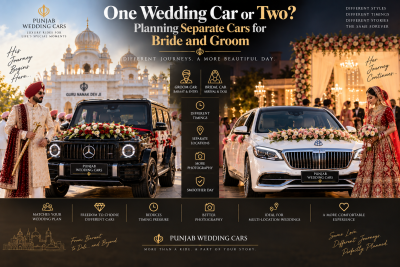
The Groom's G Wagon Does Not Have to Remain the Main Car All Day
A groom may love the Mercedes G Wagon G63 AMG, and it can be an excellent choice for his home departure and baraat. That does not mean the couple needs to continue using the G Wagon simply because it was the most expensive or visually dramatic vehicle earlier in the day.
The G63 solves the groom-entry problem exceptionally well. Its upright shape, strong road presence and recognisable styling make it ideal for photographs with the groom and for a high-energy Punjabi baraat.
After the ceremony, the priority can change from arrival presence to couple comfort.
If a Mercedes-Maybach has been reserved for the bride, it may make perfect sense for the groom to join her in the Maybach for the journey after Anand Karaj. The G Wagon can then complete its assignment or remain with the groom's family if the booking genuinely requires it later.
This is not a downgrade for the groom. It is simply using two luxury cars for the roles they perform best.
Maybach Is Particularly Strong for the Couple's First Journey Together
The Mercedes-Maybach is one of the most natural vehicles for the bride and groom to share after the ceremony because its main appeal is the rear passenger environment. Punjab Wedding Cars' current fleet information highlights the Maybach's rear-focused luxury, which is exactly what becomes important once the couple is no longer using the car mainly as an entry prop. citeturn396907search1turn396907search4
A bride in a heavy lehenga needs room. The groom may also be wearing an elaborate sherwani or achkan. Placing both in a spacious rear cabin can create a much calmer transition than separating them into two vehicles for a journey they are making to the same destination.
This becomes even more valuable when doli is intercity. A couple travelling from Ludhiana towards Jalandhar, from Amritsar towards another district or from a rural reception towards Chandigarh may spend a meaningful amount of time in the car.
At that point, the value of the Maybach is not the thirty seconds when guests see it outside the venue. It is the hour or two the couple spends inside it.
Rolls-Royce Ghost Creates a More Formal Couple Departure
The Rolls-Royce Ghost can serve the same post-ceremony role with a different visual character. Where the Maybach feels strongly passenger-focused, the Rolls-Royce can make the couple's departure feel highly formal and ceremonial.
This can work particularly well after a palace-style reception or at a large resort where the couple wants one final hero-car moment before leaving together.
The photographer can capture the bride and groom approaching the car, the chauffeur can position it so the rear doors have enough space to open, and the couple can leave in one vehicle while close family follows in support cars.
Using the same Rolls-Royce also gives the wedding photographs a clear visual hierarchy. The couple occupies the main vehicle while everyone else moves around them.
The result often feels more organised than having two luxury cars competing for attention during the final departure.
Range Rover Sport Works Well When the Route Matters as Much as the Photography
The New Range Rover Sport is especially useful when the journey after the ceremony includes a mixture of city roads, village approaches, farmhouses or several venues.
It offers enough road presence for an earlier groom or couple entry but can also function naturally as a shared car after the ceremony. That flexibility makes it attractive when the couple wants one premium SUV that remains suitable throughout different stages of the wedding.
A Range Rover can also make sense when the bride personally prefers easier SUV-style entry or the couple is travelling towards a venue where a higher vehicle is more practical than a long saloon.
The important distinction is that the car should be chosen because it suits the couple and route, not simply because somebody believes an SUV is automatically better for Punjabi weddings.
Sharing One Car Gives the Couple a Rare Quiet Moment
Punjabi weddings can be extremely social from the moment preparations begin. The bride is surrounded by makeup artists, bridesmaids and family. The groom is surrounded by friends, photographers and the baraat. Once the ceremony begins, both continue moving through a highly structured public schedule.
The first journey together can therefore be one of the rare moments when the couple is not standing in front of a camera or surrounded by several dozen relatives.
A private chauffeur-driven rear cabin can give them a few minutes to speak, settle down and absorb what has just happened.
This may sound like a small emotional detail compared with fleet choice or route planning, but it is one of the strongest arguments for using the same car after the ceremony.
The car stops being a wedding prop for a while and becomes private space.
One Couple Car Makes the Convoy Easier to Understand
Using one principal vehicle after the ceremony also improves convoy organisation.
The photographer knows which car contains the couple. The family coordinator knows which chauffeur needs the next destination. Venue staff know which vehicle should receive priority at the reception entrance. Supporting family cars can follow without trying to remain level with two separate hero vehicles.
This can be especially useful when the wedding moves from Gurudwara Sahib towards a marriage palace or reception resort.
If the bride and groom remain in separate cars, photographers may try to capture both arrivals, venue staff may not know which vehicle should stop first and family cars can become mixed between them.
One clearly identified couple car removes much of that complexity.
Photography Usually Becomes Cleaner With One Principal Vehicle
Wedding photography is another strong reason to consolidate the bride and groom into one vehicle after the ceremony.
If the couple is travelling together, the photographer can plan one arrival sequence. The car approaches the palace, reaches the agreed stopping point and the bride and groom exit together.
The photographer can then create couple portraits with the same vehicle without needing to reposition another car or wait for the second chauffeur to arrive.
This becomes especially useful at night when venue entrances are crowded and photographers are working around artificial lighting.
One principal car requires one protected stopping position.
Two hero cars require significantly more space and coordination.
Separate Cars Can Still Make Sense When the Couple Has Different Next Destinations
Not every post-ceremony journey immediately becomes doli.
Some weddings have another family ritual before the couple joins up. The groom may need to travel with his family to one location while the bride briefly returns elsewhere. The reception may be scheduled differently for each side. Photography plans can also separate the couple temporarily.
In those cases, keeping two cars remains completely logical.
Transport should follow the real wedding sequence rather than forcing the bride and groom together simply because the ceremony has technically finished.
Once their next destination becomes the same, the family can then decide whether consolidating into one car makes more sense.
The wedding car should support the traditions and family schedule rather than dictate them.
Separate Reception Entries Can Justify Two Cars
Some couples intentionally plan different reception arrivals.
The groom may want a powerful G Wagon entry with friends and dhol while the bride arrives later in a Maybach or Rolls-Royce. This can happen when the reception itself contains another major ceremonial entrance rather than simply continuing directly from Anand Karaj.
In that situation, separate cars are part of the wedding production.
The groom's G Wagon has a genuine second job, and the bride's car has its own visual responsibility.
The family should simply recognise that this increases transport complexity. Both chauffeurs need the correct venue entrance. The photographer needs enough time to capture both arrivals. The venue needs space to keep the two hero vehicles from becoming mixed with normal guest parking.
If those separate moments matter to the couple, the additional planning can be worthwhile.
Doli Usually Favours One Couple Car
Once the actual doli begins, the argument for using one vehicle becomes much stronger.
The bride and groom are normally going to the same destination. Close family may follow, but there is little practical advantage in the couple travelling separately unless a specific custom or logistical requirement demands it.
The Bridal Doli Transport Checklist from Punjab Wedding Cars focuses on exactly this stage of the wedding, where the bridal car, final route, luggage and supporting family movement need to come together as one coordinated departure. citeturn396907search0
A dedicated couple car keeps that farewell clear.
The bride and groom enter together, the principal chauffeur receives the final destination and the supporting vehicles follow independently.
Bridal Luggage Is One Reason Not to Put Everyone in the Same Car
Sharing one wedding car does not mean every wedding item also needs to travel in that vehicle.
Bridal luggage can include suitcases, garment bags, shoes, gifts and personal belongings. If all of that is loaded into the same luxury saloon carrying the bride and groom, the couple can lose much of the cabin comfort they selected the vehicle for.
The cleaner arrangement is often one couple car plus one support vehicle.
The Maybach or Rolls-Royce carries the bride and groom. A family SUV carries the larger luggage and any relatives who genuinely need to travel to the same destination.
This is consistent with Punjab Wedding Cars' current doli guidance, which recommends separating larger bridal luggage where appropriate so the main bridal vehicle remains comfortable. citeturn396907search0
One shared wedding car should simplify the couple's journey, not turn that vehicle into storage.
The Bride's Outfit Should Influence the Shared-Car Decision
Not every luxury vehicle offers the same experience for a bride wearing a large wedding outfit.
A G Wagon may look exceptional with the groom but the bride may personally find a long saloon easier or more comfortable for the final journey. Another bride may prefer the higher seating position of a Range Rover.
This is why the shared-car decision should involve the bride rather than being made entirely around the groom's earlier vehicle choice.
If the groom entered in a G63 but the bride has specifically chosen a Maybach for doli, the most logical post-ceremony plan may be for both of them to use the Maybach.
The hero groom car has already done its job.
The next vehicle should be chosen around the next passenger requirement.
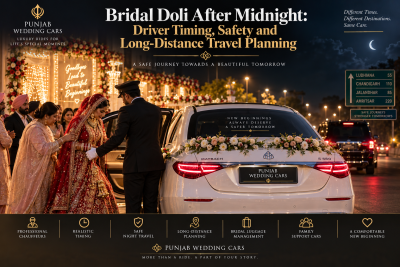
Late-Night Doli Makes Sharing One Comfortable Car Even More Logical
The later the wedding finishes, the more useful one comfortable couple car can become.
At 1:00 AM, neither the bride nor groom normally benefits from travelling separately simply to maintain the earlier vehicle arrangement. They have been photographed throughout the day, the main wedding functions are finished and the final journey should feel calm.
If the destination is intercity, one chauffeur-driven Maybach, Rolls-Royce, Jaguar or Range Rover can carry the couple while family support cars follow.
This also simplifies communication.
One chauffeur needs the final pin. One couple vehicle needs to be positioned before doli. One principal car needs to be protected from guest parking.
A complicated two-car departure provides little additional value unless there is an actual reason for it.
Sharing One Car Can Reduce Unnecessary Empty Trips
There is also a simple transport-efficiency advantage.
If both bride and groom are travelling to the same destination in separate luxury cars, the wedding is using two chauffeurs, two vehicles and two road movements for one couple journey.
That may still be appropriate when both cars have genuine ceremonial roles, but it should be a conscious decision.
When one vehicle comfortably accommodates the couple, sharing it can reduce unnecessary duplication while still allowing parents, luggage and close relatives to use support vehicles.
The result is not less luxurious.
It can actually look more premium because there is a clear hierarchy rather than several expensive cars moving without defined roles.
Parents Should Not Automatically Travel With the Couple
Once the bride and groom decide to share one car, another question usually follows: should parents or siblings join them?
For most luxury couple journeys, keeping the principal car primarily for the bride and groom is cleaner.
Parents can travel in a supporting Audi A6, Jaguar, Range Rover or another chauffeur-driven vehicle. This gives them flexibility while preserving the couple's rear-cabin comfort and privacy.
It can be particularly important when the bride's outfit occupies significant space.
The couple car should not be filled simply because technically another passenger can fit.
The best use of luxury space is not always the maximum number of people.
The Photographer Usually Should Not Travel in the Couple Car
A similar principle applies to the photography team.
If the photographer needs to capture the couple arriving at the next venue, travelling inside the same Maybach makes that impossible.
The photographer should move ahead in a separate vehicle when the arrival shot matters.
By the time the couple reaches the marriage palace or resort, the camera team can already be positioned and the chauffeur can complete the arrival once.
This is much more efficient than making the couple wait outside because the photographer travelled with them and is still unloading equipment.
The couple car should primarily serve the couple.
Do Not Make the Couple Switch Cars Repeatedly for Social-Media Photos
Luxury fleets can tempt families to use several different cars throughout one wedding simply because each model creates a different photograph.
The groom enters in a G Wagon, the couple changes into a Rolls-Royce, then switches to a Range Rover for another video and finally uses the Maybach for doli.
That can create more disruption than value.
Every switch requires the vehicles to be positioned, the bride's lehenga to be moved again, belongings to be transferred and chauffeurs to coordinate another handover.
If the family genuinely wants several distinct car moments, they can be planned properly.
Otherwise, one strong groom vehicle followed by one strong couple or bridal vehicle usually creates a cleaner wedding story.
Same-Car Travel Can Make Intercity Doli Much Easier
An intercity doli is where the shared-car decision becomes particularly practical.
If the couple is leaving Amritsar for Jalandhar, Ludhiana for another district, Patiala towards Chandigarh or Phagwara towards a village home, both passengers are completing the same long journey.
One comfortable car simplifies the route and arrival.
The receiving family only needs to track one principal vehicle. The chauffeur has one exact destination. The bride's luggage can follow separately, while the couple stays together throughout the road journey.
This is one of the strongest situations for choosing a passenger-focused car such as the Maybach or Jaguar XJL.
The road time can be considerably longer than the reception photography, so the interior experience deserves more weight than the exterior styling alone.
Same-Car Travel Is Not About Tradition Versus Modern Planning
Families sometimes approach this question as though there is one correct traditional answer.
In practice, Punjabi wedding formats vary widely between families, districts and ceremony schedules. Some couples begin doli immediately after Anand Karaj. Others attend a reception first. Some weddings involve several venues and hotels, while village weddings may have additional family traditions before the final departure.
Transport should respect those differences.
The practical principle is simply that when the bride and groom have the same next destination and no ceremony requires separate movement, one suitable luxury car usually provides the cleanest journey.
When their next responsibilities differ, keep the cars separate until the routes naturally come together.
The Couple Should Decide Which Car Becomes “Their” Car
This is one decision worth making before the wedding.
The groom may have a G Wagon for the baraat and the bride a Maybach for doli. The couple should already know which car they will use once they begin travelling together.
That avoids a conversation outside Gurudwara Sahib where several relatives are suddenly asking whether the groom should get back into the G63 or join the bride.
The answer can be as simple as deciding in advance that the G Wagon is the groom-entry vehicle and the Maybach becomes the couple car after Anand Karaj.
For another wedding, the Range Rover may remain the couple vehicle throughout.
The exact model matters less than having the decision made.
Pricing Should Reflect Whether One or Two Cars Continue After the Ceremony
The shared-car decision also affects the actual booking requirement.
If the G Wagon is released after groom entry and the Maybach continues with the couple, the family is booking two vehicles with different duty lengths.
If both vehicles remain through the reception because they have separate ceremonial responsibilities, the booking duration changes.
This is why families should describe the complete wedding sequence when requesting a quotation.
Punjab Wedding Cars' current fleet includes more than twenty chauffeur-driven vehicles and states that its main fleet bookings include a uniformed chauffeur, decoration, fuel and tolls. citeturn396907search1 The most useful quotation still depends on knowing which car is required at which stage rather than simply counting the total number of vehicles.
The Best Plan Usually Becomes Simpler After the Ceremony
Before the ceremony, weddings naturally need more moving parts. The bride and groom start separately. Parents and guests travel on different schedules. The groom's hero car and bridal car can have completely different visual and practical responsibilities.
After the ceremony, the transport plan often has an opportunity to become simpler.
If the bride and groom are travelling to the same place, sharing one well-chosen luxury car can reduce convoy confusion, simplify photography and give the couple a private transition between major wedding stages. The G Wagon can complete its job as the groom's statement vehicle, while a Maybach or Rolls-Royce becomes the couple's more comfortable post-ceremony car. A Range Rover can remain the shared vehicle when the couple wants SUV versatility, while a Jaguar XJL offers a quieter long-wheelbase alternative.
Separate cars still make perfect sense when the wedding programme genuinely requires them. The groom may have another formal reception entry, the bride may temporarily follow a different route or both hero cars may have clearly planned photography responsibilities. In those situations, the extra coordination serves a real purpose.
What families should avoid is maintaining separate cars merely because the bride and groom started the day separately.
Punjab Wedding Cars' current luxury wedding-car fleet includes the Maybach, G Wagon G63 AMG, New Range Rover Sport, Rolls-Royce Ghost, Jaguar XJL, Audi A6 and other vehicles for different bride, groom and family roles. citeturn396907search1 The smartest booking is not necessarily the one where both luxury cars remain on duty for the longest possible time. It is the one where each car is used for the stage it suits best.
For many Punjabi weddings, that means the groom enjoys his G Wagon arrival, the bride has her dedicated bridal vehicle, and once the ceremony is complete the couple continues together in one comfortable car.
The wedding begins with two separate journeys.
After the ceremony, it often makes sense for the road ahead to become one.