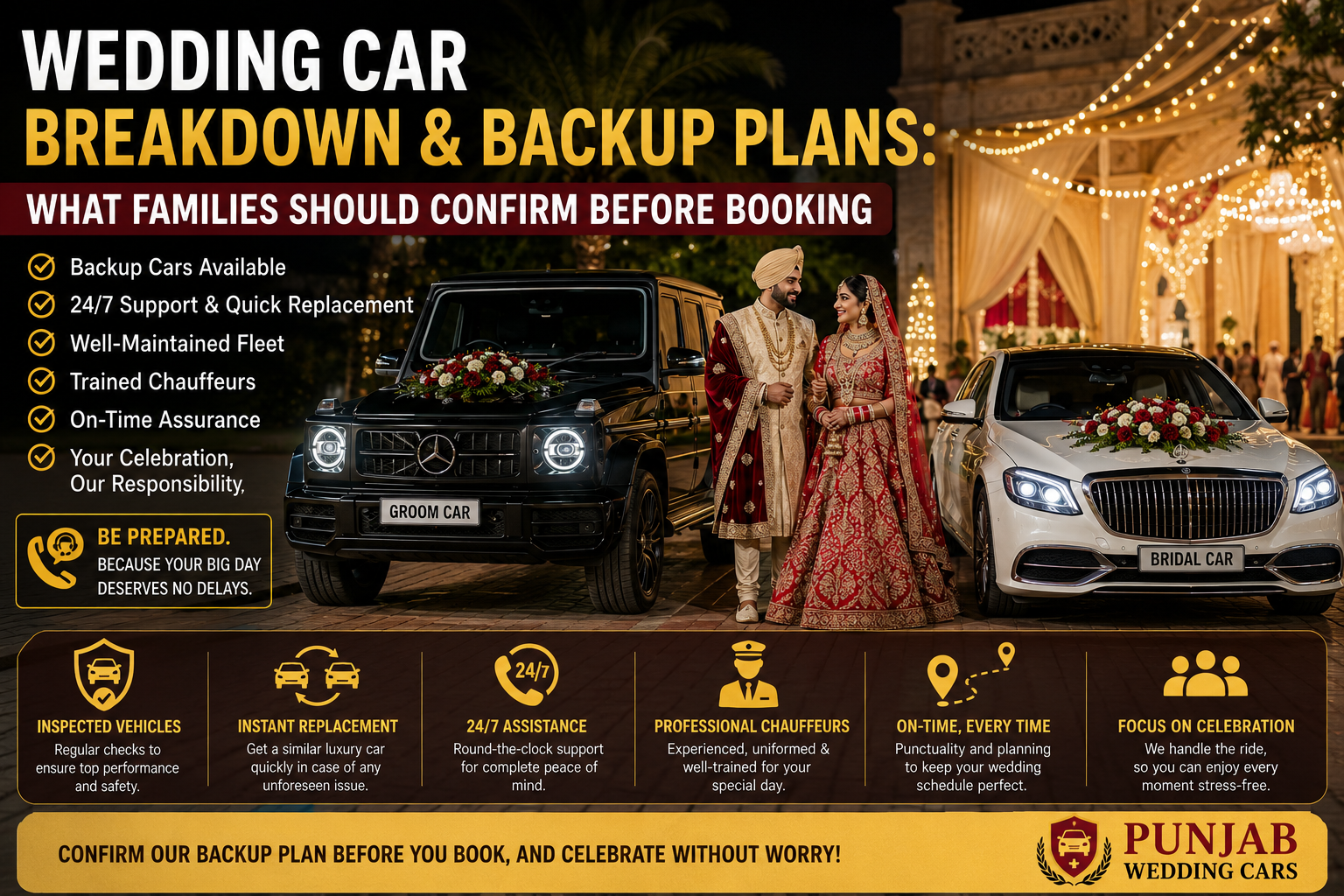
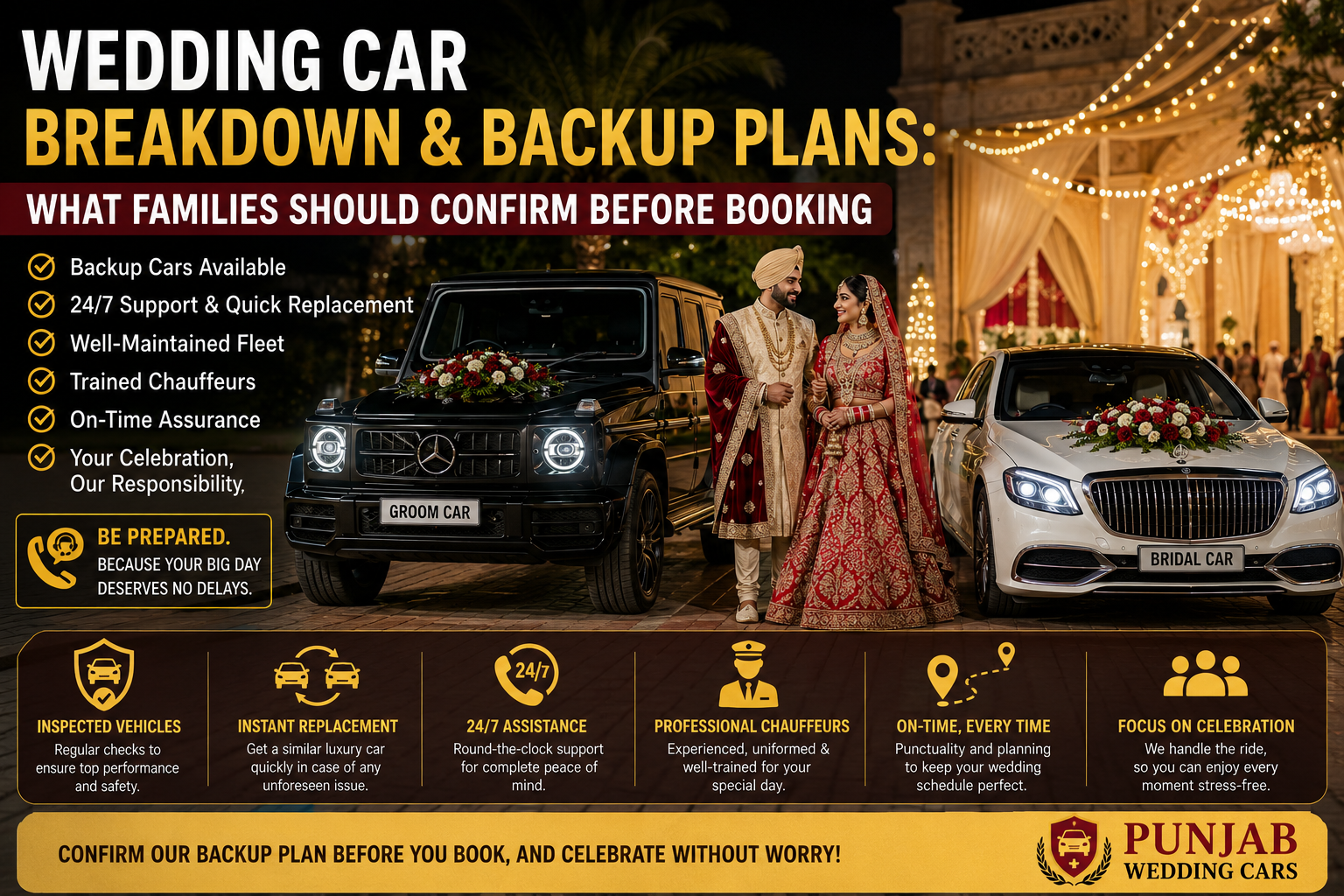
Wedding Car Breakdown and Backup Plans: What Families Should Confirm Before Booking
A luxury wedding car is usually booked months before the family actually needs it, which means most couples spend far more time thinking about the model, colour and photographs than about what happens if something unexpected occurs on the wedding day. A Mercedes-Maybach may be the bride's first choice, the groom may have selected a G Wagon G63 AMG for his baraat, and the photographer may already have planned the arrival around that exact vehicle. The practical question is what happens if the booked car develops a mechanical problem, suffers tyre damage, has an electrical issue, becomes unavailable because of an earlier incident, or cannot complete the duty for another genuine operational reason.
No professional transport company can honestly promise that a mechanical problem is physically impossible. Even a properly maintained premium vehicle remains a machine. What families can reasonably expect is a clear process for reducing the risk, communicating quickly and arranging a suitable alternative if the original car cannot safely perform the wedding duty.
This is why a replacement policy should be treated as part of the booking rather than as something to discuss only after a problem occurs. Punjab Wedding Cars' current booking-red-flags guide specifically advises families to understand the replacement policy before paying an advance and notes that a documented replacement process is safer than relying on a last-minute verbal promise. Its current Jalandhar wedding-car guidance also states that it maintains a backup-vehicle protocol for unexpected mechanical issues.
The objective is not to make couples worry about breakdowns. It is to make sure that if a rare problem appears, the bride, groom and family are not standing outside a Gurudwara or marriage palace trying to invent a backup plan under pressure.
In Short
Before booking a luxury wedding car in Punjab, families should confirm the exact vehicle, written booking details, replacement policy, who decides when a vehicle is unsafe to continue, what category of replacement can be provided, how quickly the company can communicate with the family, and whether the chauffeur has direct support if an unexpected problem develops. The family should also share the complete route, reporting time, waiting duration and final doli destination because a backup car can only be useful when the provider understands the actual wedding duty. A strong contingency plan does not guarantee that the replacement will always be the identical model and colour, but it should explain how the company will try to provide a comparable vehicle while protecting safety and the wedding schedule.
A Backup Plan Begins Before the Wedding Car Leaves the Base
The best breakdown plan is not waiting for a breakdown. It starts with the normal condition of the vehicle before the wedding duty begins.
A wedding car should be roadworthy, properly maintained and prepared for the actual route it has been booked to complete. Punjab Wedding Cars' current booking guidance says families should confirm the exact vehicle and should expect the car to be clean, presentable and suitable for the planned route while maintaining a safety-first standard. Its night and intercity safety guidance also stresses that vehicle condition, chauffeur readiness and route planning matter when a car is travelling long distances or operating after dark.
This distinction matters because a car required only for a thirty-minute groom entry has a different duty from a Maybach expected to report in Ludhiana, wait through a reception and then complete a late doli towards Jalandhar. The longer assignment deserves planning around the whole journey, not only the visual arrival.
Families should therefore provide the complete route rather than asking only whether a particular model is available on the date. A vehicle can be suitable for one wedding duty and less appropriate for another because of distance, venue access, waiting time or road conditions.
Confirm the Exact Car Before You Discuss the Backup
A replacement policy only makes sense when the original booking is clear.
The family should know exactly which vehicle is being reserved, including the model and colour where those details matter. Punjab Wedding Cars' current booking-red-flags guide specifically warns against relying only on generic photographs and recommends confirming the exact car that is being reserved.
This is especially important for signature wedding cars because the difference between categories can be significant. A groom who has planned his styling around a black Mercedes G Wagon G63 AMG may not consider a normal luxury sedan equivalent. A bride who has booked the Mercedes-Maybach for a long doli may care more about rear-seat comfort than about replacing it with another SUV.
The written booking should therefore establish the original expectation before anybody talks about what “comparable replacement” means.
Ask What “Comparable Replacement” Actually Means
The phrase “we will provide another car” sounds reassuring until the family tries to understand what type of car that could be.
A proper backup discussion should focus on category, passenger need and wedding role. If a G Wagon becomes unavailable, does the company attempt to provide another G Wagon first, then another premium SUV such as a Range Rover if the exact model is impossible? If a Maybach becomes unavailable, is the replacement likely to be another formal rear-seat luxury saloon such as Rolls-Royce, Bentley or Jaguar depending on fleet availability?
The answer can never be completely guaranteed months in advance because replacement availability depends on what is genuinely free at that time. What matters is whether the provider has a realistic process and a broad enough fleet to solve the problem intelligently.
Punjab Wedding Cars currently lists more than twenty luxury wedding vehicles across its fleet, including Maybach, G Wagon, Range Rover Sport, Defender, Rolls-Royce Ghost, Jaguar XJL, Audi A6 and other vehicles. A wider active fleet can make a backup plan more practical because there are more categories available if a problem develops.
An Identical Replacement Is Ideal but Should Not Be Assumed
If the exact booked car develops a problem, the first preference will naturally be the same model and similar colour if another one is available.
Families should still understand that an identical replacement cannot always be guaranteed. If two G63s are already committed elsewhere on the same peak wedding date, a provider may have to choose the best genuinely available alternative rather than delay the groom indefinitely while searching for an exact duplicate.
This is why the family should decide which characteristic matters most before the wedding. For a groom, the priority might be SUV road presence. For a bride, it might be rear-seat space and a formal four-door saloon. For a farmhouse wedding, vehicle access may matter more than brand. For a palace reception, the visual category may be the priority.
Those preferences make the backup decision much clearer if the original car cannot be used.
The Wedding Role Should Decide the Backup Car
A backup should be chosen according to the passenger and stage of the wedding rather than only according to price.
If the original G Wagon is being used purely for groom photography and baraat entry, a New Range Rover Sport may preserve much of the premium-SUV role better than a Maybach even if the Maybach is more luxurious in other ways.
If the bride is beginning a two-hour doli, replacing her Maybach with a G Wagon solely because both are expensive would not necessarily preserve the original passenger experience. A Rolls-Royce Ghost or Jaguar XJL may be a more logical replacement category when rear-seat travel matters most.
A good contingency plan therefore begins with understanding why the original car was booked.
Vehicle Safety Should Override the Wedding Photograph
Families can become understandably emotional if the exact wedding car develops a problem shortly before an important arrival.
The wrong response is to pressure the chauffeur to continue driving a vehicle that does not appear safe merely because the photographer is waiting.
A professional operator should be able to stop the duty when a genuine mechanical or safety concern makes continuing inappropriate. That decision may be disappointing in the moment, but passenger safety and roadworthiness have to come before maintaining the visual plan.
Punjab Wedding Cars' current booking guidance explicitly states that appearance should never come before safety. Its night-travel material follows the same principle by placing vehicle condition and safe operation ahead of unrealistic wedding timing.
The family should know before booking that a responsible chauffeur may refuse to continue in a car if a serious issue develops.
A Warning Light Should Not Become a Family Debate
Modern luxury vehicles contain extensive electronic systems, and not every warning has the same meaning. Some issues may be minor and safely resolvable while others require the car to stop.
The chauffeur and transport support team should handle that assessment rather than allowing several relatives to decide whether the vehicle can “just manage another twenty kilometres.”
This becomes particularly important during a late doli or intercity journey. A warning that appears near a marriage palace in Ludhiana is easier to address before the car begins travelling towards another district than halfway through a poorly lit rural route after midnight.
The family's role should be to maintain communication and allow the provider to make the operational decision.
Tyre Problems Need a Different Backup Response From Major Mechanical Problems
Not every wedding-car interruption requires replacing the complete vehicle.
A tyre puncture or wheel-related problem may be repairable if the car is in a safe location and sufficient time exists. A more serious mechanical, electrical or cooling-system issue may make a full replacement more appropriate.
The important point is that the family should not have to diagnose the problem.
What matters is whether the company has support and a clear decision path. If resolving the issue will take too long and threaten the wedding schedule, dispatching a replacement may be more practical than protecting the original car at all costs.
A backup policy should therefore be flexible enough to solve the wedding transport problem rather than focusing only on repairing one vehicle.
The Chauffeur Needs a Support Contact Too
Families often ask who they should call if something goes wrong.
The chauffeur should also have somebody to call.
A driver standing beside a disabled luxury car should not be expected to simultaneously diagnose the issue, find a replacement, contact every family member and manage the route.
There should be operational support behind the chauffeur so another vehicle can be coordinated while the family receives one clear update.
Punjab Wedding Cars' current FAQ lists dedicated support numbers for wedding-day booking help and says customers can contact its support team regarding booking queries on the day.
That type of central contact is important because it gives the family somewhere to escalate the issue without turning the chauffeur into the entire support system.
One Family Contact Should Handle the Emergency Conversation
The transport provider should also know exactly who speaks for the wedding family.
If a problem occurs and five cousins call with different instructions, the backup can become slower rather than faster.
One local family coordinator should receive the update, understand what replacement is being dispatched and communicate with the bride, groom or parents as appropriate.
This is particularly important for NRI weddings where the person who originally booked the vehicle may be in Canada, the UK or Australia while another relative is physically managing the event in Punjab.
Punjab Wedding Cars' current online-booking guidance recommends including a local family member or wedding coordinator for NRI bookings so the chauffeur has a reliable Punjab contact if access or route details need to be confirmed. The same person can be invaluable if a vehicle issue occurs.
The Backup Car Needs the Complete Route Immediately
A replacement vehicle cannot perform properly if it knows only where the original car broke down.
The replacement chauffeur needs to understand the next wedding responsibility.
Is the vehicle collecting the groom for baraat? Is the bride waiting at Gurudwara Sahib? Is the couple leaving for reception? Is this the final doli towards another city?
The route, passenger, next stop and expected release time should already be recorded within the booking.
Punjab Wedding Cars' safety guidance recommends that the assigned vehicle, reporting point, passenger, route and final destination be clear before the wedding day begins. This becomes especially valuable during a backup situation because the new chauffeur can continue the assignment with less explanation from the family.
Exact Pins Matter Even More During an Emergency
“Come near our village” is inconvenient during normal wedding coordination.
During a backup dispatch, it can waste critical time.
The replacement chauffeur should receive the exact pickup or breakdown location, the correct venue entrance and the next destination pin.
If the groom is waiting at a farmhouse with two gates, the family needs to identify which gate the replacement should use. If the bride is leaving from a Gurudwara complex with separate parking, the correct meeting point matters.
A clearly documented booking reduces the number of questions that need to be answered under pressure.
Route Familiarity Can Prevent a Backup Car From Becoming Another Delay
A replacement arriving quickly is useful only if it can then complete the route properly.
Punjab weddings often involve local roads, village entrances and farmhouses where the final approach may not be obvious from the city name.
The family's original route information should therefore include any important local detail such as the preferred gate, a known difficult turn or a venue pin that differs from the common public entrance.
This is another reason the booking should be based on the complete itinerary instead of a simple line such as “Jalandhar wedding.”
The same information that helps the first chauffeur also protects the backup.
Peak Wedding Season Makes Backup Fleet Depth More Important
A backup plan is easiest when the replacement vehicle is sitting idle nearby.
Peak wedding season makes that less likely.
Popular dates can have many vehicles already committed, particularly signature models such as G Wagon, Maybach and Rolls-Royce. That does not mean a replacement is impossible. It means the family should understand that the provider may have to work from the genuinely available fleet.
A large active fleet becomes particularly valuable on these dates because the company has more categories to work with.
This is also one reason booking through a professional fleet operator can offer a different backup position from hiring one privately owned standalone luxury car.
If the only vehicle available from the supplier is the one that has developed a problem, the backup plan may depend entirely on finding somebody else at the last minute.
A Social-Media Car Owner Is Not Automatically a Backup System
Instagram can be useful for discovering wedding cars.
It should not be the only thing a family checks before paying.
A beautifully photographed private car may be exactly what the groom wants, but the family should still ask what happens if that one vehicle becomes unavailable. Does the provider operate other cars? Do they have relationships that allow a comparable replacement? Is the booking documented? Who is responsible on the wedding morning?
Punjab Wedding Cars' current booking-red-flags guide recommends using an official website or app and obtaining proper written confirmation rather than relying only on social-media messages.
The issue is not that every private provider is unreliable. The issue is whether there is a real contingency process beyond “we will arrange something.”
Written Booking Confirmation Protects the Backup Conversation
The original vehicle, date, reporting time, pickup, drop and price should be documented.
This matters because a backup dispute is much harder when the original booking itself was vague.
Punjab Wedding Cars' current FAQ says every booking receives written confirmation, while its app-booking process asks customers to review the selected car, wedding date, pickup and drop locations, reporting time, price, route information, waiting requirement and contact details before confirmation.
Those details give both sides something concrete to work from if an unexpected replacement becomes necessary.
The backup process should preserve the wedding duty as closely as possible to that written booking.
Families Should Ask About Replacement Before Paying the Advance
The correct time to ask, “What happens if this car has a problem?” is before the booking is confirmed.
The question does not insult the provider.
It is a normal operational question for a significant wedding service.
The family should understand whether the company has its own backup fleet, whether the replacement is based on availability, how comparable vehicles are selected and who contacts the family if the original car becomes unavailable.
Punjab Wedding Cars' current booking-red-flags article specifically lists understanding the replacement policy as one of the checks families should make before paying an advance.
If a provider becomes defensive about the question, that itself gives the family useful information.
Cancellation Terms and Breakdown Terms Are Not the Same
Families should also distinguish between the customer cancelling the booking and the provider needing to replace the vehicle.
A cancellation policy deals with what happens when the family changes or cancels the wedding arrangement. A replacement policy deals with what happens when the booked car cannot perform.
Those should not be confused.
A provider may allow a date change under one policy while having a separate process for vehicle substitution. The family should understand both.
This is particularly important for NRI weddings where flights, venues and dates can move, but it also matters for ordinary local weddings because the contract should explain who is responsible for each type of change.
What if the Original Car Becomes Unavailable the Day Before?
An operational problem discovered before the wedding is usually easier to manage than a breakdown during the actual function.
The provider has more time to contact the family, explain the situation and show potential replacements.
This is where good communication matters more than pretending nothing has happened.
If a comparable vehicle is available, the family can review it and adjust the photography or decoration plan if necessary. A groom who loses the exact G63 may still have time to decide between another G Wagon, Range Rover Sport or Defender according to availability and style.
The family may be disappointed, but they still have control.
A provider who waits until the chauffeur's reporting time to reveal a known problem has removed that control unnecessarily.
What if the Car Develops a Problem on the Way to the Groom?
This is one of the most time-sensitive situations because the vehicle has not yet reached the passenger.
The family should receive a clear update quickly rather than discovering the problem only when the car misses the reporting time.
If the issue can be resolved without threatening the wedding, the original car may still complete the duty. If not, the replacement should be dispatched while communication continues.
This is another reason reporting time should contain sensible preparation margin. A groom vehicle arriving before the actual departure has more operational buffer than a car scheduled to arrive at the exact minute the baraat needs to leave.
Good wedding timing cannot prevent mechanical problems, but it can reduce how much one problem affects the rest of the event.
What if the Car Develops a Problem After the Groom Entry?
A breakdown after the main ceremonial use can be much less disruptive if the vehicle has already completed its actual responsibility.
For example, a G Wagon may have completed groom pickup, photography and reception entry. If it later develops an issue while parked and the family no longer genuinely needs it, the wedding may not need a replacement at all.
This is why every car should have a defined duty.
Families sometimes retain vehicles indefinitely without knowing whether they will be used again. That makes any later problem feel larger than it really is.
If the bridal Maybach is still available for the couple's final departure, the groom's earlier hero car may no longer be operationally essential.
What if the Bridal Car Develops a Problem Before Doli?
This is usually more sensitive because doli is a real passenger journey, not only a photography moment.
The replacement needs to prioritise the bride's comfort, route and final destination.
A backup vehicle should be brought into position before the emotional farewell reaches its final stage where possible. The bride should not be standing outside while the family begins discussing replacement models.
If the original Maybach is unavailable, another formal luxury saloon or premium SUV may be the most appropriate substitute depending on route, passenger comfort and what is free.
The final choice should protect the journey first and the photograph second.
A Backup Chauffeur Can Matter as Much as a Backup Car
Vehicle problems are not the only disruptions that can happen.
A professional fleet should also have a process for chauffeur availability if the assigned driver becomes unexpectedly unable to perform the duty.
The family does not necessarily need to know the internal staffing arrangement in detail, but it is reasonable to ask whether the company has multiple professional chauffeurs rather than relying on one driver for the entire operation.
Punjab Wedding Cars' current FAQ says chauffeur service is included with wedding bookings and describes the drivers as trained, uniformed and professional.
A larger chauffeur pool can make contingency planning more realistic than a booking dependent on one driver being available under every circumstance.
Long-Distance Weddings Need More Backup Thinking Than Short Local Entries
A car travelling five kilometres to a nearby marriage palace has fewer route variables than a vehicle beginning a late-night intercity doli.
Longer duties create more exposure to tyre issues, road delays, weather and simple wear on the vehicle.
That does not mean long-distance luxury-car bookings are unsafe. It means they deserve proper preparation.
Punjab Wedding Cars' night and intercity safety guidance recommends planning around the exact route, passenger, final destination and realistic timing. Those details also make contingency support easier.
A backup plan for a local groom entry and a backup plan for Delhi-to-Punjab airport wedding transport are not the same operational problem.
Farmhouse and Village Weddings Need Access Backup Too
Sometimes the vehicle itself is fine and the problem is the route.
Heavy rain can make an open parking area unsuitable. A decorated gate can accidentally reduce clearance. Guest vehicles can block the driveway. Roadwork may appear near the village approach.
The backup plan should therefore include route alternatives where the venue access is uncertain.
A long Maybach may remain outside a difficult farmhouse ramp while the bride walks a short protected paved distance. A Range Rover may use another entrance. The photographer may move the hero-car shot to a cleaner part of the property.
Not every wedding-day transport problem requires changing the car.
Sometimes the backup is changing the access plan.
Weather Should Be Part of the Contingency Conversation
Punjab weddings can face winter fog, monsoon rain and extreme summer heat.
Each creates a different operational issue.
Fog can increase travel time. Rain can change venue parking and road conditions. Summer heat increases the importance of AC readiness and vehicle waiting position.
A good backup plan is therefore wider than mechanical breakdown.
It includes what happens if the original route becomes slower or the original stopping point becomes unsuitable.
The family should not expect the chauffeur to recover weather-related delay through faster driving. The schedule should be allowed to move safely.
Decoration Should Be Easy to Transfer if a Replacement Is Required
A heavily customised flower arrangement can make a last-minute replacement more difficult because the new vehicle may have a different bonnet, grille or body shape.
This does not mean families should avoid fresh flowers or custom decoration.
It means highly specific decoration should be designed with some practical flexibility when possible.
A restrained bonnet arrangement, ribbons and door flowers are often easier to adapt from one luxury vehicle to another than an elaborate structure built around one exact grille.
If the original car must be changed unexpectedly, the family will usually care more about having a properly presented replacement than recreating every flower in the identical position.
The Photographer Should Know a Replacement Is Possible
If the wedding car is a major part of the photography concept, the photographer should understand that any vehicle can theoretically require substitution.
The photography plan should not collapse because the exact colour or body shape changes.
A good photographer can adjust the framing, venue position and couple pose around the replacement.
This becomes especially relevant for NRI weddings where elaborate mood boards may have been created months earlier around one specific model.
The car is part of the story, but it should not become so rigid that one operational change ruins the entire visual plan.
Families Should Save the Booking and Support Details
The day before the wedding, the family coordinator should have the booking confirmation and support contact readily available.
Nobody should be searching through six months of WhatsApp messages to find the provider's number after a problem appears.
The key information should include the vehicle booked, reporting point, reporting time, chauffeur or support contact where available, next destination and final doli address.
Punjab Wedding Cars currently provides support through its published helplines and app while also offering written booking confirmation.
Simple preparation reduces panic when something changes.
Do Not Judge the Backup Plan Only by How Fast the Replacement Arrives
Speed matters, but suitability matters too.
A replacement arriving in ten minutes is not automatically the best solution if it cannot carry the bride comfortably or cannot access the final destination.
The company should balance urgency with the role of the vehicle.
A groom waiting for a hero SUV may be better served by a Range Rover that arrives slightly later than by an unsuitable small sedan sent immediately. A bride beginning doli may be better served by a spacious four-door saloon than by whatever vehicle is physically closest.
The family and provider should focus on restoring the wedding duty, not merely filling the empty parking space.
A Comparable Backup Protects the Experience, Not the Badge
This is the most useful way to think about replacement.
The provider should try to preserve the experience the family booked.
For a groom, that may mean a premium SUV with strong road presence. For a bride, it may mean a quiet luxury rear cabin. For an outdoor farmhouse, it may mean vehicle access. For a palace reception, it may mean a formal premium look.
The identical badge is ideal when available.
The correct wedding role is more important when it is not.
The Best Booking Is the One That Already Knows What Happens if Something Goes Wrong
Wedding families should not book a luxury car expecting a breakdown.
They should book knowing that the provider has thought about one.
The exact car should be confirmed in writing. The route and reporting time should be correct. The passenger and final destination should be recorded. The family should understand the replacement policy and know whether comparable alternatives are arranged subject to availability. One local coordinator should be designated, and support contact details should be easy to find.
Punjab Wedding Cars' own current guidance tells families to confirm the actual vehicle, route, timing, booking terms and replacement process before paying an advance, and its current Jalandhar content states that a backup-vehicle protocol is maintained for unexpected mechanical issues. Its FAQ also confirms written booking agreements, professional chauffeurs and wedding-day support contact.
A backup plan should never be used as an excuse for poor maintenance or vague booking practices. Its purpose is to protect a properly planned wedding against the small number of problems that cannot always be predicted.
If the exact G Wagon, Maybach, Rolls-Royce or Range Rover arrives and completes the duty perfectly, the family may never think about the backup plan again.
That is the ideal outcome.
But if something unexpected does happen, the family should already know who is handling it, what kind of replacement can be considered and how the wedding journey will continue.
That is what a real luxury wedding-car service should provide: not only an impressive vehicle when everything goes right, but a clear plan for keeping the bride and groom moving when something does not.