How Much Waiting Time Should You Book for a Punjabi Wedding Car?
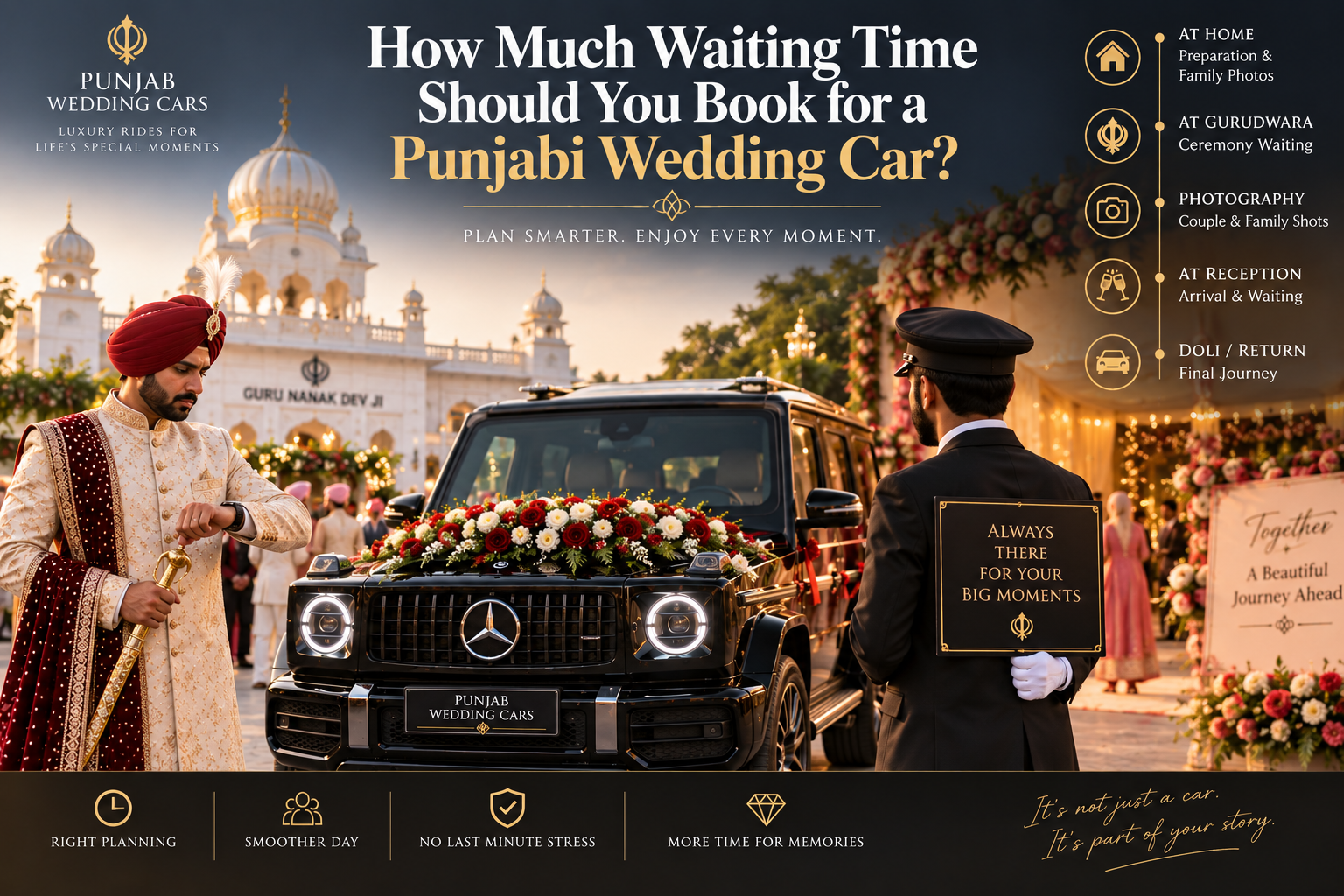
Waiting time is one of the easiest parts of a Punjabi wedding-car booking to underestimate because families naturally think about the journeys rather than the hours between them. A groom may travel only twenty kilometres from home to the Gurudwara, yet his luxury car can be involved with the wedding for several hours before that journey is finished. The chauffeur may report early for photographs, wait while sehra-bandi and family preparations continue, remain outside during the Anand Karaj and then wait again while the couple takes photographs before everyone moves towards the reception. A bridal car can spend even longer parked because it may be required again for a late doli. This is why the right question is not simply how far the wedding car will travel. Families booking through Punjab Wedding Cars should consider how long the vehicle needs to remain committed to the wedding from its first reporting time until its final planned movement. A car sitting outside a Gurudwara or marriage palace may not be covering kilometres, but it is still unavailable for another assignment and its chauffeur is still working with the wedding.
Start by Separating Reporting Time, Driving Time and Waiting Time
The first step is understanding that the car's booking period contains different types of time. Reporting time begins when the chauffeur is required at the pickup location, not when the groom or bride eventually sits inside the vehicle. Driving time covers the actual movements between the home, Gurudwara, reception, hotel or final destination. Waiting time is everything in between when the car remains available for the family but is not travelling. These periods can overlap with photography, ceremonies, lunch and family preparations, which is why a wedding car that only drives for ninety minutes can still be involved for six or seven hours. The Punjab Wedding Cars guide explaining what time a wedding car should arrive from groom pickup through doli is useful when building this schedule because the chauffeur should normally report before the intended departure. That early reporting period is already part of the vehicle's real wedding-day commitment and should be considered when deciding whether a short ceremony booking or longer arrangement is more suitable.
Allow Proper Waiting at the Groom's Home Before the Baraat Leaves
The groom's home is often the first place where waiting grows beyond what the family originally expected. A car may be requested at 7:00 AM because the family intends to leave at 7:30 AM, but the photographer begins groom portraits, grandparents want photographs, sehra-bandi continues and relatives are still arriving. Suddenly the car leaves at 8:15 AM. This kind of delay is completely normal in a Punjabi wedding and does not necessarily mean anybody has done something wrong. The mistake is booking the car as though it will arrive and immediately leave. For a straightforward groom pickup, allowing around thirty to sixty minutes between the chauffeur's reporting time and the intended road departure is often a sensible planning starting point, although a larger family photography programme can require more. The vehicle should be outside early enough that nobody is watching the clock while the groom completes important family moments, but the planned buffer should not become an excuse to start preparations only after the car arrives. The objective is calm preparation followed by a controlled departure.
An Anand Karaj Can Create Several Hours of Genuine Waiting
For a morning Sikh wedding, the Gurudwara is usually where the largest block of waiting develops. Once the bride and groom have arrived, the vehicles may remain outside throughout the ceremony and continue waiting while family photographs, greetings and post-ceremony arrangements take place. The car has not stopped being part of the booking simply because the chauffeur is temporarily parked. If the same vehicle is then required for the couple's movement towards the reception or another venue, it remains committed throughout this entire period. For many Anand Karaj schedules, families should think in terms of a multi-hour ceremony window rather than imagining a short pause between two journeys. The Punjab Wedding Cars complete home-to-Gurudwara-to-reception Anand Karaj transport timeline explains how this waiting fits into the wider day. A car that reports before the groom leaves home, waits during the ceremony and then travels to the reception can easily spend much more time waiting than driving, particularly when the Gurudwara and reception are located relatively close to each other.
Photography Can Quietly Add More Waiting Than the Ceremony Schedule Suggests
Wedding photographers often become one of the largest variables in car timing because the vehicle itself is part of the visual story. A groom may want portraits beside a G Wagon before leaving home, the couple may take photographs with a Maybach or Range Rover after the Anand Karaj, and the same car can be needed again for reception-arrival photographs later. None of these sessions has to be excessively long to affect the booking. Fifteen minutes before departure, twenty minutes outside the Gurudwara and another half hour at the reception can collectively add more than an hour during which the vehicle needs to remain available. Couples should therefore discuss photography with the transport plan rather than treating it as something that happens independently. If the photographer has already planned several locations with the wedding car, a longer booking can make considerably more sense than repeatedly trying to squeeze the vehicle into a short ceremony window. The car is not simply transporting the couple at that point; it is also functioning as part of the wedding photography setup.
A Straightforward Morning Anand Karaj Often Needs More Than a Two-Hour Booking
Families occasionally calculate a morning wedding by adding only the road journeys. If home to Gurudwara takes thirty minutes and Gurudwara to reception takes another thirty minutes, they may assume two hours is plenty. In reality, the chauffeur may report forty-five minutes before departure, wait several hours during the Anand Karaj, remain available through family photography and then complete the next journey. For a relatively straightforward morning programme, planning roughly three to five hours of total vehicle availability can be far more realistic than trying to fit everything into an extremely tight window, and some weddings will naturally require longer. This should be treated as a planning range rather than a fixed Punjab Wedding Cars package or universal rule because the actual requirement depends on reporting time, ceremony duration, photography, route and what happens after the Gurudwara. Families with several venue movements should also read the guide on planning wedding cars across the Jaggo, Anand Karaj and reception, because a car needed repeatedly through the day should be planned differently from one required only for the principal ceremony.
Reception Waiting Is Usually Less Predictable Than Gurudwara Waiting
An Anand Karaj normally has a recognisable ceremonial structure even when the exact timetable moves, whereas reception waiting can expand much more unpredictably. A groom may arrive at a marriage palace at 7:30 PM and initially expect the car to be needed again at 10:30 PM, only for stage photographs, dinner, relatives and final couple portraits to continue well past midnight. If the same luxury vehicle is supposed to take the couple back to a hotel or family home, it may remain outside for several hours after its main arrival job has been completed. This is why night weddings need particular care when estimating waiting. A car required only for the groom's entrance is very different from a vehicle that must remain available for the final couple departure. Families should decide which role applies before booking. If the car has no further job after the groom steps out, a focused ceremony booking can be efficient. If the couple expects to use the same car again at the end of the reception, the real requirement should include the entire gap between those two journeys.
Doli Waiting Should Never Be Planned to the Exact Minute
The doli is one of the least predictable moments in a Punjabi wedding, particularly when it follows a long reception or a traditional family farewell. A schedule may say the bride leaves at 3:00 PM or 11:30 PM, but final photographs, family emotions, luggage coordination and rituals can move that time considerably. If a Mercedes-Maybach, Rolls-Royce Ghost, Range Rover or another dedicated bridal car is expected to handle the doli, the booking should allow enough flexibility that the bride is not being hurried because the original estimated departure has passed. This does not mean families should assume unlimited waiting, but it does mean they should share a realistic expected window when booking. A vehicle brought specifically for doli can sometimes be scheduled closer to the expected departure rather than remaining unused through the entire wedding. Where the same car has been involved from the morning onward, however, a full-day or extended arrangement may provide better continuity than attempting to build the entire day around a short booking.
Multi-Venue Weddings Need Availability, Not Just Waiting
The word waiting can become misleading when a wedding involves several locations because the car may repeatedly alternate between driving and parking. It reports at the groom's home, waits for preparation, travels to the Gurudwara, waits through the Anand Karaj, moves to a reception venue, waits for photography and later completes another journey. This is better understood as vehicle availability rather than one continuous waiting period. If the same luxury car has a meaningful role at three or four stages, the family should compare a longer booking against the cost and complexity of multiple shorter assignments. The Punjab Wedding Cars article comparing full-day and ceremony-only wedding-car packages is particularly useful here. A ceremony-only package can provide excellent value when the vehicle genuinely has one clear job, but it becomes less suitable when the family already knows they need the car again several hours later.
Full-Day Does Not Automatically Mean Unlimited Waiting
Families should not interpret a full-day booking as meaning that the vehicle can remain available for any number of hours, unlimited kilometres and unlimited route changes without affecting the arrangement. “Full day” is useful shorthand for a longer wedding assignment, but the exact journey, expected reporting time, venues and likely finish should still be discussed while requesting the quotation. A morning Anand Karaj ending in the afternoon is very different from a vehicle reporting before sunrise and remaining required until a midnight doli. The car and chauffeur are being reserved around a specific wedding requirement, and a major extension can change that requirement. The Punjab Wedding Cars guide answering whether wedding-car waiting time can cost extra explains the useful distinction between expected waiting that has already been considered in the booking and a substantial extension beyond what was originally agreed. Families receive a clearer quotation when they describe the real programme rather than simply asking for a “full-day price” without explaining how long their full wedding day actually lasts.
Booking Too Little Waiting Can Cost More Than Planning Properly
The shortest possible booking does not automatically provide the best value. A family may choose a tightly timed package because the initial quotation is lower, then discover that the Anand Karaj runs later, photography takes another hour and the car is still needed at the reception. At that point the original booking no longer represents the actual requirement. The family has saved money only on paper because the vehicle was always going to be needed longer. At the opposite extreme, booking a Rolls-Royce or Maybach for ten hours when it is genuinely required only for a forty-minute doli journey can also be unnecessary. The strongest approach is to map every meaningful job the car has during the day and then choose the booking around that schedule. Punjab Wedding Cars' explanation of what happens when a Punjabi wedding ceremony runs late is useful for understanding why normal wedding delays should be expected without designing the entire booking around an unrealistic assumption that everything will happen to the minute.
Intercity Wedding Cars Need a Larger Time Window
Waiting becomes even more important when the bride, groom or couple is travelling between cities. If a wedding car is operating from Amritsar to Jalandhar, Ludhiana to Chandigarh, Hoshiarpur to Phagwara or another longer Punjab route, the assignment contains road time as well as ceremony waiting. Traffic and local access can change the journey, while the chauffeur may still need to remain available at the destination for photographs or another movement. Families should therefore avoid booking a narrow time window based only on the fastest estimated driving time. A car that travels for ninety minutes, waits through a three-hour ceremony and then completes another hour-long journey is effectively committed for most of the day even though its wheels may only be moving for a fraction of that period. The exact pickup address, venue location and final drop become especially important on these bookings because the family cannot accurately calculate duration by using city names alone.
The Groom's G Wagon Does Not Have to Wait for the Bride's Doli
A useful way to reduce unnecessary waiting is to separate the groom and bridal requirements. The groom may want a Mercedes G Wagon G63 AMG for his home departure and baraat entry, while the bride may prefer a Mercedes-Maybach for her later doli. If the G63 has no meaningful job after the groom arrives, keeping it outside the venue for another six hours merely so that one luxury vehicle remains present may not provide much value. A shorter groom-car assignment and a separately timed bridal-car booking can sometimes be the smarter solution. The same principle applies to the New Range Rover Sport, Audi A6, Jaguar XJL or other vehicles in the Punjab Wedding Cars luxury fleet. The family should decide whether it wants one signature car throughout the wedding or different cars for different moments and then book waiting time accordingly.
Parents and Guest Cars Should Not Be Forced to Follow the Couple's Waiting Schedule
The bride and groom may remain at a reception for several hours, but parents, grandparents and hotel guests do not necessarily need to keep their chauffeur-driven vehicles waiting for exactly the same period. Senior relatives may want to leave earlier, while NRI guests staying at a hotel can use a separate return vehicle rather than remaining dependent on the couple's doli timing. Separating those movements often reduces unnecessary waiting while improving comfort. The main bridal or groom car can remain committed to the couple, while parent and guest vehicles perform defined pickups and drops. This becomes particularly valuable at night weddings where the difference between a parent's departure and the couple's final exit can be several hours. A wedding transport plan should therefore consider which passengers genuinely need continuous vehicle availability and which only require scheduled journeys.
Winter Weddings Can Use Waiting Time Differently
During winter, families sometimes ask the luxury car to report very early because they are worried about fog or road delays. That can be sensible for an intercity morning Anand Karaj, but the extra margin should be planned intelligently rather than automatically turning into several hours of unnecessary waiting at the pickup address. The chauffeur can report early enough to protect the road journey while the family also ensures the groom is actually ready within the agreed window. Once at the Gurudwara, however, the vehicle may still need to wait through the normal ceremony period. Winter therefore does not necessarily reduce waiting; it often shifts more of the total booking towards earlier reporting and conservative travel timing. The family should think about the entire assignment rather than asking only how many hours the car will sit outside the venue.
A Late-Night Reception Needs More Waiting Than Families Usually Predict
Night receptions are where wedding-car schedules most often expand because there is no clear ceremonial endpoint in the same way as a morning Gurudwara programme. The couple may reach the stage later than expected, photographers can spend considerable time with family groups, dinner continues and the final departure keeps moving. A car expected to wait two hours may eventually be required for four. If the same vehicle is definitely needed for the final hotel or home transfer, it is usually better to acknowledge that possibility while booking than to create a schedule that only works if the reception runs unusually quickly. For a reception-only entrance where the vehicle finishes once the groom or couple arrives, the opposite is true: there is little value in booking hours of waiting that will never be used. The car's final job should therefore determine whether reception waiting belongs in the booking.
So How Much Wedding-Car Waiting Should You Actually Book?
For a focused groom departure or reception entrance where the car has no further responsibility, the required waiting may be limited mainly to reporting, preparation and photographs. Where the same vehicle is involved in a morning Anand Karaj, several hours of availability are much more realistic because Gurudwara waiting and post-ceremony movement are part of the job. For a straightforward morning wedding, around three to five hours of total vehicle involvement can be a useful starting point for planning, while multi-venue weddings, extensive photography and later doli requirements can easily push the vehicle into a six-to-ten-hour or longer assignment. These are not fixed Punjab Wedding Cars packages or guaranteed times; they are practical planning ranges that help families think beyond the road distance. The actual booking should always be based on the ceremony timetable, route, exact locations, vehicle selected and what the car is expected to do after each period of waiting.
Book Enough Time for the Wedding You Are Actually Planning
The safest approach is neither to book the minimum possible waiting nor to reserve an expensive luxury car for the entire day without understanding why. Start with the chauffeur's reporting time and follow the car through every stage of the wedding. Consider how long the family realistically needs before leaving home, how long the Anand Karaj or ceremony may keep the vehicle parked, whether the photographer needs the car afterwards, whether it travels to the reception and whether the same vehicle remains necessary for the doli or late-night return. Once those movements are clear, the correct booking duration becomes much easier to estimate.
Punjab Wedding Cars can plan chauffeur-driven luxury vehicles around short ceremony assignments, extended wedding schedules and multi-venue days across Punjab and Chandigarh. Families should share the real timetable when requesting the quotation instead of assuming that a short road distance means a short booking. The luxury car may spend only a small part of the wedding moving, but when the bride, groom or couple needs it again later, the hours in between are part of the transport requirement too. Booking that waiting properly gives the family something more valuable than extra time on paper: it removes the pressure to hurry important wedding moments simply because the car schedule was made too tight.