How Smart Wedding Car Route Planning Can Reduce Extra Mileage and Waiting Time
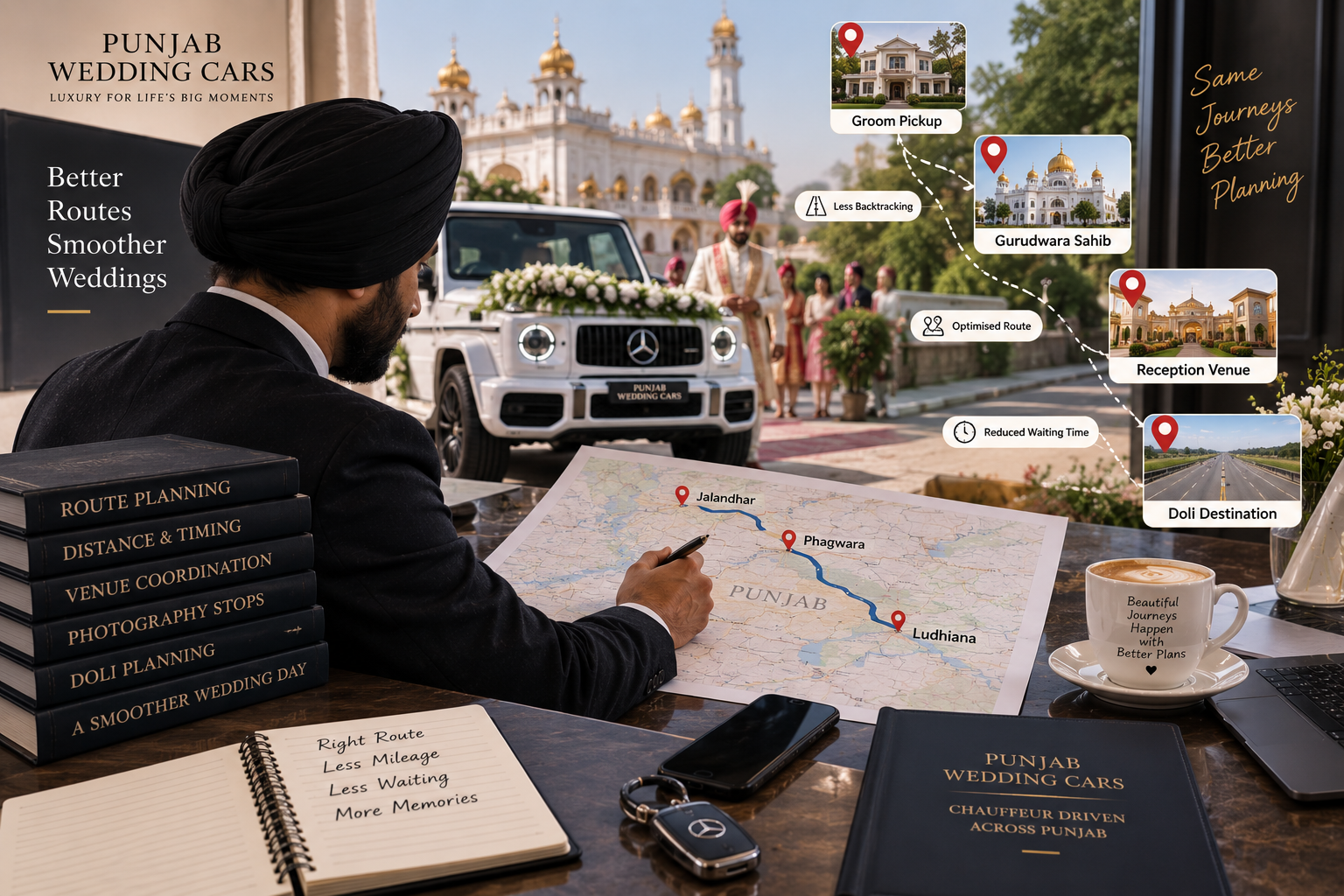
A luxury wedding car can cover far more distance during a Punjabi wedding than the bride or groom ever sees from the rear seat. The visible journey may appear simple: the groom leaves home, reaches the Gurudwara Sahib, continues to the reception venue and later travels for the doli. In practice, the vehicle may have already travelled to reach the pickup, moved between different entrances, waited while photographs were taken, returned toward an earlier location because of a forgotten stop, travelled to a hotel for another family member and then crossed the same road again before the wedding day is finished. Smart wedding-car route planning is not about rushing a Punjabi wedding or trying to eliminate every minute of waiting. Weddings naturally move at their own pace, and some waiting is necessary. The real objective is to remove movement that adds nothing to the experience. When the actual pickup point, ceremony location, reception venue, photography plan and final doli destination are understood early, Punjab Wedding Cars can plan the chauffeur-driven journey around the real wedding rather than around a rough city-to-city estimate. Couples can still choose whichever vehicle suits the occasion from the Punjab Wedding Cars luxury wedding-car fleet, but a well-planned route helps that vehicle spend more of the day doing what it was booked to do and less time travelling unnecessarily.
The Wedding-Car Route Starts Before the Groom Gets Inside
Families usually think of mileage from the moment the groom enters the car, but the vehicle’s working journey may begin much earlier. A Mercedes G Wagon G63 AMG, Mercedes Maybach or New Range Rover Sport may need to position itself from another location before reaching the wedding pickup, and that makes the exact address important. Saying that the groom is in Jalandhar, Ludhiana or Amritsar is useful for an initial enquiry, but it does not describe the complete journey. A hotel in central Jalandhar and a family residence twenty kilometres outside the city can create very different vehicle movements even though both families may casually describe the booking as a Jalandhar wedding. The same applies when the groom is getting ready in a farmhouse or village rather than a city hotel. Punjab Wedding Cars has already explored this issue in its guide to why the pickup address matters for an intercity wedding-car quote, because accurate routing begins with where the car actually has to report rather than with the name of the nearest city.
Planning the Whole Wedding Journey Prevents Backtracking
One of the most common causes of unnecessary mileage is planning each wedding movement separately instead of looking at the day as one continuous route. The groom may travel from home to the Gurudwara Sahib, then somebody decides photographs should be taken back near the original pickup, after which the car travels in the opposite direction again toward the marriage palace. Later, the same vehicle may be sent toward a hotel because a relative needs to collect something before returning to the venue. None of those movements may look significant when discussed individually, but together they can cause the car to cross the same part of the route several times. A smarter itinerary considers the direction in which the wedding is naturally progressing and places optional movements around that sequence. Photography can often happen at the groom’s pickup, outside the reception venue or at a location that already lies between the ceremony and the next function. A hotel stop can sometimes be scheduled before the ceremony rather than after it if that removes an unnecessary return journey. Smart routing does not change the wedding itself; it simply arranges the optional pieces so the principal wedding car is not travelling backwards and forwards across Punjab without a good reason.
Photography Should Fit Into the Route Instead of Creating a New Route
Luxury wedding cars are frequently chosen because couples want them in the photographs, so photography should be treated as part of the transportation plan rather than something added at the last moment. A groom who books the Mercedes G Wagon G63 AMG may want portraits beside the vehicle before the baraat leaves, while a groom choosing the Mercedes Maybach may prefer a more formal sequence of the chauffeur opening the rear door and the groom stepping out at the venue. Both can be accommodated without adding unnecessary mileage when the photography is planned where the vehicle already needs to be. If photographs are required after the Anand Karaj, the photographer can often identify a suitable location along the natural route toward the reception rather than sending the vehicle back toward an earlier part of the journey. The point is not to restrict the photographer’s creativity but to connect the photography plan with the actual geography of the wedding, because twenty good minutes with the car at the right location is usually more valuable than adding another hour of driving simply to reach a second photo spot.
Waiting Time Is Not Always Wasted Time
A wedding car remaining stationary does not automatically mean the route has been planned badly. During an Anand Karaj, there may be no reason for the main bride or groom car to travel anywhere else, and keeping the chauffeur positioned nearby can actually be the most efficient choice. If the vehicle leaves to perform another task, it has to travel away, complete that movement and return before the family is ready, which adds mileage and creates another opportunity for traffic or timing delays. Planned waiting therefore needs to be distinguished from avoidable waiting. If everyone already knows that the car will remain through the ceremony, lunch and photography before the doli, that time is part of the real booking. Avoidable waiting is different: it happens when a vehicle reports far earlier than necessary because the schedule was not realistic, or when the family keeps the car stationary for hours because nobody clarified when the next movement would actually happen. Punjab Wedding Cars explains this distinction further in its guide to wedding-car waiting time in Punjab, where the focus is on understanding how the car is genuinely required rather than pretending that every wedding will run exactly to the minute.
Chauffeur Reporting Time Should Match the Real Wedding Morning
An efficient route begins with a realistic reporting time. If the groom expects to leave at 9:00 a.m., the car should normally arrive earlier so there is time for positioning, final presentation and photography, but that does not mean the vehicle needs to be outside at 7:00 a.m. unless the family actually requires it then. The correct reporting time depends on what happens before departure. A groom who wants twenty minutes of G Wagon photography, a few family portraits and a calm baraat departure needs a different arrival plan from a groom who simply wants the vehicle ready shortly before leaving. This is why the wedding-car company should receive the actual schedule rather than a deliberately exaggerated early time “just to be safe.” Excessive buffers can create long unnecessary waiting, while schedules that are too tight create pressure and rushed photography. The best timing sits between those extremes, allowing the chauffeur to arrive with enough margin to support the wedding while still reflecting when the family realistically expects to move.
The Main Wedding Car Should Not Be Used for Every Family Errand
A major source of unnecessary mileage is treating the principal wedding car as though it were the family’s general transport vehicle for the day. The groom’s G Wagon may reach the ceremony and then be asked to collect a relative from a hotel, pick up clothing from another house or move luggage because another vehicle is unavailable. Each small request pulls the car away from the route it was booked to perform and increases the chance that it will be somewhere else when the groom or bride needs it. A better structure uses the headline car for the headline wedding moments while supporting vehicles handle ordinary family movement. Punjab Wedding Cars has vehicles such as the Audi A6, Jaguar XJL, BMW 530 and Land Rover Defender that can support parents, relatives and VIP guests while the main Maybach, G Wagon or Range Rover remains committed to the bride or groom. This kind of vehicle allocation often reduces both extra mileage and confusion because each car has a clear role.
Hotel and Marriage-Palace Entrances Can Create Unnecessary Repositioning
Large hotels and wedding venues can have several entrances, and poor access information can make even a short local journey inefficient. A chauffeur may be told to report to a hotel without being told that the groom is waiting at the banquet entrance on the opposite side of the property. The car reaches the main lobby, the family starts calling, and the driver has to circle the property or re-enter through another driveway. The same problem appears at large marriage palaces where guest traffic is sent through one gate while the groom’s ceremonial arrival is expected somewhere else. These are not large distances individually, but they create avoidable movement and disrupt the wedding schedule. A precise map pin combined with a simple local instruction can remove most of this problem. The best routing details are often not about highways at all; they are about knowing exactly where a luxury vehicle needs to stop when it reaches the destination. A five-minute conversation with the venue or local family member before the wedding can save repeated repositioning when hundreds of guests are already arriving.
Village Pickups Need Local Knowledge More Than Extra Mileage
Village and farmhouse weddings are not difficult simply because they are outside a city, but the final approach can require local knowledge that navigation apps do not provide. A route may lead a chauffeur directly toward the family home even though the last section of the lane is too narrow for a large luxury SUV once wedding tents, guest cars and catering vehicles are in place. If nobody checks beforehand, the chauffeur may drive into the lane, realise the vehicle cannot proceed comfortably and then reverse out before finding another stopping point. That entire movement is unnecessary. A family member in Punjab can usually identify a wider road or suitable meeting position in advance so the groom reaches the car there. This is particularly useful for the G Wagon G63 AMG, New Range Rover Sport and Defender, where positioning space matters more than with a small family car. Smart route planning at a village wedding often comes down to understanding the last few hundred metres rather than changing the main road journey.
Intercity Weddings Benefit Most From Better Sequencing
The larger the distances between wedding locations, the more important the order of those locations becomes. A wedding that begins near Jalandhar, continues toward Phagwara and ends in Ludhiana can remain relatively efficient if the vehicle generally moves in that direction throughout the day. The same wedding becomes much less efficient if a hotel stop sends the car back toward Jalandhar after the ceremony before it then turns around again for Ludhiana. Intercity route planning therefore depends as much on sequence as on distance. This is why the complete wedding itinerary should be shared rather than asking only for a quotation between two city names. Punjab Wedding Cars discusses the effect of detours, additional stops and real route movement in its guide to hidden wedding-car route costs in Punjab. The purpose is not to discourage couples from using several venues, but to make sure optional stops fit naturally into the direction of travel whenever possible.
The Doli Must Be Included in Route Planning From the Beginning
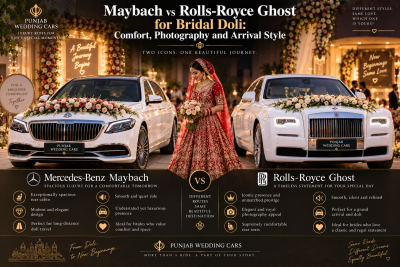
The bridal doli can transform a short local booking into a substantial intercity journey. The groom may travel only a few kilometres to the ceremony in the morning, while the bride and groom later travel an hour or more to the final destination. If the wedding-car route is planned only around the baraat, the most important final journey is missing from the picture. Including the doli early helps the company understand how long the vehicle is actually committed and also helps the couple decide whether the same car should remain throughout the day. A Mercedes Maybach, Rolls-Royce Ghost or Jaguar XJL can make particular sense when the couple expects a longer rear-seat journey after the wedding, while a G Wagon used mainly for the groom’s entrance may complete its role earlier. Once the doli destination is known, the complete route makes much more sense and unnecessary repositioning becomes easier to identify.
Separate Groom and Bridal Cars Can Sometimes Create a Cleaner Route
Using one luxury car for the entire wedding may sound more efficient, but it is not always the best route strategy. A groom may want the G63 specifically for his baraat while the bride prefers the Maybach for a long doli. Trying to force the G Wagon to remain through several hours of ceremony and reception only so it can perform the final bridal journey may create unnecessary waiting if the couple would genuinely prefer another vehicle later. In some weddings, separate headline cars allow each vehicle to follow a cleaner assignment. The G Wagon can complete the groom-side role while the bridal car is positioned according to the doli schedule. This does not automatically mean two luxury cars are cheaper, nor should it be done simply to reduce mileage, but it demonstrates an important planning principle: the vehicle allocation should follow the real roles within the wedding rather than assuming one car must perform every premium movement. Families can compare those roles through the Punjab Wedding Cars fleet before deciding whether one headline vehicle or separate groom and bridal cars make more sense.
Airport Transport Should Stay Separate From the Main Wedding Route
NRI weddings frequently add airport journeys to an already complicated transport plan, especially when relatives are arriving through Delhi, Amritsar or Chandigarh. It can be tempting to use the groom’s luxury vehicle for an important airport pickup because the car is already booked and the family wants to give the guest a premium experience. That decision can add substantial mileage and another timing dependency to a vehicle whose main purpose may be the baraat or bridal departure. Airport transportation is generally better planned as its own journey, particularly when international passengers are carrying significant luggage or travelling several hours from Delhi into Punjab. Punjab Wedding Cars provides airport pickup and drop services for Delhi, Amritsar and Chandigarh, allowing those movements to remain separate from the principal wedding-car schedule. The car that creates the best groom entrance does not necessarily need to be the car that performs a long airport transfer two days earlier.
One Family Transport Coordinator Can Eliminate Unnecessary Movement
Some route inefficiency comes from geography, but a surprising amount comes from conflicting instructions. One relative tells the chauffeur to begin moving toward the marriage palace, another asks the driver to return to the hotel, and a third later says the groom is still at the original location. The car may travel several unnecessary kilometres simply because nobody has authority over the transport plan. One local coordinator can prevent much of this. That person should understand which movement is genuinely next and should remain the main operational contact for the chauffeur. Other family members can still request changes, but those changes should be checked through the same coordinator before the principal wedding car starts moving. This becomes especially important at large NRI weddings where cousins, parents and wedding planners may all be helping. Clear communication can reduce extra mileage just as effectively as choosing a shorter road.
Google Maps Is Useful, but Wedding Routing Needs Local Judgment
Navigation apps are excellent for understanding distance, traffic and alternative roads, but they do not know the wedding context. A navigation system may recommend the fastest route to a marriage palace without knowing that the groom’s ceremonial entrance is on another side of the property. It may route a G Wagon through a narrow village lane that is technically passable but uncomfortable once cars are parked along it. It may also recommend a road that works well for one vehicle but becomes awkward for a large wedding convoy. This is where professional chauffeur experience and local family information matter. Smart route planning is therefore not the same as blindly choosing whichever route displays the fewest kilometres. Sometimes a slightly longer road produces a smoother arrival, reduces manoeuvring and avoids a congested market area. The objective is to remove unnecessary mileage without compromising the quality of the wedding journey.
Route Planning Also Makes the Original Quotation More Accurate
Accurate routing helps before the wedding day because it allows the quotation to reflect the service the family genuinely expects. A request based only on “Jalandhar to Ludhiana” leaves out the groom’s real pickup, ceremony location, waiting requirement, additional reception stop and final doli destination. When those details appear later, the actual booking may be much larger than the first enquiry suggested. Punjab Wedding Cars' guide to what details make an online wedding-car quote more accurate explains why genuine pickup, route and timing information create a more useful price than a rough city estimate. Better route planning therefore reduces surprises as well as mileage. The family understands what the car is expected to do, while the company can plan the chauffeur and vehicle around a realistic assignment from the beginning.
NRI Families Should Review the Route Before Flying to India
NRI couples often reserve their wedding car from Canada, the UK, Australia or the United States before the complete wedding itinerary exists. That is normal, but the booking should not remain frozen in the rough form it had six months earlier. Before flying to India, the couple and family in Punjab should look at the journey as it now stands. The hotel may be final, the Gurudwara Sahib confirmed, the reception venue booked and the doli destination known. This is the ideal stage to identify unnecessary backtracking, unclear access or optional stops that could be moved to a more logical point in the day. A family member in Punjab can provide the local knowledge while the couple retains control over the important wedding choices. By the time the bride or groom lands in India, the route should be coherent enough that wedding-week changes are refinements rather than a complete redesign of the transport plan.
Smart Route Planning Should Protect the Wedding Experience, Not Restrict It
Reducing mileage and waiting does not mean choosing the absolute shortest route at the expense of the wedding. A couple may genuinely want photographs at a special location. The groom may want a particular entrance even if another gate is closer. The bride may prefer a more comfortable vehicle for a longer doli even if keeping one car all day would technically reduce a transfer. Those decisions are part of the wedding experience and should remain. Smart planning focuses on movement that adds no value: repeated hotel runs, unnecessary return journeys, vehicles being sent away only to come back, and main wedding cars being used for errands that another family vehicle could perform. A well-planned route should feel relaxed rather than tightly controlled. The bride and groom should still have the photographs, entrance and doli they want; the transportation simply follows those moments in a more logical order.
A Good Wedding-Car Route Should Feel Invisible on the Day
The best route plan is one the family hardly notices once the wedding begins. The chauffeur reaches the correct pickup without having to circle a neighbourhood, the groom gets the photography time he expected, the vehicle moves naturally toward the ceremony, waiting happens where waiting is genuinely useful, and the next venue lies logically within the day’s movement. Supporting cars absorb family errands, the principal wedding car remains protected, and the doli destination is already known long before the bride leaves. Punjab Wedding Cars can then use vehicles from its luxury chauffeur-driven fleet according to clearly defined roles rather than continually repositioning the same car around changing instructions. Smart route planning therefore does more than reduce extra mileage. It makes the transport easier to coordinate, makes waiting more predictable, gives the chauffeur a clearer day and reduces the number of calls the bride, groom and family need to make. The result is not a wedding that feels scheduled to the minute; it is a wedding where the cars are simply where they need to be when they need to be there.