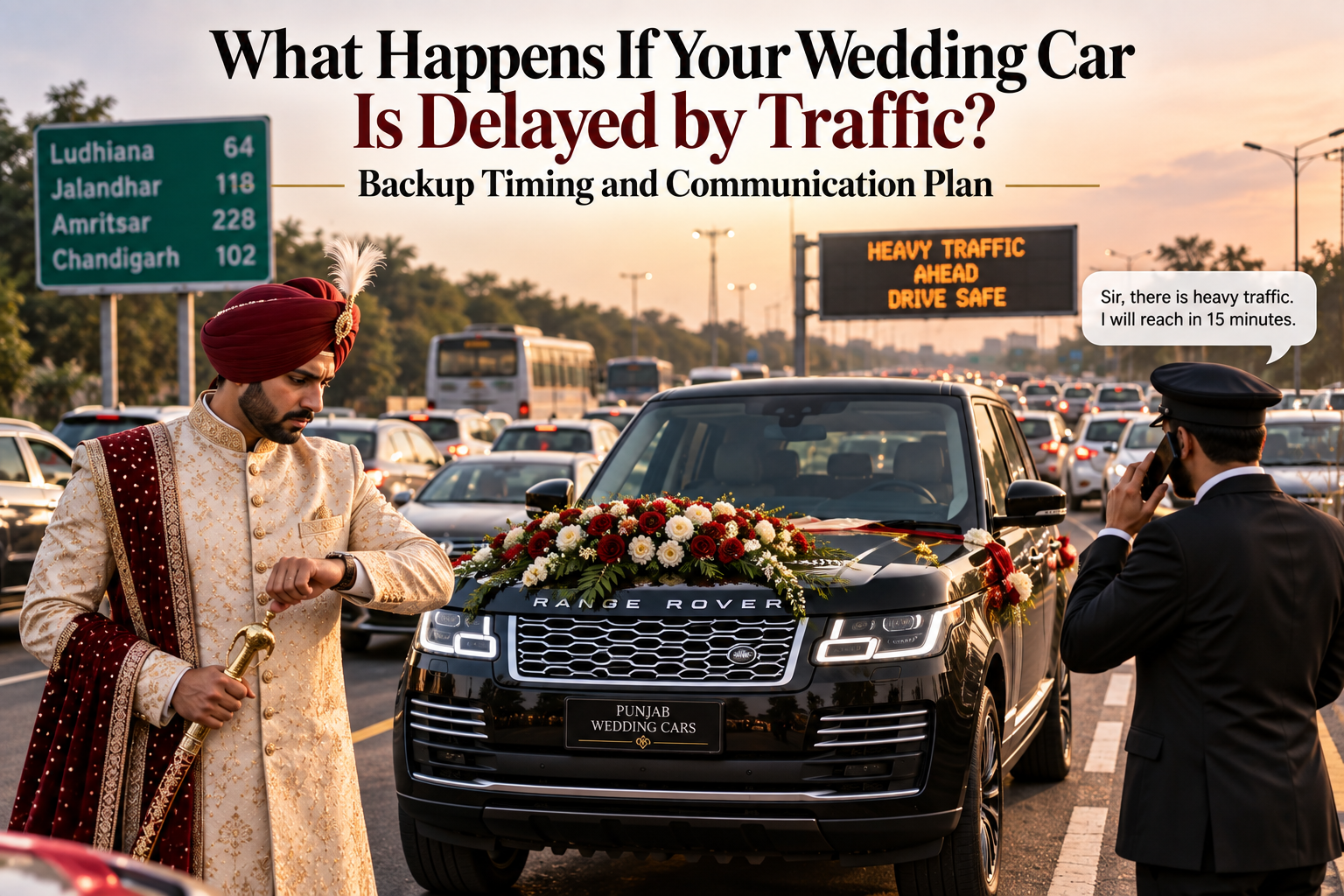
What Happens If Your Wedding Car Is Delayed by Traffic? Backup Timing and Communication Plan
A luxury wedding car being fifteen or twenty minutes late feels very different from an ordinary taxi being late. The groom may be dressed and waiting outside with the photographer, relatives may already be gathering for the baraat, the bride may have a fixed salon-to-Gurudwara movement ahead, or the family may be trying to reach an Anand Karaj where timing affects several other parts of the day. That is why traffic delay should not be treated as something to think about only after the chauffeur calls to say the road has slowed down. Good wedding transport planning builds enough flexibility into the schedule that ordinary traffic does not automatically become a wedding emergency. Punjab roads can involve city congestion, busy market areas, highway slowdowns, railway crossings, local functions, construction, agricultural traffic and unexpected diversions, but the important question for the family is not whether traffic can happen. It is how the transport plan behaves when it does.
For couples booking through Punjab Wedding Cars, the strongest approach is to separate three timings that families often mistakenly treat as one: the time the chauffeur should report, the time the family expects to leave and the time the vehicle genuinely needs to reach the ceremony or venue. Punjab Wedding Cars' own wedding-car arrival guide already makes the point that a chauffeur should normally report before the intended departure because families still need time for vehicle checks, decoration, photography and passenger preparation. citeturn157382search6 That gap is not wasted time. It is one of the first layers of protection against a delay becoming a crisis.
A Wedding Car Should Not Be Scheduled to Arrive at the Exact Departure Time
If the groom intends to leave home at 8:00 AM, asking the car to arrive at 8:00 AM leaves no room for anything to go slightly wrong. Even if the chauffeur reaches the house exactly on schedule, the family may still want to inspect the vehicle, adjust flowers, take photographs with parents, complete the sehra ceremony or wait for relatives before leaving. A better wedding schedule gives the vehicle an earlier reporting time and treats the planned departure as a separate moment. Punjab Wedding Cars' existing timing guidance explains that the correct reporting time depends on the ceremony, pickup location, route, weather, traffic and planned stops rather than one universal rule for every wedding. citeturn157382search6 This distinction becomes especially useful on a traffic-heavy morning because a chauffeur who encounters a fifteen-minute slowdown may still reach the family before they actually need to leave. The family sees the car slightly later than the ideal reporting time, but the Anand Karaj schedule remains protected.
Traffic Buffer Should Be Built Into the Journey, Not Added After the Delay
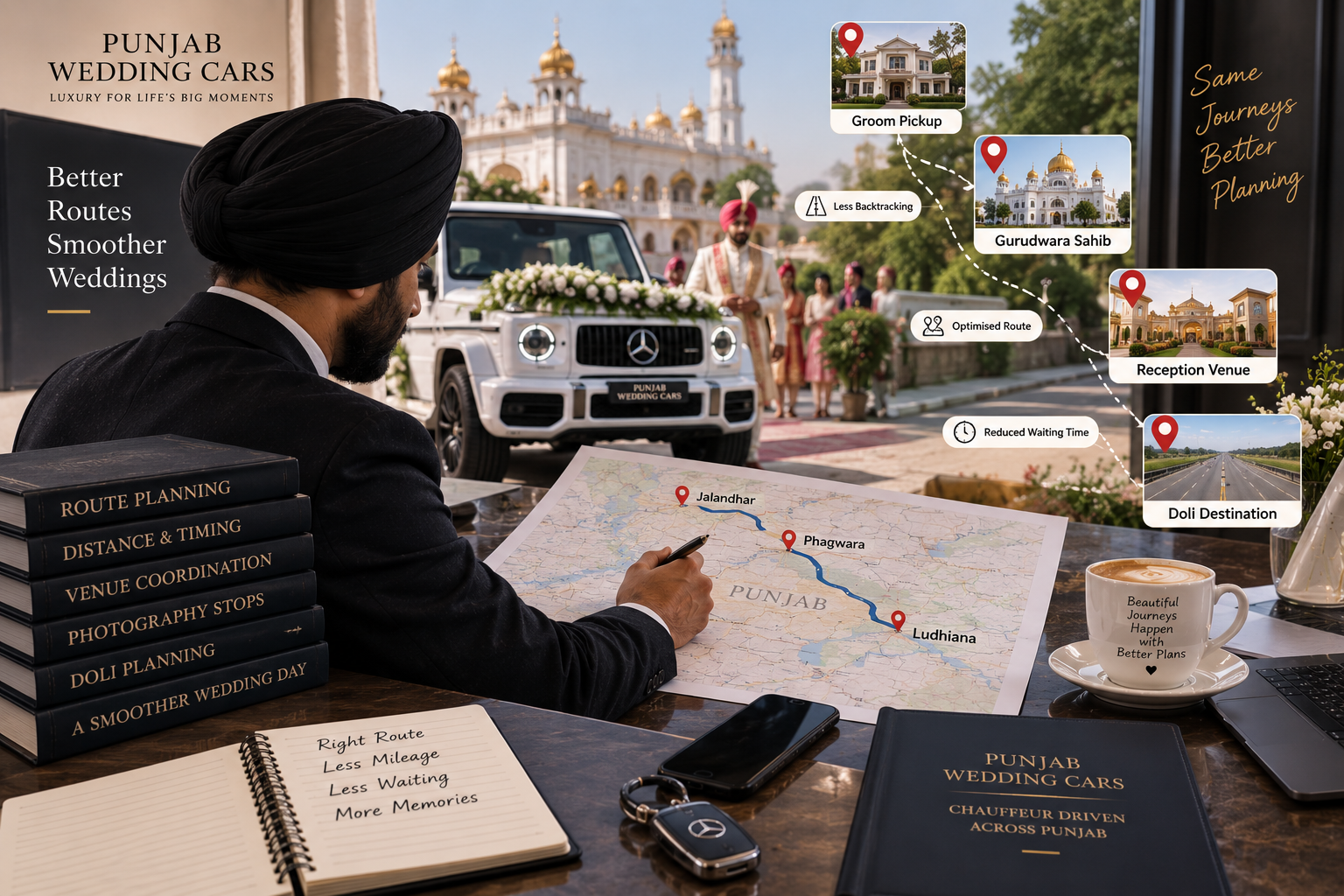
Families sometimes say they will “leave early if traffic is bad,” but by the time traffic is obviously bad the useful planning window may already have disappeared. Buffer time works best when it is built into the original route. If the groom must reach a Gurudwara at a particular time, the family should work backwards from that arrival rather than starting with the time they would prefer to leave home. The route may include a city exit, highway movement, village approach and final Gurudwara parking, all of which take time beyond the simple distance shown between two place names. The exact pickup point is especially important for intercity weddings because a home in a village outside Jalandhar or Ludhiana can add meaningful local travel before the chauffeur even joins the main road. Punjab Wedding Cars' guide to intercity pickup addresses explains that the actual home, hotel or village location affects reporting time and route planning, not merely the headline city-to-city distance. citeturn157382search1 A realistic buffer therefore belongs inside the original journey calculation rather than appearing as an emergency adjustment after everybody is already dressed and waiting.
Not Every Fifteen-Minute Delay Is a Wedding Emergency
Wedding mornings can make small transport variations feel much larger than they are. If the car was scheduled to report at 7:15 AM for an 8:00 AM departure and reaches the house at 7:30 AM, the chauffeur is technically fifteen minutes behind the ideal reporting time, but the family may still have thirty minutes available before departure. That situation requires communication, not panic. The problem becomes more serious when the vehicle was already booked too tightly and the reporting time, departure time and ceremony time were almost identical. This is why families should judge a delay against the actual wedding deadline rather than the first number in the schedule. The transport coordinator needs to understand whether the car is simply running later than expected or whether the route now threatens the ceremony timing. Those are very different situations, and reacting to both as though the wedding is collapsing can create more confusion than the traffic itself.
The Chauffeur Should Contact One Coordinator, Not Ten Relatives
Communication becomes critical as soon as a delay develops, but more communication is not always better. If the chauffeur calls the groom, then the groom's brother calls another driver, an uncle calls the booking office, a cousin sends a different location pin and somebody else tells the chauffeur to use another entrance, the transport plan can become less organised precisely when clarity matters most. One family transport coordinator should normally receive the chauffeur's update and pass the relevant information to the people who actually need it. That coordinator may be the groom's brother, a cousin, wedding planner or another reliable family member, but ideally not the bride or groom themselves. The chauffeur can then say that traffic has slowed on the current route, give the best available updated reporting expectation and continue driving rather than repeatedly answering calls from different relatives. A calm communication chain is one of the most useful backup systems because it prevents ordinary road delay from turning into ten people giving competing instructions.
The Groom's Delay and the Bride's Delay Have Different Consequences
A groom car delayed before a baraat often affects a visible chain of events. Family photographs may shift, dhol timing may move, relatives may start assembling before the car arrives and the planned departure towards the Gurudwara can slide. A bridal-car delay can create a different problem because the bride may be moving between a salon, family home, Gurudwara, hotel or doli point where privacy and preparation timing matter more than the public spectacle of the baraat. The backup plan should reflect these differences. For a groom pickup, the family may be able to continue sehra, photographs or other home preparations while the vehicle is approaching. For a bride, the coordinator may instead need to adjust when she leaves the dressing area or whether a later photography sequence should move. Treating both situations as simply “the wedding car is late” ignores how differently those cars function within the day.
Anand Karaj Timing Should Control the Transport Schedule
For Sikh weddings, the Gurudwara Sahib timing deserves more protection than optional photography stops or a leisurely baraat departure. If the family has an agreed ceremony schedule, road planning should work backwards from the time the groom, bride and essential family members need to be there. Photography outside the house, a longer-than-expected groom send-off or a scenic stop cannot be allowed to consume every minute that was originally reserved as travel buffer. Punjabi weddings naturally move around their printed schedules, and Punjab Wedding Cars' guide to wedding-car waiting time notes that ceremonies, photography and doli timings often extend beyond the original plan. citeturn157382search0turn157382search2 That flexibility should not be confused with having no priorities. When traffic has already reduced the available margin, the ceremony should take precedence over optional stops that can be shortened, moved or photographed later.
A Baraat Should Not Depend on the Fastest Possible Road Time
One of the most fragile wedding plans is a schedule that only works if the route performs exactly like the fastest estimate. A groom may technically be able to reach the Gurudwara in forty minutes under clear conditions, but that does not mean the wedding should be designed around a forty-minute journey. The chauffeur may need to leave a residential area slowly because relatives are gathered around the car, the convoy can take longer to organise, the vehicle may move behind dhol for part of the departure, and the final approach to a venue can involve parking congestion. A luxury wedding car also should not be expected to recover lost time through aggressive driving. The correct backup for traffic is earlier planning and cleaner communication, not asking the chauffeur to drive faster because the family left with no margin.
Convoys Need More Buffer Than a Single Groom Car
A single chauffeur-driven G Wagon or Maybach can respond to traffic more easily than a convoy of five or six vehicles. Convoys become separated at junctions, traffic lights and busy roundabouts, while slower family cars behind the lead vehicle can affect the pace of the entire group. If the groom is travelling in a G63 AMG with Range Rovers and family cars behind him, the family should decide whether every vehicle genuinely needs to remain together throughout the road journey or whether the principal wedding car can proceed according to the ceremony schedule while other relatives follow safely. Punjab Wedding Cars' guidance on single cars versus luxury convoys emphasises the value of coordinated lead vehicles rather than simply creating the longest possible procession. In a traffic-delay situation, that principle becomes even more useful because the groom's required arrival should not necessarily be held back by a distant relative who missed a turn several kilometres earlier.
The Exact Pickup Address Can Create or Remove Delay Before the Journey Begins
Many apparent traffic delays actually begin with poor pickup information. A chauffeur may reach the correct village but be sent to the wrong side of it, discover that the family's preferred lane is blocked by tents or parked vehicles, or receive a city name without the actual hotel or house location. Punjab Wedding Cars' intercity booking guidance specifically recommends providing the real pickup point because local access, village approaches and exact addresses affect when the chauffeur can report. citeturn157382search1 Families can reduce this risk by sharing the correct location pin before the wedding day and mentioning any unusual access issue that matters to a large luxury vehicle. If a G Wagon cannot comfortably enter the narrow lane where the groom's house is located, it is better to identify a nearby pickup point beforehand than discover the problem while the photographer and twenty relatives are waiting outside.
Venue Entry Traffic Can Be Just as Important as Highway Traffic
A wedding car may complete the intercity journey on time and still lose twenty minutes at the final kilometre. Marriage palaces can have several functions nearby, Gurudwaras may have busy parking areas, hotel entrances can become crowded with guest vehicles and farmhouses may use narrow access roads that slow down once the baraat reaches the property. The transport schedule should therefore protect the final approach rather than assuming that reaching the destination city means the journey is finished. When the family knows that a particular palace has a separate groom or baraat entrance, that information should be shared with the chauffeur beforehand. The same applies when wedding planners have organised a specific holding point for the groom car before the formal entry. Knowing where the car needs to stop prevents the chauffeur from wasting valuable minutes looking for the correct gate while multiple relatives provide different instructions.
Photography Is the First Thing to Compress When Traffic Has Used the Buffer
Wedding photography is important, but its timing should remain flexible enough to protect the ceremony. If traffic has taken twenty minutes out of the morning schedule, the family can often shorten the static car photographs before departure and capture additional vehicle shots later at the Gurudwara, reception venue or another controlled point. This is much safer than telling the chauffeur to make up the same twenty minutes on the road. A groom may only need a few strong photographs outside his home before leaving rather than a complete editorial shoot involving several relatives and multiple car positions. Similarly, the bride's doli car can often be photographed later in the day when the vehicle is stationary. A good backup timing plan recognises which elements of the schedule are fixed and which can move without affecting the ceremony.
A Delay During the Ceremony Creates a Different Problem
Traffic is not the only reason the day's transport can move. Sometimes the chauffeur reports correctly, the couple reaches the ceremony on time and the wedding itself runs later than expected. Punjab Wedding Cars' waiting-time guidance explains that agreed waiting may already form part of a booking, while major extensions can change the assignment depending on the duration and original requirement. citeturn157382search5 The useful lesson for traffic planning is that the vehicle schedule needs some tolerance on both sides of the journey. If the car reaches the Gurudwara late because of traffic and the ceremony later runs long as well, the entire day can shift. Families should therefore communicate major changes rather than assuming the chauffeur automatically knows that the doli will now be two hours later. The transport provider can only manage the moving schedule properly if the people coordinating the wedding keep the vehicle team informed.
A Backup Plan Does Not Always Mean Sending a Second Luxury Car
When families hear the phrase “backup vehicle,” they sometimes imagine that a second G Wagon or Maybach should physically follow the main car throughout the entire day. That is rarely the most practical interpretation. A strong backup plan is usually operational before it is mechanical. The booking office knows the assignment, the chauffeur has the exact locations, the family coordinator has working contact numbers, the route contains buffer time and the ceremony timing is clear. If an exceptional problem affects a vehicle rather than ordinary traffic, the company can then respond according to availability and the situation. Traffic itself usually cannot be solved simply by dispatching another car from behind the same congestion. In many cases, a better backup is an earlier reporting schedule and a transport team that knows how important the journey is within the wedding timeline.
The Family Should Know When to Stop Waiting for a Particular Photo or Relative
Some wedding delays are blamed on traffic even though the real problem occurred before the car moved. The vehicle may be outside on time while a relative needed for photographs has not arrived, the groom is still finishing preparation or the family is waiting for one final ceremony at home. Once the journey already contains a known traffic risk, somebody needs the authority to say that the car should leave. This is especially important when a Gurudwara timing is involved. Waiting another fifteen minutes for one cousin before departure can easily become thirty minutes once that delay combines with road congestion. A good wedding-day coordinator protects the important timing without making the groom or bride responsible for every decision.
Intercity Weddings Need a Larger Communication Window
Traffic communication becomes even more important when the wedding car is travelling between cities. A local fifteen-minute journey can tolerate more uncertainty because the chauffeur remains relatively close to the destination. On an Amritsar-to-Jalandhar, Ludhiana-to-Chandigarh or another intercity wedding route, a slowdown can develop much earlier and affect the expected arrival substantially. The family should receive useful updates when the situation materially changes rather than expecting the driver to send messages every few minutes while driving. If the journey appears likely to affect the ceremony, the transport coordinator can then alert the photographer, dhol team or wedding planner and begin adjusting flexible parts of the schedule. The objective is not to create continuous tracking anxiety. It is to make sure the people who can actually change something receive the information early enough to act.
Keep the Main Wedding Car Separate From Unnecessary Pre-Wedding Jobs
A car booked for the groom's main departure should not be sent on an unrelated guest pickup shortly beforehand unless that movement is deliberately part of the assignment. The same applies to a bridal Maybach or Rolls-Royce that needs to report at a hotel or salon later in the day. Additional trips introduce additional road exposure, waiting and traffic risk before the vehicle reaches the moment for which it was primarily booked. Supporting cars can handle guest, parent and hotel movements while the principal wedding vehicle remains focused on the couple. This separation is especially useful on busy wedding dates because it prevents one delayed guest transfer from becoming a delayed groom or bridal pickup.
Communication Should Remain Calm and Specific
The most helpful delay message is not “traffic bahut hai.” The family needs to know what has actually changed. The chauffeur or transport coordinator should communicate that the car is on the way, that the current route has slowed, and that the expected reporting time has moved from one realistic window to another. The family coordinator can then decide whether photography should be shortened, relatives should remain inside for a little longer or another part of the sequence can continue while the vehicle approaches. Dramatic messages create dramatic reactions. Specific information creates decisions. The same standard should apply when the family updates the chauffeur. Instead of saying “baraat late hai,” it is more useful to explain that the groom now expects to depart approximately thirty minutes later so the driver understands the revised movement.
Written Booking Details Make Delay Management Easier
Before the wedding, the family should have a clear understanding of the reporting location, reporting time, planned route, destinations and approximate waiting requirement. Punjab Wedding Cars' booking and pricing guidance explains that accurate pickup, drop, route and waiting information helps define the actual wedding assignment. citeturn157382search4turn157382search1 When those details are recorded properly, it becomes much easier to understand whether the vehicle is genuinely late or whether the family has changed the schedule. If the booking says the chauffeur reports at the groom's home at 7:15 AM and the family later decides they actually need the car at 6:45 AM for photography, that difference should be communicated beforehand rather than appearing as a dispute on the morning itself.
The Best Backup Plan Is One the Couple Barely Notices
A well-planned wedding does not eliminate traffic. It prevents ordinary traffic from controlling the day. The car is asked to report before the departure time, the route includes sensible margin, the exact pickup and venue locations are already shared, one family coordinator speaks to the chauffeur, and everyone understands which moments are fixed and which can be compressed. If the road slows, the photographer may lose fifteen minutes rather than the Anand Karaj. If the chauffeur is delayed reaching the groom, family preparations continue instead of twenty people repeatedly calling the driver. If the ceremony later runs late, the transport team receives the revised timing rather than being left to guess.
That is the useful definition of a wedding-car backup plan.
Punjab Wedding Cars provides chauffeur-driven luxury wedding cars across Punjab, Chandigarh and longer wedding routes, but even the best vehicle cannot remove every unpredictable condition from the road. What professional transport planning can do is create enough structure around the journey that a normal delay remains manageable. Families can also read the existing guide to wedding-car waiting time when a Punjabi wedding runs late and the guide explaining why the exact pickup address matters for an intercity wedding-car quote when building the wider transport schedule. citeturn157382search0turn157382search1
The safest mindset is not to ask, “What if there is traffic?”
Assume that some part of the wedding day may move more slowly than planned, and build the transport schedule so the important moments can absorb it. When reporting time, route buffer and communication are planned properly, traffic may change the clock, but it does not have to change the wedding.