Planning Wedding Cars Across Punjab and Delhi for Overseas Guests
When relatives are flying in from Canada, the UK, Australia, the United States, Europe or the Middle East for a Punjabi wedding, transportation can become much bigger than arranging one bridal car and one groom car. A family may have grandparents landing at Delhi Airport, cousins arriving in Amritsar, another group staying in Chandigarh, the groom’s family based in Jalandhar and the wedding functions taking place across two or three different locations.
That is where NRI wedding transportation starts becoming a coordination job rather than a simple car booking.
The mistake is usually not booking too few luxury cars. The bigger problem is failing to separate airport travel, family movement and the main wedding-car requirements. When all three are mixed together, one relative starts arranging Delhi pickups, another books cars in Punjab, somebody else changes a hotel destination and the bride or groom eventually receives messages from several drivers asking where everyone is supposed to go.
For overseas families, the most effective system is to plan transportation in layers. Delhi Airport arrivals should be treated as long-distance guest transfers. Punjab hotel and family movement should be organised around where people are actually staying. The bride and groom’s wedding cars should remain protected from routine guest transport. Once these movements are separated, even a large NRI wedding becomes considerably easier to manage.
Punjab Wedding Cars provides airport pickup and drop services for Delhi, Amritsar and Chandigarh, as well as chauffeur-driven wedding transportation across Punjab and Delhi NCR. That wider coverage can be useful when the same wedding has guests entering Punjab through several different arrival points. Punjab Wedding Cars
Start With Where Overseas Guests Are Actually Landing
An NRI wedding invitation may say that relatives are “coming from Canada,” but that information is not enough to arrange transportation.
The transport plan begins with the airport.
One family from Vancouver might land at Delhi Airport because its flight connections are convenient. Another relative from Birmingham may travel directly to Amritsar. Someone flying from Australia may connect through Delhi and continue to Chandigarh. Even guests attending the same wedding can therefore require completely different pickup arrangements.
For each overseas arrival, the useful information is the airport, flight arrival time, passenger count, approximate luggage requirement, destination in Punjab and a working mobile or WhatsApp number.
The destination matters just as much as the airport. A Delhi Airport pickup ending in Ludhiana is not the same booking as one continuing to Jalandhar, Amritsar, Patiala or Chandigarh.
This is why the family should avoid sending a chauffeur a message saying, “Three guests arriving from Toronto on Friday.”
The chauffeur needs to know which flight, which airport, where the passengers will exit, how many people are travelling and where the journey finishes.
For families planning several NRI arrivals, the existing Punjab Wedding Cars guide on VIP wedding guest transport from airport pickup to venue entry is also useful because airport collection should connect with the rest of the wedding itinerary rather than operate as an isolated booking.
Delhi Airport Guests Need a Different Plan From Guests Landing in Punjab
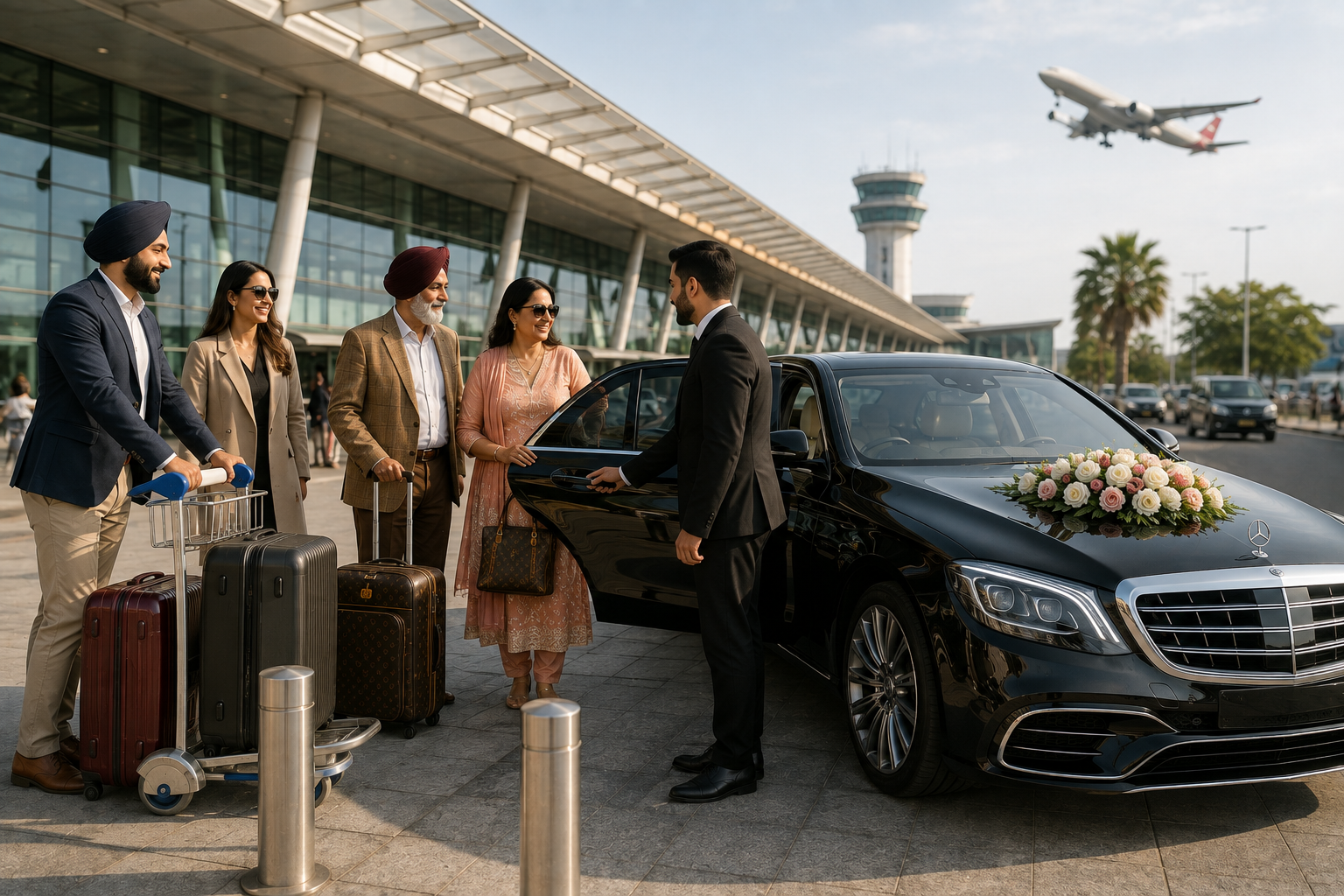
Delhi Airport deserves its own transportation plan because travelling from Delhi into Punjab is normally a substantial road journey rather than a short local airport transfer.
For many wedding destinations in Punjab, northbound road movement uses the Delhi–Panipat–Karnal–Ambala corridor before continuing toward different parts of Punjab. NHAI identifies the Panipat–Jalandhar section as part of NH44, one of the major highway corridors connecting Delhi-side traffic with Punjab. National Highways Authority of India
From the passenger’s perspective, however, the highway number matters less than the length of the complete travel day.
Someone may already have spent eight, ten or fourteen hours travelling internationally before reaching Delhi. Immigration, baggage collection and airport exit add more time. The guest then has a significant journey into Punjab.
That changes the type of vehicle you should book.
A car selected for a twenty-minute wedding entrance is not necessarily the vehicle you would choose for grandparents travelling from Delhi Airport to Punjab with several suitcases.
For long-distance overseas guest transfers, comfortable seating, luggage capacity, effective air conditioning, a professional chauffeur and sensible journey planning usually matter more than having the most dramatic wedding car available.
Do Not Send the Bride’s or Groom’s Main Wedding Car to Every Airport Pickup
This is an easy mistake to make when the family has booked a particularly desirable vehicle.
Suppose the groom has reserved the Mercedes Maybach for his wedding day. A relative may think it would be impressive to use the same car to collect an important uncle from Delhi Airport two days earlier.
It certainly looks impressive.
Operationally, however, the family should first ask whether that is the best use of the principal wedding car.
Long-distance airport work adds mileage, road exposure and scheduling dependency to a vehicle that may have been selected specifically for the groom or bride. If the flight is delayed or the transfer takes longer than expected, the car becomes tied to an airport movement rather than remaining part of the wedding plan.
There are situations where an ultra-luxury airport transfer makes perfect sense, particularly for VIP relatives or parents. But it should be a deliberate booking rather than an automatic extension of the bride or groom’s car.
For many guests, an Audi A6, Jaguar XJL or another executive chauffeur-driven vehicle may provide exactly the level of comfort required without occupying the headline wedding car.
Plan for Luggage Before You Choose the Airport Car
Wedding families often underestimate overseas luggage.
A couple arriving for a three-week trip may have two or three large suitcases. Parents may be carrying wedding clothing separately. Relatives sometimes travel with gifts, additional cabin baggage and garment bags.
Four passengers therefore do not always mean that an ordinary four-passenger luxury car is suitable.
Passenger capacity and luggage capacity are different things.
A premium saloon can be exceptionally comfortable for two overseas guests but become impractical when several large suitcases need to travel with them. A larger SUV such as the New Range Rover Sport or Land Rover Defender may suit certain airport transfers better when luggage volume is substantial.
The important thing is to tell the transportation provider about the luggage before the car reaches the airport.
Discovering at Delhi Airport that every suitcase cannot fit comfortably creates exactly the kind of problem advance planning is supposed to prevent.
Do Not Treat Every Overseas Guest as a VIP-Car Requirement
A large NRI wedding can easily have twenty, thirty or more relatives arriving from abroad.
Trying to give every passenger an individual luxury saloon can create a complicated fleet with very little practical benefit.
Instead, decide where premium cars genuinely improve the experience.
Parents of the bride or groom, elderly grandparents, an important family guest or a couple travelling directly to a high-end wedding hotel may justify a more personalised chauffeur-driven pickup. Larger family groups may be better organised together depending on passenger and luggage requirements.
Luxury transportation should solve a wedding problem, not create one.
If five members of the same family land on the same flight and are travelling to the same hotel, it is usually better to plan them as one arrival group rather than treating them as five separate bookings.
This principle becomes even more valuable at Delhi Airport because every additional independent pickup creates another vehicle that must travel between Delhi and Punjab.
Never Use the Scheduled Landing Time as the Pickup Departure Time
Flight arrival time and airport departure time are not the same.
An international flight may land at one time, but passengers still need to disembark, complete immigration formalities, collect baggage and exit the terminal.
Families should therefore avoid planning the next part of the wedding itinerary too tightly around the flight’s scheduled arrival.
If grandparents are arriving at Delhi Airport after a long international journey, do not organise a family function in Punjab based on the assumption that they will leave the airport immediately after the aircraft lands.
The same principle applies when a guest is supposed to travel directly from the airport to a mehndi, sangeet, jaggo or reception.
Allow the arrival day some breathing room.
Wedding transportation becomes much more reliable when the itinerary is designed around real passenger movement rather than the time printed beside the flight number.
Track Flights, but Keep a Human Contact Too
Flight tracking is extremely useful, but it does not replace direct communication.
A chauffeur may know that the aircraft has landed without knowing that one passenger’s suitcase has not arrived. The flight may show as completed while the family remains inside the terminal dealing with immigration or baggage.
Give the arriving guest the chauffeur or transport coordinator’s contact details before the flight whenever practical.
The local family coordinator should also have the guest’s number.
That creates a simple communication triangle between the passenger, family and transportation team.
For elderly relatives who may not use Indian mobile data immediately after landing, nominate another passenger in the same group as the communication contact.
Airport transport should not depend on everyone finding a WhatsApp message after leaving a twelve-hour flight.
Delhi and Punjab Transport Should Have One Coordinator
Large NRI weddings often fail at transportation because too many relatives are trying to help.
One person books the Delhi Airport cars.
Another handles Amritsar arrivals.
A cousin manages the hotel.
The groom’s brother deals with wedding-day cars.
The bride’s uncle begins changing return-airport pickups.
Each person may be competent, but there is no single view of the transportation plan.
The family should nominate one transport coordinator who understands the complete picture.
That person does not need to personally answer every chauffeur call. They simply need authority over the final transport schedule.
If a Delhi pickup changes destination from Jalandhar to Ludhiana, the coordinator should know. If a guest extends their hotel stay, the coordinator should know. If one luxury car has been reserved specifically for the groom and cannot be reassigned, the coordinator should know.
For a large overseas wedding, transportation works much better when someone can see the complete board rather than only one journey.
Keep Delhi Airport Transfers Separate From Wedding-Day Cars
A useful transport plan should have a mental dividing line between arrival transport and wedding transport.
Arrival transport gets people into Punjab.
Wedding transport moves them through the celebrations.
That distinction helps avoid scheduling conflicts.
Once an overseas guest reaches their hotel or family home in Punjab, their Delhi Airport journey is complete. They should then become part of the local wedding transportation plan rather than continuing to use the airport-transfer vehicle automatically for every function.
For example, relatives arriving in Delhi may travel to a hotel in Jalandhar one day, attend a jaggo the next evening, travel to the Anand Karaj two days later and attend a reception somewhere else that night.
Those are separate transportation requirements.
Planning them individually allows the family to choose appropriate vehicles for each stage instead of paying for premium long-distance cars to remain unnecessarily tied to individual guests.
Protect the Groom’s Arrival Car From Guest Logistics
The groom’s wedding car should have a clear job.
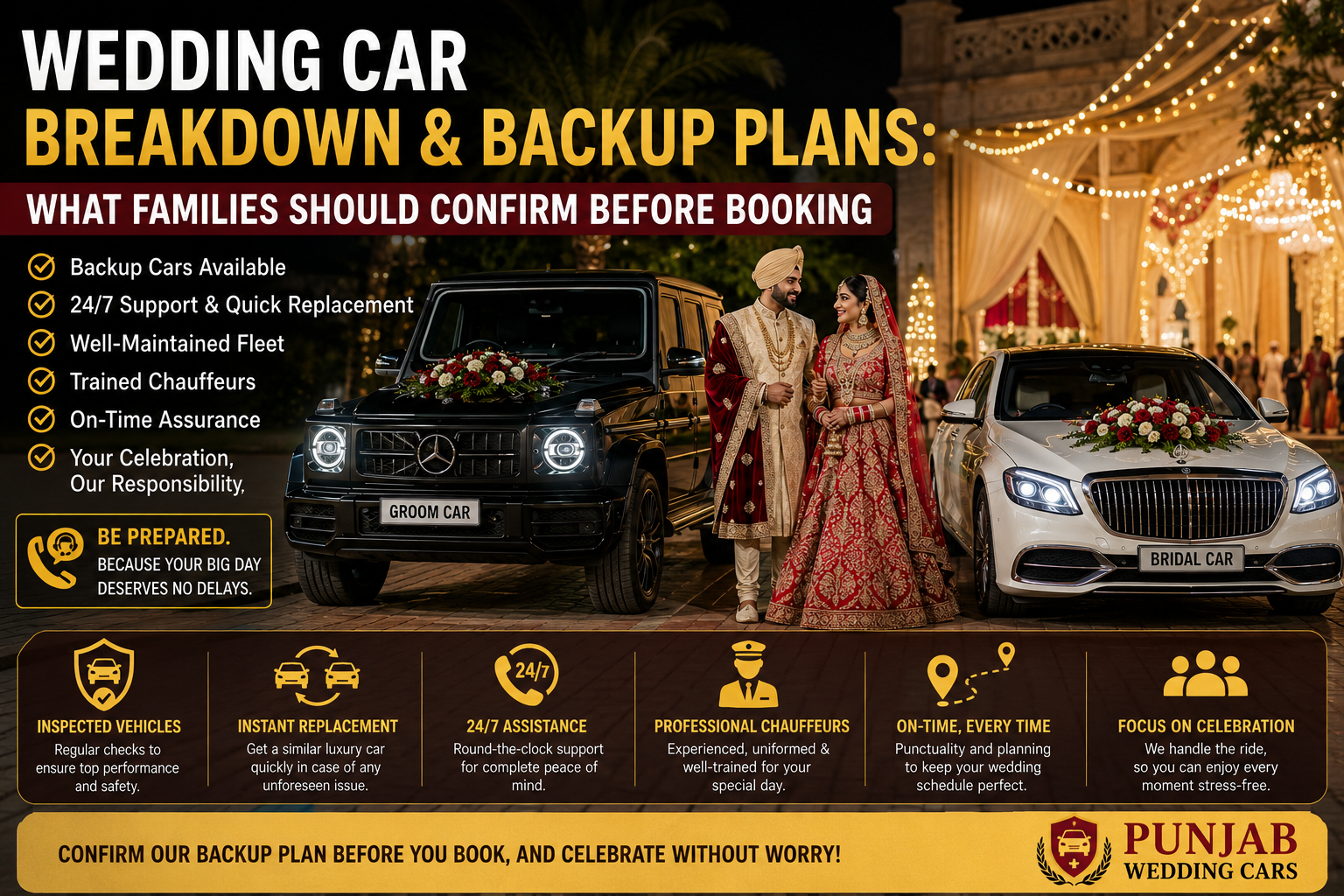
If he has selected the Mercedes G Wagon G63 AMG because he wants a strong baraat arrival, that vehicle should be scheduled around the groom.
It should not suddenly become the vehicle collecting relatives from a hotel because another family car is running late.
The same applies to the Mercedes Maybach, Rolls-Royce Ghost or any other principal wedding car.
The main wedding car is one of the few vehicles in the transport plan that should generally remain protected from improvisation.
Its chauffeur needs time to reach the pickup, present the vehicle properly, coordinate decoration if required and remain ready for the groom or bride.
Using that car as general family transport before the ceremony can introduce delays into the one journey where the family usually wants the highest level of punctuality.
Plan the Bridal Doli as Its Own Long-Distance Journey
The bridal car may have an even more complicated route than the groom’s arrival car.
A bride can be picked up after the ceremony or reception and then travel a significant distance to the groom’s residence, hotel or another city.
For NRI couples, the first destination after the doli may not even be the traditional family home. Some couples stay at a hotel because additional wedding functions are taking place the next day. Others may travel between districts.
The doli route should therefore be confirmed independently of guest transportation.
A Mercedes Maybach may suit a couple prioritising a quieter, formal rear-seat experience. A Rolls-Royce Ghost gives the doli a very different visual character, while a New Range Rover Sport may appeal to couples who prefer SUV styling and a higher seating position.
The best bridal car is not necessarily the car being used for overseas guests.
These jobs should remain separate unless the itinerary genuinely makes combining them sensible.
Think in Terms of Transport Zones Across Punjab
When an NRI wedding involves several Punjab cities, it helps to think of the plan geographically.
Delhi is one transport zone.
The family’s main Punjab base is another.
The ceremony and reception areas may form another.
Airport arrivals at Amritsar or Chandigarh may create separate movements again.
For example, a family may be based in Phagwara while overseas relatives stay in Jalandhar. The Anand Karaj may take place near the groom’s village while the reception is in Ludhiana. Another group may land in Delhi the night before.
Trying to manage that wedding with one list of “cars needed” is difficult.
Instead, determine which people need to move between which zones.
This reveals where a chauffeur-driven long-distance car is genuinely necessary and where relatives are simply moving locally between a hotel and venue.
It also prevents unnecessary empty travel.
Delhi Airport Is Not Always the Best Arrival Point for Every Guest
Overseas families sometimes tell every relative to fly into Delhi simply because Delhi offers extensive international connectivity.
That may be convenient for the flight but inconvenient for the wedding.
A guest attending a wedding closer to Amritsar may find a suitable connection into Amritsar Airport. A family whose functions are centred around Chandigarh, Mohali, Rupnagar or nearby areas may prefer a Chandigarh arrival where flight options work.
The correct decision depends on the individual itinerary.
Punjab Wedding Cars lists airport transfers for Delhi, Amritsar and Chandigarh, so families can treat these as separate gateways rather than automatically routing every guest through Delhi. Punjab Wedding Cars
The important comparison is not simply the airfare.
Consider the international flight, connection, luggage, road journey after landing and final wedding destination together.
A slightly different flight can sometimes remove several hours of road travel from an already exhausted guest’s arrival day.
Give Elderly Overseas Guests a Different Transport Standard
Grandparents and older relatives should not automatically be placed into whatever car is available.
After a long-haul flight, priorities change.
Easy entry and exit become important. Seating comfort matters. Good climate control matters. Smooth chauffeur behaviour matters. The ability to stop when required matters.
If an elderly couple is travelling from Delhi into Punjab, a comfortable executive or luxury vehicle may provide more value than choosing something simply because it looks dramatic in photographs.
For these journeys, the chauffeur becomes especially important.
A professional driver should understand that the objective is not merely to reach Punjab quickly. The passengers may need a break, may be tired after international travel and may not be familiar with the route.
That is where chauffeur-driven guest transportation is fundamentally different from arranging a random car at the airport.
Give Every Arrival Group a Destination, Not Just a City
“Take them to Jalandhar” is not a complete instruction.
Where in Jalandhar?
A hotel? Family home? Village outside the city? Marriage palace? Another relative’s property?
This sounds obvious until several overseas groups arrive within twenty-four hours.
The transport plan should contain the exact hotel, residence or venue destination for each group.
The same is true in Delhi.
If guests spend a night in Delhi before travelling to Punjab, confirm the hotel before dispatching the vehicle. If relatives are being picked up from an Aerocity hotel rather than the airport itself, treat that as a hotel transfer rather than an airport arrival.
Small distinctions prevent large misunderstandings.
Hotel Transport Needs Its Own Morning Plan
NRI weddings increasingly involve large groups staying in hotels rather than all relatives staying at family homes.
Once that happens, the hotel becomes a transportation hub.
On the wedding morning, ten relatives may need to leave the hotel together. Another four may need to leave later. Grandparents may require a separate car. The groom may be staying at the same hotel but using a completely different wedding vehicle.
If hotel movement is not planned, everyone begins calling for cars at the same time.
The solution is not necessarily more luxury vehicles.
The solution is a clear departure plan.
The groom’s principal vehicle should remain separate. Elderly relatives can be assigned an appropriate chauffeur-driven car. Other family groups can move according to their passenger count and destination.
This is considerably easier than allowing every guest to independently arrange their own ride to the ceremony.
Do Not Forget the Journey Back From the Reception
Transportation planning often ends mentally when everyone reaches the wedding.
The guests still have to get back.
This becomes particularly important when overseas relatives are staying in hotels and the reception ends late.
Some guests will leave early.
Grandparents may want to return before the dance floor closes.
Younger relatives may stay considerably later.
If the family has only planned one return movement, people eventually start searching for vehicles after midnight.
Return transportation should therefore be considered at the same time as the outbound journey.
The exact departure times can remain flexible, but there should be a realistic plan for different groups.
The bride and groom’s car should again remain separate from general guest return transportation.
Consider the Next Flight Before Sending a Guest Back to Delhi
Return-airport transportation deserves just as much attention as arrivals.
An international guest travelling from Punjab to Delhi Airport should not have their car scheduled by working backwards from the flight time using an unrealistically perfect road journey.
Road conditions, city traffic, stops and airport processing all require buffer.
The exact departure time should be planned according to the flight, terminal requirements, location in Punjab and conditions expected on the travel day rather than using one universal rule for every guest.
This is especially important when several guests have flights on different days.
Do not send everyone to Delhi early simply because the first passenger is leaving.
Separate the groups when doing so produces a more comfortable and sensible journey.
Delhi NCR Weddings Need a Different Fleet Strategy
Some NRI weddings are not simply using Delhi as an airport gateway. Part of the wedding itself may take place in Delhi NCR.
A family might have a Punjab ceremony followed by a Delhi reception, or relatives may be staying in Delhi before travelling to Punjab.
Punjab Wedding Cars has a dedicated luxury wedding-car service page for Delhi NCR, covering Delhi-area wedding transportation alongside its Punjab operations. Punjab Wedding Cars
In these situations, do not automatically assume the same car should remain with the couple through every Delhi and Punjab movement.
Look at each event separately.
The most appropriate car for a Punjab Anand Karaj may be different from the best vehicle for a formal Delhi reception. Likewise, an airport-transfer car should not automatically become the couple’s reception car simply because it is already in Delhi.
A coordinated fleet lets each vehicle perform the job it was selected for.
Use Executive Cars for Support and Reserve Statement Cars for the Main Moments
One of the smartest ways to manage a large NRI wedding is to create a difference between statement cars and support cars.
A statement car may be the Rolls-Royce Ghost, Mercedes Maybach, G Wagon G63 AMG or another distinctive vehicle chosen for the bride or groom.
Support cars perform the less visible but equally important work.
An Audi A6, Jaguar XJL, BMW 530 or suitable SUV can move parents, VIP relatives and important guests without using the main wedding vehicle for every movement.
This produces a better-balanced fleet.
Not every journey needs the Rolls-Royce.
But every important journey needs to be planned.
Build the Transport Plan Around People, Not Cars
Families often begin by asking, “How many cars do we need?”
A better first question is, “Who needs to move?”
Once you know the people, the cars become much easier to allocate.
You may have grandparents arriving from Toronto, an aunt and uncle from London, six cousins arriving together from Melbourne, the groom’s parents, the bridal party, the groom himself and several hotel guests.
Those people have different requirements.
Some need airport luggage capacity.
Some need rear-seat comfort.
Some need a formal wedding arrival.
Some simply need reliable movement between a hotel and venue.
Starting with passengers prevents the family from overbooking impressive cars while still having practical transport gaps.
Keep One Master Itinerary
For a wedding spread across Delhi and Punjab, a master itinerary is invaluable.
It does not have to be complicated.
Every important journey should have a date, passenger or group name, pickup point, pickup time, destination, vehicle and contact person.
The family can maintain this privately while the transportation provider receives the relevant operational information.
The important thing is that there is one version of the truth.
If a cousin changes their flight, update the master plan.
If grandparents decide to stay at a different hotel, update it.
If the reception timing changes, update it.
Do not allow five WhatsApp conversations to become five independent transport schedules.
Reconfirm Everything Once the Overseas Guests Start Arriving
A plan made two months earlier will almost certainly change.
Flights change.
Hotels change.
Relatives decide to travel together.
Someone who planned to land in Delhi may eventually connect through Amritsar.
A cousin extends their stay.
Another guest leaves early.
That is normal.
The family should complete a final transport review once the major overseas guests begin arriving.
The purpose is not to redesign everything. It is to make sure the transport provider is working from current information.
The principal wedding cars should be reconfirmed too. If the groom has reserved the G Wagon and the bride is using the Maybach for the doli, those bookings should remain clearly separated from the constantly changing guest schedule.
The Best NRI Transport Plan Is the One Guests Barely Notice
Well-organised wedding transportation is almost invisible.
The guest exits Delhi Airport and knows who is collecting them.
The chauffeur knows the hotel.
The luggage fits.
Grandparents travel comfortably.
The next morning, relatives know when to leave for the wedding.
The groom’s vehicle arrives without being diverted to another task.
The bridal car is ready when the doli actually happens.
Guests who want to leave the reception early have transport.
Those returning to Delhi Airport know when their car will arrive.
Nobody needs to call the bride or groom to ask where a driver is.
That is the standard families should aim for.
Planning wedding cars across Delhi and Punjab is not primarily about booking the largest number of luxury vehicles. It is about assigning the right vehicle to the right journey and keeping the complete movement plan connected.
Punjab Wedding Cars provides luxury chauffeur-driven wedding cars, airport transportation for Delhi, Amritsar and Chandigarh, and wedding-car services in Delhi NCR, allowing NRI families to coordinate different parts of the journey through one broader transportation plan.
For overseas guests, the journey to the wedding often begins long before the baraat.
Sometimes it begins at Delhi Airport after a ten-hour flight.
Plan that part properly, and the rest of the wedding feels much easier.