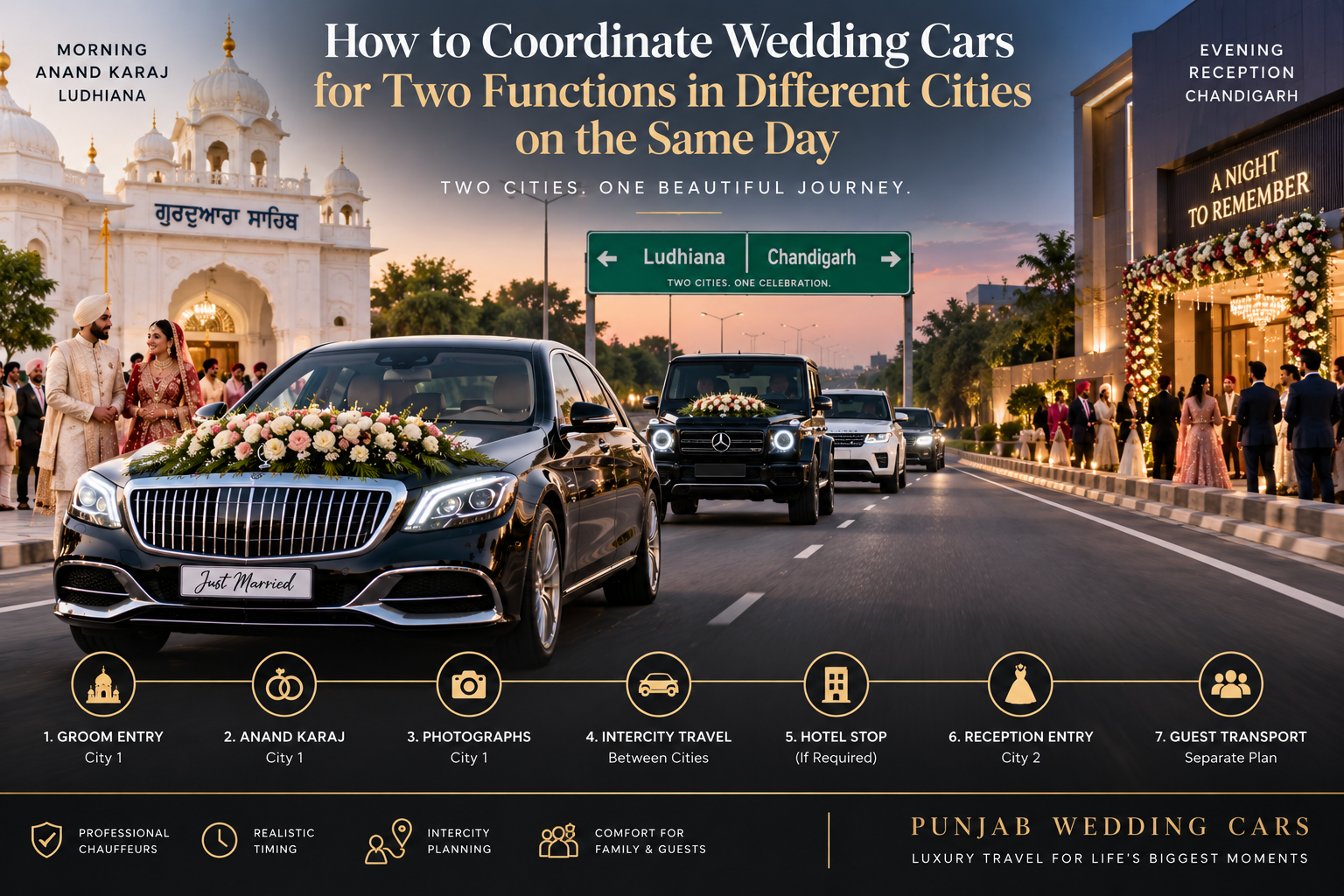
How to Coordinate Wedding Cars for Two Functions in Different Cities on the Same Day
A Punjabi wedding can become a completely different transport operation when the Anand Karaj is in one city and the reception, family dinner or evening celebration is in another. The difficulty is not simply that the wedding car has more kilometres to cover. The entire day becomes dependent on the handover between the first function and the second. The groom may leave one city early in the morning, the couple may finish photographs later than expected, parents may need to travel ahead, the bridal car may still be waiting at the Gurudwara, and the reception venue may already have decorators, photographers and guests expecting a fixed arrival time in another district. Families using Punjab Wedding Cars should therefore treat a two-city wedding as one connected transport schedule rather than two unrelated bookings. The most important decision is not which luxury car looks best at each venue. It is which vehicles remain with the couple, which ones finish after the first function, which chauffeurs are continuing, and how much genuine road buffer exists between the two cities.
Start With the Second Function and Work Backward
When two functions are happening in different cities on the same day, the second event should often control the planning. If the reception begins at 7:00 PM in Chandigarh after a morning Anand Karaj in Ludhiana, the family should not simply ask what time the first ceremony normally ends. They should work backward from the time the couple genuinely needs to be at the reception venue, then account for intercity travel, hotel or clothing changes, photographs and the final venue approach. The same principle appears in the Punjab Wedding Cars guide to a home-to-Gurudwara-to-reception Anand Karaj transport timeline, where the wedding day is treated as one movement rather than isolated journeys. In a two-city wedding, this becomes even more important because a thirty-minute delay at the first function can easily become a much larger delay by the time the second city is reached.
Do Not Assume the First Function Will Finish Exactly on Time
A multi-city plan becomes fragile when the road journey is calculated from an ideal ceremony finish. Anand Karaj photographs may continue longer than expected, relatives can delay departure, lunch can run late and the couple may need additional time before getting back into the car. Punjab Wedding Cars' guide on what happens when a Punjabi wedding ceremony runs late explains why wedding transport should expect some movement in the schedule rather than depend on minute-perfect ceremony timing. If the second function is in another city, that expected flexibility needs to be built before the intercity leg. The family should decide which parts of the first function can be shortened if time begins slipping. Additional car photography can often move, while the road journey to the next city cannot simply be compressed safely.
The Couple's Main Car Should Have One Clear Role Between the Cities
The principal bride-and-groom vehicle should not become general family transport once the first function finishes. If the couple is travelling from the Anand Karaj directly towards the reception city, their car needs to remain dedicated to that movement. A Mercedes-Maybach, New Range Rover Sport, Rolls-Royce Ghost or another suitable luxury vehicle can perform the intercity couple journey, but its route should remain clean. Asking the same chauffeur to drop one relative at a hotel, stop for luggage at another house and then collect somebody else before leaving the city can quickly destroy the road buffer. Supporting vehicles should handle those separate requirements. The couple's car should normally move from the first wedding location towards the next planned stop with as few unnecessary detours as possible.
Separate Groom and Bridal Cars Can Make the Morning Much Easier
If the groom and bride begin in different locations and later need to continue to another city, using separate cars in the first half of the day can remove a major timing dependency. The groom may use a G Wagon G63 AMG for his baraat while the bride has a Maybach or Rolls-Royce dedicated to her own arrival and later couple journey. The Punjab Wedding Cars guide on one wedding car or separate bride and groom cars explains why one shared vehicle becomes difficult when both sides need transport at overlapping times. In a two-city wedding, that problem becomes stronger because the car that eventually carries the couple may need to be ready for the intercity journey immediately after the first ceremony. Keeping the bride's vehicle available independently can be more efficient than trying to release the groom's hero-entry car and convert it into the couple's next transport job.
The Groom's Entry Car Does Not Always Need to Continue to the Second City
A G63 may be the perfect vehicle for the groom's morning departure and baraat, yet there may be little value in keeping it committed through several hours of ceremony waiting and then sending it to another city if the couple is travelling separately. This is where families should distinguish between a ceremonial vehicle and a transport vehicle. The G Wagon can complete its hero-entry role and finish, while a Maybach, Range Rover or another long-distance-suitable luxury car handles the couple's second-city movement. The Punjab Wedding Cars comparison of full-day versus ceremony-only wedding-car packages is especially useful for this kind of day. Keeping every premium car for the complete schedule can be unnecessary when some vehicles have only one meaningful job.
Intercity Travel Needs Its Own Protected Time Block
The road section between the two functions should be treated as a fixed part of the wedding, not as spare time between events. If the couple is travelling from Ludhiana to Chandigarh, Amritsar to Jalandhar, Patiala to Mohali or another Punjab route, that journey should have a realistic start and arrival window. The road buffer should not be consumed by extra photographs, unscheduled stops or last-minute family errands. Punjab Wedding Cars' guide to what happens if a wedding car is delayed by traffic makes the important point that time lost at a function should not be recovered through more aggressive driving. In a same-day two-city wedding, this is critical because the temptation to “make up time” on the highway can become much stronger once the reception clock is approaching.
A Hotel Change Can Be the Hidden Third Function
Many couples do not travel directly from the Anand Karaj to the reception venue. They may first return to a hotel to change clothes, rest, refresh makeup or prepare for an evening entrance. That hotel stop should be treated as a real part of the transport schedule rather than a fifteen-minute assumption. The car has to reach the property, the couple has to get upstairs, change, possibly complete another photography sequence and then come back down. If NRI relatives are staying in the same hotel, the driveway may already be busy with guest transport. Punjab Wedding Cars' guide to wedding-car pickup from hotels for NRI families shows why hotel entrance, reporting point and departure time need to be clear. On a two-city day, the hotel stop can easily consume more time than the family expects, so it should be planned honestly.
Parents May Need to Leave the First City Before the Couple
Parents often have responsibilities at the second venue before the bride and groom arrive. They may need to meet relatives, check reception arrangements or simply be there to receive guests. It can therefore make sense for them to travel ahead in a separate chauffeur-driven vehicle while the couple remains at the first function for photography. This reduces pressure on the couple's car and prevents the family from insisting that everyone leave together. An Audi A6, Jaguar, Range Rover or another comfortable vehicle can move parents independently while the main wedding car stays with the bride and groom. This is especially valuable in NRI weddings where older relatives may also prefer a calmer journey and earlier hotel arrival.
Guest Transport Should Not Follow the Couple's Exact Schedule
The couple's intercity movement is usually the most sensitive part of the day, but general guests do not need to follow the same timing. Some relatives may go directly from the Anand Karaj to the reception city. Others may return home, change vehicles or join later. Trying to keep every family car together across an intercity route usually creates more delays than coordination. The principle behind the Punjab Wedding Cars guide to planning a luxury wedding car convoy without delaying the baraat applies here as well: vehicles should share the destination and plan without needing to remain physically attached for the complete journey. The couple's chauffeur should not keep stopping to wait for distant relatives once the intercity leg has begun.
If You Want a Convoy at the Second Venue, Regroup Near the Destination
A family may still want the couple to arrive at the evening reception with several luxury vehicles around them. The cleanest way to do this is usually to let the cars travel normally between cities and regroup near the second venue. Supporting SUVs can reach a pre-agreed holding point, the couple's car can join them there and the final approach can be completed in formation. This produces a stronger visual arrival than asking four or five cars to remain together for an hour or more through normal traffic. It also reduces the risk that the groom's or couple's car is delayed because one supporting vehicle missed a junction earlier in the route. The convoy becomes ceremonial where it matters visually and independent where it matters operationally.
Chauffeur Duty Length Needs to Be Considered From the Start
A same-day two-city wedding can produce a very long chauffeur assignment. The driver may report before sunrise, travel to the groom's pickup, wait through the Anand Karaj, complete an intercity journey, wait again at a hotel or reception venue and finally drive the couple after midnight. That should not be treated as though it were one short local wedding job simply because only one vehicle is involved. Punjab Wedding Cars' guidance on how much waiting time to book for a Punjabi wedding car is relevant because the hours when the car is parked still form part of its commitment. If the wedding creates an unusually long working day, the transport provider needs to know that before allocating the chauffeur and vehicle.
A Driver Change Can Be Better Than One Chauffeur Doing Everything
For particularly long schedules, a transport company may choose to manage driver duty differently rather than expecting one chauffeur to perform every stage. The family does not need to dictate the internal staffing method, but it should give the provider the true start time, road distance and likely finish. This gives the operator enough information to plan safely. A car that begins at 5:30 AM for a morning Anand Karaj and may still be needed after midnight is not the same assignment as one reporting at 5:00 PM for a reception entrance. Honest timing allows the wedding-car company to decide how the job should be staffed instead of discovering the extended requirement once the day is already underway.
Decoration May Need to Change Between the Two Functions
The car's decoration does not always need to remain identical throughout a two-city wedding. A stronger floral arrangement can work beautifully for the groom's morning entry, but if the same vehicle then has a long highway journey, the decoration should be checked before the intercity section. Punjab Wedding Cars' guide on whether wedding-car decoration should be removed before a long highway journey explains why loose ribbons, delicate fresh flowers and oversized bonnet pieces deserve a second look before sustained road travel. A secure, simplified arrangement may be better for the highway and can still look elegant when the car reaches the second city. If the reception uses a different colour palette, a second light decorative treatment can also be planned rather than forcing one floral concept to survive from dawn until midnight.
The Couple May Need a Different Car for the Evening Function
There is no requirement that the car used during the Anand Karaj must also be the car used for the reception. A morning Range Rover can be ideal for intercity travel while a Maybach or Rolls-Royce is waiting at the second venue for a formal evening arrival. The opposite can also work. The family may keep a comfortable luxury saloon with the couple throughout the day and bring a G63 or other statement vehicle specifically for the evening groom-and-bride entrance. The important thing is that the switch is deliberate and does not create a time-consuming roadside transfer. When the second car is already positioned at the hotel or venue, the change can feel like part of the wedding rather than a transport problem.
Bridal Lehenga and Evening Outfit Changes Can Affect Car Choice
A bride wearing a large traditional lehenga during the first function may need maximum rear space in the morning, while her evening reception outfit could be more streamlined. That can make a Maybach especially useful for the Anand Karaj and intercity journey even if the couple later chooses another car for the reception entry. The Punjab Wedding Cars guide on how much rear-seat space a bridal lehenga needs is useful because bridal comfort should be judged according to the longest journey, not only the arrival photographs. If the bride will spend an hour or more travelling between cities before changing into another outfit, the rear cabin matters considerably more than the exterior impact of the first venue arrival.
Luggage Should Travel Ahead Whenever Possible
Two-city weddings often involve clothing bags, suitcases, makeup kits and reception outfits moving with the couple. Those items should not be loaded into the main wedding car simply because it is travelling to the correct city. A support vehicle can take luggage ahead to the hotel or second venue while the couple's cabin remains uncluttered. This is particularly useful when the bride is wearing a large lehenga and the groom is travelling beside her. The Punjab Wedding Cars Bridal Doli Transport Checklist follows the same principle: larger luggage belongs in another vehicle so the luxury car can remain focused on passenger comfort.
One Coordinator Should Control the Handover Between Cities
A same-day multi-city wedding can create too many people giving instructions if one person is not clearly responsible. The first-city family coordinator may tell the chauffeur to wait, the second-city planner may be calling to ask where the couple is, and a photographer may request another stop. One person should understand the complete timeline and have authority to protect it. That coordinator needs to know when the couple must leave the first function, whether the hotel stop is still happening, where the second venue entry begins and which supporting cars are meeting them there. The bride and groom should not be resolving these conflicts from the rear seat while travelling between cities.
The Second Venue Should Receive Realistic Arrival Updates
A reception planner should not be told that the couple is “five minutes away” when they are still thirty kilometres outside the city. Realistic communication is much more useful than optimistic updates. If the first function runs late, the venue can delay the couple's formal entry, adjust photography or change the order of another programme element. The same principle applies to the dhol team and family members waiting at the second venue. A clear updated arrival window allows people to respond properly rather than standing at the gate for an hour because everyone was repeatedly told the car was almost there.
Do Not Schedule the Second Function at the Fastest Possible Travel Time
The most fragile plan is one where the first function ends at 2:00 PM, the map says the second city is two hours away, and the reception entry is therefore scheduled at 4:00 PM. That leaves no room for parking, the couple getting into the vehicle, traffic, comfort stops, hotel movement or the final venue approach. A same-day two-city wedding needs more margin than an ordinary intercity journey because the passengers are not simply travelling from point A to point B. They are moving between two major wedding functions while wearing formal clothing and carrying the emotional and logistical weight of the day. The schedule should reflect that reality.
Morning Anand Karaj and Evening Reception Is Usually the Easiest Two-City Combination
Among same-day multi-city weddings, an early Anand Karaj followed by an evening reception often provides the strongest structure because there is a natural block of time between the two functions. The morning ceremony can finish, the couple can travel during the afternoon, reach the hotel or second city, rest and prepare before the evening programme. The Punjab Wedding Cars comparison of morning Anand Karaj versus night wedding transport planning helps explain why these two parts of the day have different transport rhythms. The morning requires precision around the Gurudwara, while the evening requires flexibility around reception and final departure. When the road journey is protected between those two phases, the same day can work very smoothly.
Two Major Evening Functions in Different Cities Are Much Harder
The plan becomes more difficult when the first function itself is in the afternoon or early evening and the second city expects the couple later that night. There is less recovery time if the first programme slips, and the intercity drive can move directly into peak traffic or late-night travel. In these cases, families should question whether every ceremonial element genuinely needs to happen in both places on the same day. Transport planning can manage road movement, but it cannot create additional hours. If the second function is important enough to justify another city, it should be given enough time that the couple arrives composed rather than being hurried out of the first event.
The Final Return Journey Must Be Included Too
Families often plan successfully from the first city to the second and forget that the wedding car may still have another journey after the reception. If the couple is going to a hotel, family home or another district after midnight, that final section should already be part of the assignment. The PWC guide on bridal doli after midnight is relevant because chauffeur timing and late-night road conditions matter greatly after a long multi-city day. A car that has already travelled between cities and waited through two functions should not suddenly be given an unplanned two-hour extension at 1:00 AM.
The Best Two-City Wedding Plan Separates Ceremony, Road and Reception Time
The strongest way to coordinate two functions in different cities is to stop thinking of the day as one continuous flexible wedding schedule. The first ceremony has its own protected window. The intercity road journey has another. The hotel or outfit-change period has another. The second venue has its own arrival and waiting requirement. When those sections are clearly defined, everyone knows which parts can move and which cannot. Extra photography at the first function can be shortened if necessary. The intercity road journey should not be. A reception entry may move slightly if the couple is genuinely delayed. Chauffeur safety should not.
Punjab Wedding Cars can coordinate vehicles from the luxury wedding-car fleet for multi-city wedding days across Punjab and Chandigarh, including separate groom and bridal cars, intercity couple transport, parent vehicles, supporting SUVs and reception arrivals. The right plan may use one luxury vehicle throughout the day, or it may use different cars for the groom entry, couple journey and evening function. What matters is not keeping the same badge in every photograph. It is making sure each vehicle is where it needs to be without the second function depending on an unrealistic first-function finish.
A two-city wedding can work beautifully on the same day when the road between the functions is treated with the same seriousness as the functions themselves. Protect the intercity travel window, let supporting vehicles handle relatives and luggage, give parents their own timing where necessary, communicate real arrival updates and avoid making the chauffeur recover lost ceremony time on the highway. When those pieces are in place, the couple can leave one city without feeling that they are already late for the next—and arrive at the second function ready to celebrate rather than feeling as though they have just completed a transport emergency.