Wedding Photography Stops: How Much Extra Time Should Be Added to the Car Booking?
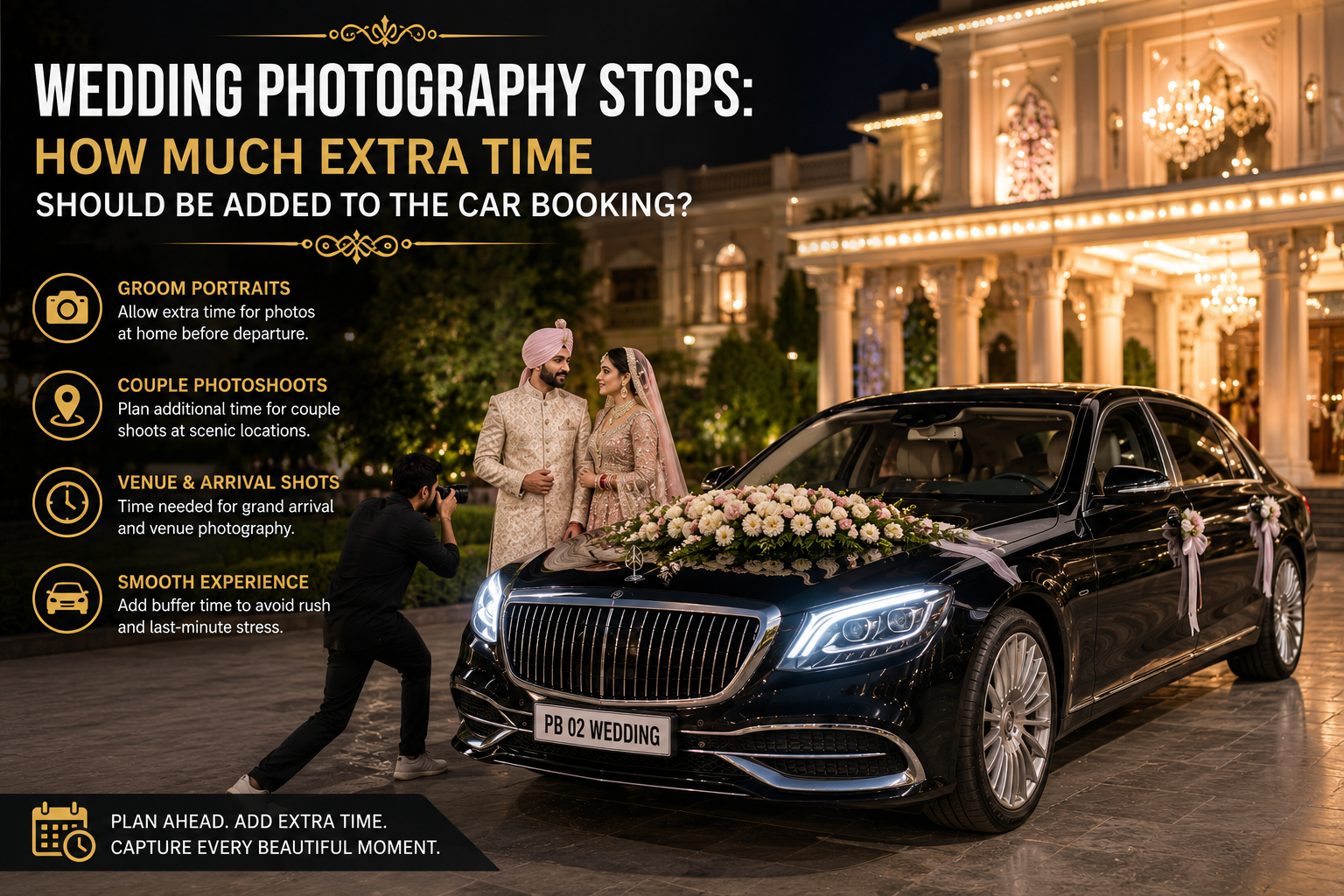
Wedding photography can quietly become one of the largest hidden time blocks in a Punjab wedding-car booking. A family may calculate the journey from the groom's home to Gurudwara Sahib, check the travel time to the marriage palace and assume the chauffeur only needs a modest buffer. Once the wedding begins, however, the photographer wants groom portraits beside the G Wagon, another set with parents, a short roadside sequence, couple photographs outside the venue and perhaps a final bridal-car session before doli. Thirty minutes of expected photography can easily become far more once vehicle positioning, family movement and photographer setup are included.
The answer is not to reduce the photographs. A luxury wedding car is often chosen partly because the family wants it to appear in the wedding film and album. The better solution is to treat photography as a genuine part of the vehicle duty instead of pretending it happens without using any booking time.
Punjab Wedding Cars' current waiting-time guidance specifically identifies photography as one of the reasons wedding-car schedules extend beyond the original driving time, and its current arrival-time guide recommends that the vehicle report before passenger departure so there is enough room for photography, decoration checks and family preparation. This means families should think about the photography plan before finalising the car duration, particularly when the selected vehicle is a Maybach, G Wagon, Range Rover or Rolls-Royce that has been booked as part of the wedding's visual identity.
In Short
For a simple set of groom or bridal photographs at the pickup location, allowing roughly thirty to forty-five minutes beyond the pure driving schedule is usually more realistic than assuming the photographer will finish in ten minutes. If the car will also stop at another location for a dedicated couple shoot, hotel portrait session, palace entrance sequence or roadside photography, an additional forty-five to ninety minutes can be more sensible depending on access and how elaborate the shoot is. A wedding involving several photography stops may be better treated as a longer or full-duty booking rather than repeatedly extending a short transport assignment. The important point is not that every Punjab wedding needs the same photography buffer; it is that planned photography should appear in the car schedule before the wedding instead of becoming surprise waiting on the day.
The First Photography Delay Usually Happens Before the Car Moves
The first extra photography time is often created at the groom's house. The chauffeur arrives as scheduled, the G Wagon is positioned outside, and the family initially expects the groom to be ready within ten minutes. Once the photographer begins working, the sequence expands naturally. The groom takes solo portraits beside the vehicle, then parents join him, siblings want photographs, the sehra may still be adjusted and friends begin gathering around the car.
Punjab Wedding Cars' current waiting-time material specifically describes this kind of situation, noting that the chauffeur can report on time while preparation and family photography continue for much longer than expected. The practical mistake is not taking the photographs. The mistake is telling the booking team that the car is required from the exact planned departure time when the family already expects a significant photography session before departure.
If the groom wants thirty minutes of photographs with the car, that thirty minutes belongs in the booking. It should not later be treated as unexplained waiting or recovered by asking the chauffeur to reach the venue faster.
Thirty Minutes of Photography Rarely Means Only Thirty Minutes of Car Time
A photographer may say a groom shoot will take thirty minutes, but the car can be involved for longer than that. The vehicle first needs to be positioned where the photographer wants it, and the photographer may need to wait for relatives or adjust the frame. Afterwards, the baraat may gather around the car, making it difficult for the chauffeur to leave immediately even if the formal photography is technically finished.
This is why families should distinguish between camera time and vehicle commitment. A twenty-five-minute shoot can occupy forty minutes of the wedding-car schedule once setup, passenger movement and departure organisation are included.
The same applies at a hotel. A groom may take photographs in the lobby first, then move outside, wait for the valet area to clear and finally stand beside the vehicle. The photographer's stated “fifteen-minute car shoot” can therefore require much more than fifteen minutes of chauffeur availability.
The G Wagon Usually Needs More Photography Space Than Time Alone Suggests
The Mercedes G Wagon G63 AMG is one of the most photographed groom cars because its upright proportions and instantly recognisable shape work strongly with Punjabi baraat styling. The challenge is that a good G Wagon photograph benefits from distance. If the SUV is squeezed directly against a gate or surrounded by guest cars, the photographer may need to reposition it several times before getting the desired composition.
This means G Wagon photography should not be scheduled too tightly. The strongest workflow is usually to position the vehicle before the groom emerges, let the photographer complete the clean vehicle and groom portraits, and only then allow the larger baraat crowd to build around him.
When relatives surround the SUV first and the photographer later asks for a clean full-car photograph, the chauffeur may have to wait for everyone to move. A five-minute image becomes a fifteen-minute operation. Good preparation saves more time than rushing the photography itself.
Maybach Photography Uses Time Differently
A Mercedes-Maybach usually does not need the same aggressive wide-angle setup as a G Wagon. Its strongest bridal photographs can involve the bride entering the rear cabin, sitting with the door open briefly, standing beside the car or using the vehicle against a hotel, residence or palace background.
The photography can still take considerable time because the bride's movement is slower and more deliberate. A heavy lehenga may need assistance, the photographer may adjust the train, and family members may want portraits beside the car before departure.
The family should therefore avoid assuming that bridal-car photography is automatically quicker than groom photography. It may involve fewer people, but each transition can take longer.
If the bride's car is also important for doli, the family should think separately about photography before the ceremony and photography at the final farewell. Those are two distinct uses of the same vehicle and both can contribute to the total booking duration.
Rolls-Royce Photography Works Best When the Car Is Not Surrounded
The Rolls-Royce Ghost generally photographs best with cleaner surroundings. A palace façade, resort entrance or landscaped driveway can provide enough visual drama without the car being surrounded by several other vehicles.
This can reduce setup time if the venue entrance has been protected. It can increase setup time significantly if guest parking has occupied the exact area the photographer expected to use.
The family should therefore coordinate the hero-car position with the venue. A five-minute conversation with valet or palace staff before the Rolls-Royce arrives can save twenty minutes of moving parked vehicles later.
Photography time is not only controlled by the photographer. Venue traffic and vehicle access directly affect it.
Roadside Photo Stops Are Often Underestimated
Punjab wedding films sometimes include a short stop on a scenic road, rural stretch, farmhouse lane or open area between functions. From the family's perspective, this may sound like a quick ten-minute stop. In practice, the chauffeur needs to pull over safely, the photographer needs to position equipment, the bride or groom needs to exit, clothing may need to be adjusted, the car needs to be aligned correctly and the passengers then need to get back inside before the journey continues.
A realistic roadside photography stop can therefore consume twenty to forty minutes even when the actual shooting time is relatively short.
The effect becomes larger during an intercity wedding. If the couple is travelling from Jalandhar towards Ludhiana or Amritsar towards another district, an extra photography stop should be added to the journey rather than hidden inside the original map estimate.
Punjab Wedding Cars' route-cost guidance specifically notes that additional planned stops and waiting can change the true wedding-car assignment even when the city-to-city distance itself remains unchanged.
One Photography Stop Can Be Easy; Three Stops Create a Different Booking
A wedding car used for one thirty-minute groom session at home is still relatively simple to plan. A vehicle required for home portraits, Gurudwara photographs, a roadside couple session and a palace arrival has become a multi-stage photography assignment.
The family should consider whether a longer booking structure is more sensible in that situation.
Punjab Wedding Cars' existing full-day guidance explains that a longer booking can be useful when the vehicle has several meaningful stops and waiting periods rather than one ceremonial movement. That logic applies directly to photography.
If the photographer needs the luxury car repeatedly throughout the day, the family is no longer hiring it only for transport. The vehicle is effectively part of the production plan.
That is perfectly reasonable. It simply needs to be quoted and scheduled that way.
Gurudwara Photography Should Not Be Allowed to Create Ceremony Pressure
Photography around Anand Karaj requires particular sensitivity. The wedding car can be photographed at the home before departure or later outside the reception where there is more time and space. The family does not need to create an elaborate vehicle shoot immediately outside Gurudwara Sahib if doing so interferes with the ceremony schedule or congregation movement.
After Anand Karaj, family photographs can naturally take longer than expected. Punjab Wedding Cars' current waiting-time guidance specifically mentions photography after the ceremony as a common source of additional waiting.
The chauffeur should know whether the same car is required after the ceremony. If it is, the expected photography period should already form part of the booking.
The Anand Karaj should not be rushed because a luxury car is waiting. The car should have been scheduled to wait if the family intended to keep it.
Reception Photography Can Add More Time Than Home Photography
At the reception, the number of variables increases. The photographer may want the car arriving under the decorative gate, the groom or couple stepping out, another static portrait after guests clear, and perhaps a night shot once the venue lighting is fully visible.
Each of those sequences can happen at a different time.
The entrance may initially be crowded. The photographer may arrive before the vehicle but still need venue staff to clear a stopping point. The couple may want to enter immediately and return later for another portrait session.
This means the reception car can remain required even when it appears to have finished its main transport duty.
If the family knows the car is part of a later reception shoot, that should be communicated before booking. A vehicle cannot be treated as released after the arrival and simultaneously expected to remain available for photography several hours later.
Repeated Arrival Shots Can Consume Time Very Quickly
A luxury wedding arrival often looks effortless in the final video because the viewer sees only the strongest few seconds.
Behind the scenes, photographers or videographers may sometimes ask for the vehicle to move again so they can capture another angle. Repeating a safe, controlled arrival can occasionally be reasonable before guests crowd the entrance, but it should not become an open-ended filming exercise.
The family should understand that every reset takes time. The car needs to reverse or circle, the entrance must remain clear, passengers may need to reposition and other wedding traffic has to wait.
If repeated vehicle shots are important to the wedding film, they deserve an explicit buffer rather than being treated as free seconds.
This is particularly relevant at night when venue traffic is heavier and manoeuvring through guests takes longer.
The Photographer Should Reach the Venue Before the Wedding Car
One of the easiest ways to save booking time is to send the photographer ahead.
If the photographer travels directly behind the groom's G Wagon and reaches the palace at the same moment, the car can end up waiting at the entrance while the camera team parks, gets equipment and works out the angle.
That is avoidable waiting.
One photographer or videographer should reach the destination first when the arrival shot matters. The venue entrance can then be checked, guest vehicles can be moved if necessary and the chauffeur can receive a clear stopping point before the car appears.
The luxury vehicle arrives once and the camera is already ready.
This simple coordination can save more time than cutting five minutes from the actual shoot.
Photographer Repositioning Should Be Included in the Schedule
Couples often think only about the time they spend posing.
The photographer also needs time to move.
A team finishing a bride-and-groom session at Gurudwara Sahib may need to reach the reception before the couple if they are expected to capture the car arriving there. If everyone travels together, the photographer cannot simultaneously be behind the car and waiting in front of it.
The transport plan should therefore include professional movement as part of the wedding timeline.
This does not necessarily add to the luxury-car booking if the photographer uses a separate vehicle and moves ahead efficiently. In fact, it can reduce wedding-car waiting because the couple's car does not need to pause outside the venue until the photographer catches up.
Couple Photography After Anand Karaj Can Add a Full Hour
One of the most underestimated photography stages is the period after Anand Karaj. Parents want photographs. Grandparents join. Siblings come forward. Friends gather. The couple may then take separate portraits and finally photographs beside the wedding car.
Punjab Wedding Cars' current waiting-time guide specifically warns that photography can quietly add an hour or more to a booking. That is not an argument against photography. It is a reminder that the car remains occupied throughout the process when it is expected to appear in those photographs or transport the couple afterwards.
Families who know this stage matters should not schedule the car as though the ceremony ends and the vehicle instantly departs.
A sixty-minute photography allowance after a major ceremony can be far more realistic than a fifteen-minute buffer.
Golden-Hour Photography Needs a Specific Plan
Some couples want a particular outdoor photography style close to sunset. That can be beautiful, especially with a Range Rover, Maybach or Rolls-Royce at a farmhouse or resort.
Golden-hour photography is also time-sensitive. The photographer may want to stop the car at a particular position and wait several minutes for the right light. The couple may need to leave dinner preparation or another part of the schedule temporarily to take advantage of the available light.
If this session matters enough to shape the wedding film, it should be treated as a planned stop.
A family should not tell the chauffeur they are going directly from the Gurudwara to the reception and then unexpectedly add a forty-five-minute farmhouse photo session halfway through the duty.
The car booking should reflect the journey the photographer and couple genuinely intend to make.
Night Photography Often Requires More Setup
Night photography can look incredibly polished because venue lights, wet pavement, chandeliers and illuminated arches create depth around a luxury car. It also often needs more setup than daytime photography.
The photographer may need to check reflections, move the vehicle a few feet, adjust lighting or wait for guest traffic to clear the frame. A black G Wagon may need a different angle from a white Maybach because the bodywork responds differently to artificial light.
For a planned night hero-car session, thirty to forty-five minutes is often a more useful allowance than assuming the photographer will get everything during the five-minute arrival.
The family does not need to use all that time. The buffer simply prevents the rest of the wedding from depending on a perfect five-minute shoot.
Bridal Doli Photography Can Add Another Final Delay
Doli has its own photography rhythm.
The car may be positioned before the bride comes outside, the family farewell takes place, photographs are captured around the bride and car, and the photographer records the couple entering. Once the doors close, the departure itself becomes another important shot.
This can add meaningful time at the end of a long wedding-car booking.
The family should avoid treating doli photography as though it occurs after the car booking has technically finished. If the vehicle is part of the farewell, the booking needs to continue through that moment and through the final journey that follows.
This becomes particularly important with an intercity doli. The Maybach or Rolls-Royce may have already waited several hours before the photography begins and then still have a long drive afterwards.
Bridal Luggage Should Not Be Loaded During the Photo Session
One easy way to save time is to load bridal luggage before the principal doli photography begins.
If several suitcases and garment bags appear while the photographer is trying to capture the bride beside the Maybach, the car becomes a loading zone instead of a photography element. The rear cabin or boot may remain open, relatives move through the frame and the chauffeur cannot prepare the vehicle for departure.
A support car can carry larger bridal luggage, particularly when the doli is intercity.
The luxury bridal car then remains available for the bride, groom and photographer without another fifteen-minute loading interruption.
So How Much Extra Time Should a Family Actually Add?
There is no universal number because the photography style matters. A straightforward groom session at home may need approximately thirty to forty-five minutes beyond driving time. A dedicated couple shoot at another location can reasonably add another forty-five to ninety minutes once travel, setup and repositioning are considered. A large reception or palace shoot can also require thirty to sixty minutes if the car is a major part of the wedding imagery.
When several of these stages exist in the same wedding, the family should stop thinking in terms of isolated ten-minute buffers. The car may need to be treated as part of the full wedding production for several hours.
Punjab Wedding Cars' current pricing and waiting guidance supports exactly this approach: booking duration, expected waiting and planned stops can all influence the final requirement even when the vehicle is stationary for much of that time.
The safest way to estimate photography time is to speak with the photographer before finalising the car duty. Ask where they genuinely want the vehicle, how many separate car sessions they expect and whether they need the car retained after the principal arrival.
Do Not Add an Hour Automatically if the Photographer Does Not Need It
Extra booking time should be realistic rather than defensive.
A couple who wants one simple groom portrait outside the home does not necessarily need to extend the car for several unnecessary hours. If the photographer finishes quickly and the vehicle has no later visual responsibility, a focused booking can still be appropriate.
The goal is not to maximise waiting.
The goal is to avoid accidental waiting.
If the family understands exactly how the photographer plans to use the car, it can reserve the right amount of time rather than either underbooking or paying for a much longer duty that has no purpose.
A Full-Day Booking Can Simplify Photography-Heavy Weddings
There are weddings where the luxury car appears throughout the story. The G Wagon is photographed at the groom's home, remains through Anand Karaj, appears beside the couple afterwards, travels to the reception and is used again at the palace entrance. Another car may remain with the bride through multiple stages.
In that type of wedding, a longer booking can simplify communication.
The family does not need to worry every hour about whether another twenty-minute shoot has exceeded a very narrow transport window. The chauffeur knows the vehicle is committed to the larger assignment and can coordinate the waiting position accordingly.
This does not mean every photography-heavy wedding requires a full-day package. It means the booking structure should match the real amount of time the car is part of the visual production.
One Family Coordinator Should Manage Photography Delays
Photography can run late without anyone doing anything wrong.
The photographer is working. The bride and groom are cooperating. Family members want their photographs. The issue begins when several relatives then give the chauffeur different instructions about what happens next.
One family coordinator should communicate actual changes.
If the couple photography session has extended by thirty minutes, the chauffeur receives one useful update. If the photographer decides the planned roadside stop is no longer required, the route can continue normally.
This approach is far more effective than five people repeatedly asking the driver whether he can wait another fifteen minutes.
The Wedding Car Should Not Be Rushed Because Photography Ran Long
This principle should remain non-negotiable.
If a photography session runs forty minutes late, the chauffeur should not be expected to recover that time on the road.
The final destination will be reached later.
Punjab Wedding Cars' current safety and waiting guidance repeatedly emphasises realistic wedding-car planning rather than treating wedding delays as something that should be recovered through faster driving.
The photographer can use the time the family has chosen to give them. The road journey should still follow normal traffic and driving conditions.
Photography Time Can Affect the Quote Even When the Car Does Not Move
This is the point that sometimes surprises families.
A car parked for photographs is still reserved.
If the photographer keeps the Maybach at a farmhouse for ninety minutes, that period can form part of the vehicle's total booking duration even though the odometer barely changes.
Punjab Wedding Cars' current pricing guide specifically states that waiting during photoshoots can be part of the wedding-car pricing requirement and that longer waiting can affect the final rental cost.
This is why two families booking the same model over similar road distances can receive different quotations.
One family may use the car mainly for transportation. Another may be using the same vehicle as transportation and a photography asset for several hours.
Those are different assignments.
Comparing Wedding-Car Quotes Requires Matching Photography Time
When comparing two wedding-car quotations, families should confirm whether both providers have priced the same photography requirement.
One quote may assume the G Wagon reports at the groom's home and leaves for the venue after a short portrait session. Another provider may have included an hour of home photography, a post-ceremony stop and a later palace shoot.
The second quotation may look higher even though the family is receiving a significantly longer vehicle commitment.
Punjab Wedding Cars' current quotation-comparison guide makes the same point about waiting: a lower figure can sometimes represent a shorter duty rather than a better price for the same service.
Families should therefore compare duration, stops and waiting before comparing the final number.
The Best Photography Plan Makes the Car Look Effortlessly Available
A well-planned wedding album should make it appear as though the luxury car was always in exactly the right place.
The viewer does not need to know that the G Wagon arrived early so it could be positioned before the baraat gathered. They do not see that the photographer travelled ahead to the palace while the groom completed his departure. They do not see the Maybach being moved from its operational waiting location back to the bridal entrance before doli.
They simply see the car in the right frame at the right moment.
That result depends on time.
Punjab Wedding Cars provides a luxury wedding-car fleet including the Mercedes-Maybach, Mercedes G Wagon G63 AMG, New Range Rover Sport, Rolls-Royce Ghost, Jaguar XJL and Audi A6. When any of these vehicles is being booked partly for photography, the family should tell the booking team where the car is expected to appear and how long the photographer is likely to need it.
For a simple one-location car shoot, around thirty to forty-five extra minutes can often provide a practical buffer. For a dedicated second photography stop, another forty-five to ninety minutes may be more realistic. For weddings where the luxury car appears repeatedly from home photography through ceremony, reception and doli, the family should think in terms of the total vehicle duty rather than adding tiny buffers one at a time.
The right amount of extra time is therefore not the longest possible allowance.
It is the amount that lets the photographer work properly without turning photography into an unexpected transport delay.
When the photographer, chauffeur and family all understand the car schedule before the wedding, the couple can take the photographs they genuinely want while the vehicle remains available, correctly positioned and professionally coordinated throughout the day.