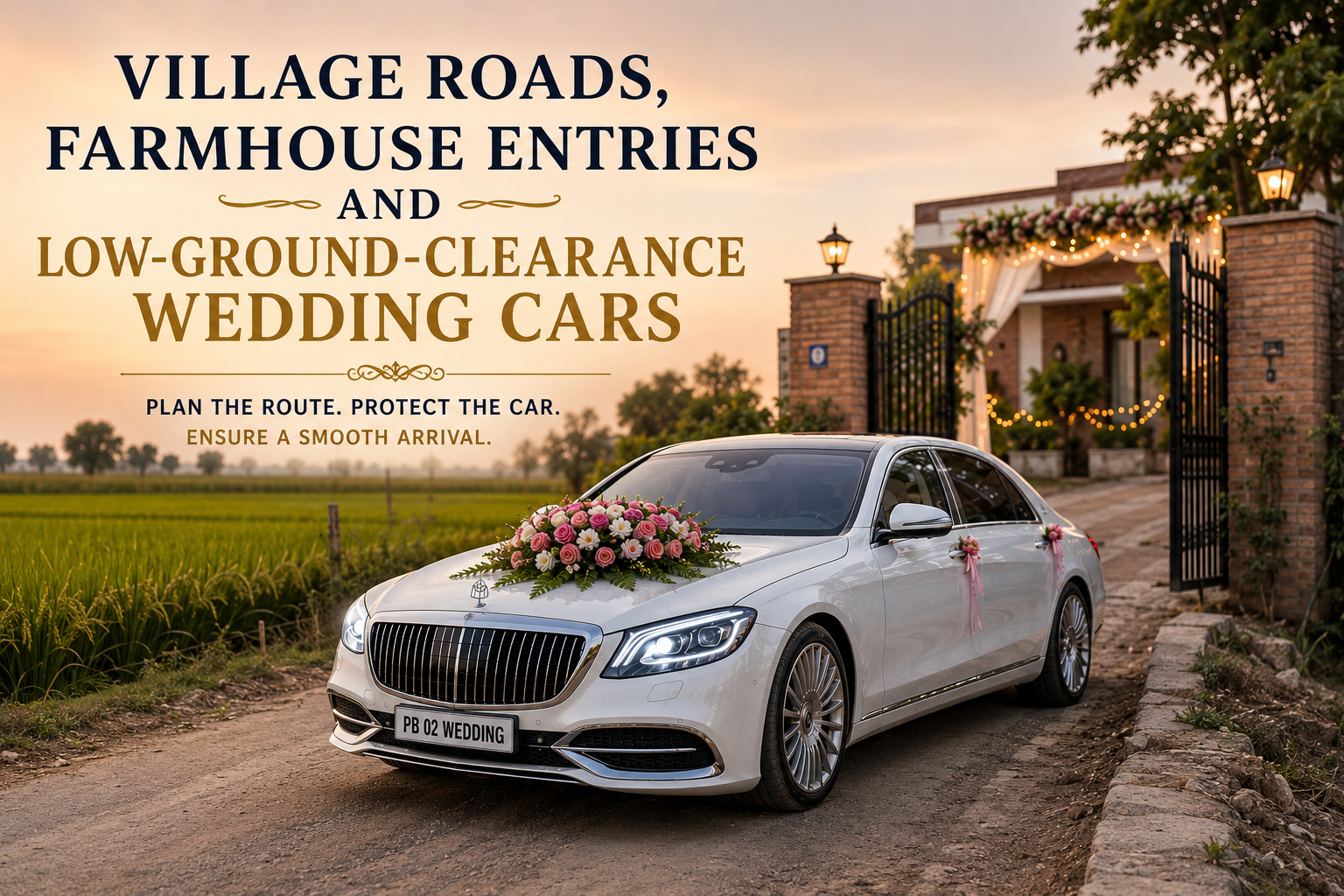
Village Roads, Farmhouse Entries and Low-Ground-Clearance Wedding Cars
A luxury wedding car does not become unsuitable simply because the bride or groom lives in a Punjab village. Some village homes have wide paved approaches that can comfortably handle a Mercedes-Maybach or Rolls-Royce, while some expensive farmhouses have awkward ramps, temporary gates or rough parking areas that require much more planning. The words “village wedding” and “farmhouse wedding” therefore tell a transport provider very little about whether a particular luxury car can genuinely reach the pickup or venue.
The important part of the journey is often the final kilometre. A chauffeur may travel smoothly for fifty kilometres on a main road and only encounter the difficult section after turning towards the bride's home or farmhouse entrance. A raised speed breaker, steep ramp, damaged shoulder, unfinished driveway or deep transition between the road and gate can matter much more to a low luxury saloon than the entire highway journey before it.
This is why wedding-car choice should follow the actual route rather than assumptions about rural Punjab. Punjab Wedding Cars currently operates more than twenty chauffeur-driven luxury vehicles across Punjab, including Mercedes-Maybach, Rolls-Royce Ghost, Jaguar XJL, Audi A6, G Wagon G63 AMG, Range Rover Sport and Defender. Its current farmhouse wedding guidance specifically identifies approach roads, decorative gates, parking areas and turning space as factors families should understand before choosing the vehicle.
For a couple who genuinely wants a Maybach or Rolls-Royce, checking the route can actually protect that choice. It can confirm that the saloon is perfectly suitable instead of forcing the family into an SUV simply because someone said the wedding is “inside a village.”
In Short
A low-ground-clearance wedding car can work very well for a Punjab village or farmhouse wedding when the final road, speed breakers, entrance ramp and parking surface are suitable. The family should verify the last part of the route, identify the best gate, keep the principal wedding car on a predictable surface and avoid assuming that every rural venue requires a Defender or Range Rover. SUVs such as the G Wagon, Range Rover Sport and Defender offer more flexibility around mixed approaches, but they should be chosen because the route or wedding style benefits from them. A Mercedes-Maybach, Rolls-Royce Ghost or Jaguar XJL may still provide the better bridal experience when the road is good and the bride has a long doli ahead.
Ground Clearance Is Only One Part of Wedding-Car Access
Families often reduce the entire vehicle-access discussion to ground clearance. That is understandable because a low car can scrape on a badly designed ramp or unusually aggressive speed breaker, but height from the road is only one part of the problem.
The angle at which the car reaches a ramp matters. The length of the vehicle matters. The transition between one surface and another matters. A long luxury saloon can be more sensitive to a sharp change in road level even when the individual surfaces on each side look perfectly usable.
The chauffeur also needs enough room to approach the difficult point correctly. A ramp may be manageable when the car can line up gradually but much more awkward if guest vehicles force a tight turn immediately before it.
This means the right question is not simply whether a Maybach is “low.” The useful question is what the final entrance actually looks like.
A Village Main Road Can Be Excellent While the House Entrance Is the Problem
Many Punjab village weddings involve excellent road access almost all the way to the family home.
The final twenty metres can still create the issue.
A house may have a driveway built significantly higher than the road. The gate may begin immediately after a drainage channel. A concrete ramp may have been added later without considering a long luxury saloon. Relatives may normally drive tractors, Fortuners or ordinary family cars through that entrance without ever noticing the angle.
A Mercedes-Maybach changes the calculation because the vehicle is longer and the family usually wants it presented carefully rather than simply forced through whatever entrance is available.
Sometimes the solution is extremely simple. The bridal car can stop safely outside the gate on the paved road rather than entering the courtyard. The photographer may actually gain a better side profile from that position, while the bride only needs a short protected walk to reach the car.
The objective should be getting the passenger into the vehicle comfortably, not proving that the car can be driven all the way to the front door.
Farmhouse Entrances Can Be More Complicated Than Village Homes
A farmhouse may appear ideal for luxury wedding cars because the property has a large gate and extensive grounds.
The actual entrance can still create several challenges.
Farmhouses often use decorative approach roads, landscaped kerbs, security gates, temporary floral arches and separate parking fields. A long driveway may include small raised transitions designed for drainage. The property can also use one entrance for normal daily traffic and a completely different decorated entrance during the wedding.
Punjab Wedding Cars' current farmhouse guide specifically notes that farmhouse weddings require attention to private approaches, decorative gates, parking, turnaround space and doli positioning.
The family should therefore avoid assuming that the biggest visible gate is automatically the best wedding-car route.
The chauffeur needs to know which entrance provides the cleanest and most predictable access for the selected vehicle.
Temporary Wedding Decoration Can Change a Perfect Gate
A gate that comfortably accommodates a Range Rover during the venue inspection may become much narrower once the wedding decorator finishes.
Flower pillars can occupy space on both sides. Fabric may hang lower than expected. Lighting stands can sit inside the turning area. A welcome board may appear exactly where the chauffeur expected to use the edge of the driveway.
This is particularly relevant when the family has booked a long luxury saloon or limousine.
The decorator sees the entrance as a visual composition. The chauffeur sees the same space as a vehicle path. Both perspectives need to work together.
The family does not need to redesign the venue around the car. It simply needs to tell the decorator what type of vehicle is expected to use that entrance and preserve enough usable width and turning room.
Speed Breakers Matter More Than Their Height Alone
A large speed breaker is easy to recognise.
The more difficult ones are often shorter but unusually sharp.
A long-wheelbase vehicle can clear the front of a speed breaker and still have its centre section approach the raised surface differently from a short SUV. The same issue can appear when the road slopes downward immediately after a raised section.
The family does not need to measure every speed breaker in the village. If there is a known difficult point that local drivers regularly approach slowly or diagonally, it is worth mentioning when booking a low luxury saloon.
A quick current route video can show far more than a description such as “road is okay.”
A Current Route Video Is One of the Best Planning Tools
For NRI couples especially, a mobile-phone route video can remove much of the uncertainty.
A relative in Punjab can begin recording at the final main-road turn and continue towards the bride's house, groom's pickup or farmhouse. The video should naturally capture speed breakers, narrow sections, road shoulders, the final gate and the area where the wedding car would actually stop.
The family does not need professional footage.
The value comes from seeing the real approach.
A video can show that the supposedly difficult village road is completely paved and suitable for a Maybach. It can also reveal that a beautiful farmhouse entrance contains a steep ramp that deserves discussion before a Rolls-Royce is confirmed.
This is one of the clearest ways to choose the wedding car from evidence instead of stereotypes.
Mercedes-Maybach Can Work Beautifully at Village Weddings
The Mercedes-Maybach should not be automatically removed from consideration because the bride lives in a village.
When the access is properly surfaced, the Maybach can be one of the strongest village bridal cars because the most important part of the vehicle is the passenger environment.
The bride may be leaving after a full day of ceremonies and travelling to another city or district. The rear cabin can therefore matter much more than whether the car has SUV-style ground clearance.
A paved village road followed by a suitable gate creates no reason to choose a different vehicle merely because the location is rural.
In fact, the visual contrast can be excellent. A white Maybach positioned outside a decorated Punjab family home can create a very different type of luxury photograph from the same car outside a hotel.
The setting becomes part of the story rather than a limitation.
Rolls-Royce Ghost Needs Planning, Not Automatic Rejection
The same principle applies to the Rolls-Royce Ghost.
The Ghost is a long luxury saloon, so the family should understand the final road and entrance before booking it for a farmhouse or village pickup. That does not mean village roads are inherently unsuitable.
If the approach is paved and the car can stop on a level area close to the passenger, the Rolls-Royce can work exceptionally well.
The more common mistake is attempting to drive the vehicle somewhere it does not need to go simply because the family wants the car physically inside the courtyard or directly under the decorative gate.
The chauffeur should be allowed to choose a sensible stopping position.
A bride walking a few additional metres on a clean paved surface can be much better than forcing a very expensive saloon across an unnecessarily aggressive ramp.
Jaguar XJL Can Be a Very Practical Rural Bridal Car
The Jaguar XJL is particularly useful when families want a long-wheelbase luxury bridal car without the visual scale of a Rolls-Royce.
Its suitability still depends on the entrance, but its main wedding value comes from rear-seat comfort and elegant saloon proportions.
For Doaba village weddings especially, a Jaguar can feel completely natural. Punjab Wedding Cars currently offers Jaguar XJL alongside Maybach, Rolls-Royce, Range Rover and G Wagon across its Punjab-wide fleet.
If the bride has a longer doli towards Jalandhar, Ludhiana, Amritsar or another district, the passenger experience may justify choosing the Jaguar over an SUV that the route never actually required.
Audi A6 Can Be an Intelligent Low-Key Choice
The Audi A6 is another vehicle that can be overlooked when families focus only on the most dramatic models.
For parents, grandparents, close family or a bride who prefers understated luxury, the Audi can provide comfortable chauffeur-driven transportation without turning every arrival into a large visual event.
The same route-access principles still apply, but the family has more options once the final road is understood.
The broader point is that low-ground-clearance cars should be evaluated individually against the actual venue rather than categorised together as “city-only cars.”
Range Rover Sport Is the Strongest Compromise for Mixed Roads
The New Range Rover Sport makes sense when the wedding genuinely includes several different road environments.
A groom might leave a city residence, travel through a village road, reach Gurudwara Sahib and then continue towards a farmhouse. The Range Rover can look premium in every part of that journey without appearing as though the vehicle was selected only because the road might be rough.
Punjab Wedding Cars currently positions Range Rover alongside the G Wagon and Defender within its SUV wedding fleet.
The advantage is flexibility.
The family gains more tolerance for uncertain approaches while still getting a vehicle that photographs naturally at a luxury venue.
That does not mean the Range Rover should be driven through muddy or unsuitable ground simply because it is an SUV. The chauffeur should still use the best available road and parking surface.
G Wagon Is Visually Strong but Still Needs Width
The Mercedes G Wagon G63 AMG can be ideal for village groom pickups because its shape looks particularly strong against Punjabi homes, farmhouses and open outdoor settings.
Its SUV stance also gives families more confidence around mixed approaches.
The G Wagon's challenge is often width and turning space rather than ground clearance.
A narrow lane filled with parked guest cars can make a large SUV more difficult to position than a saloon. A decorated gate may look wide enough when empty but become awkward once several relatives, dhol players and photographers occupy the same area.
The G Wagon therefore needs planning too.
It should be positioned before the baraat surrounds it.
The strongest groom-entry photograph usually happens when the SUV has enough clear space around it rather than being squeezed into the smallest possible village lane.
Defender Should Be Chosen Because It Fits the Wedding
The Land Rover Defender is one of the most natural choices for outdoor and farmhouse weddings.
Punjab Wedding Cars includes it in its current Punjab-wide SUV fleet and specifically positions SUV options as suitable for bold baraat and outdoor wedding environments.
Its image fits a farmhouse beautifully.
The mistake is assuming that every village automatically requires it.
If the bride wants a Maybach and the approach road is excellent, choosing the Defender purely because the wedding is rural may reduce bridal comfort without solving any actual problem.
If the groom genuinely likes the Defender, or the wedding environment includes an outdoor approach where its stance makes sense, then it becomes the right choice for real reasons.
The name of the venue should not make that decision alone.
Parking Can Create More Problems Than the Road
A road may be completely suitable when the chauffeur checks it earlier.
By the wedding evening, guests can change everything.
Cars begin parking along both sides of the lane. A bus stops near the gate. Catering vehicles remain on the shoulder. Family members leave SUVs wherever space appears.
Suddenly the principal luxury car has far less room than the road itself would normally provide.
This is why one small protected wedding-car area can be extremely valuable.
The family does not need to reserve half the village.
It only needs to keep the final turning point and the bride or groom car's stopping position clear around the important movement.
The road may not be the problem at all. Parking may be the real ground-clearance and access issue because it forces the chauffeur onto rougher edges of the road that would otherwise never need to be used.
Road Shoulders Should Not Become Luxury-Car Parking
A low luxury saloon should ideally remain on the best surface available.
If the main road is paved but guest parking forces the Maybach onto a broken or soft shoulder, the family has created an unnecessary risk.
The same applies at farmhouses where the central driveway is excellent but the bridal car is sent into an open parking field simply because that is where all the other vehicles are going.
The principal wedding car can have its own waiting location.
The chauffeur does not need to park the Rolls-Royce beside every guest vehicle.
This is especially important when the car needs to return for doli several hours later.
Hero Position and Waiting Position Should Be Separate
The most photogenic place to position the vehicle may not be the best operational waiting area.
A G Wagon can arrive through the decorated farmhouse gate, stop beneath the main lighting and become part of the groom photographs. Once those images are complete, the chauffeur can move it to a sensible waiting position.
A Maybach can be brought close to the palace entrance for bridal photography and later kept on a level paved area until doli.
This separation protects the vehicle while still giving the photographer the scene the family wanted.
It also prevents a low saloon from being left in a position where guest vehicles later box it in.
Rain Can Turn an Easy Farmhouse Into a Different Transport Environment
Weather can change the answer after the route has already been checked.
A dry parking field may become soft after heavy rain. A dirt shoulder that allowed two vehicles to pass may no longer be a sensible surface. Standing water can make it harder to judge the depth of a roadside depression.
The main paved driveway may remain perfectly usable.
This is another reason the hero wedding car should not automatically follow general guest parking.
During monsoon season, the venue should have a wet-weather plan for the principal bridal and groom vehicles.
A low Maybach can remain entirely suitable if it stays on the paved approach.
The problem begins only if somebody decides the car needs to cross wet open ground for the photograph.
The Bride Should Not Walk Across Bad Ground to Protect the Car Plan
Vehicle access planning should never make the passenger experience worse.
If the Maybach cannot safely reach the exact photography location after rain, the answer is not to make the bride walk across mud because the family refuses to alter the plan.
Move the car to the best accessible paved point.
Change the camera angle.
Protect the lehenga, footwear and passenger comfort.
The wedding car exists for the bride, not the other way around.
This is particularly important during doli, when the bride may already be exhausted after many hours of wedding functions.
Night Access Should Be Checked During Daylight
A village entrance that is easy to understand during daylight can feel completely different after midnight.
Decorative lighting may illuminate the main gate but leave the final road turn darker. Temporary parking can obscure familiar landmarks. A farmhouse with several internal paths can be confusing if the chauffeur has not been told which one leads towards the doli pickup.
If the final bridal journey is late, the chauffeur should understand the venue layout before nightfall.
The destination at the other end deserves the same treatment.
A doli ending at another village should have the exact final pin confirmed before the bride enters the car. A receiving family member can remain reachable if local directions are required.
Long Doli Journeys Can Make the Low Saloon More Valuable
This is the part that is often missed when families choose the car entirely around the farmhouse entrance.
The difficult entrance may take two minutes.
The doli journey may take two hours.
If the road beyond the venue is good, a Mercedes-Maybach, Rolls-Royce Ghost or Jaguar XJL can provide far greater rear-seat value during that long journey than an SUV selected solely because the farmhouse had one awkward ramp.
This does not mean access concerns should be ignored.
It means the family should weigh the complete duty.
Sometimes the best solution is keeping the low bridal saloon on the paved outside approach rather than replacing it completely.
That preserves the bride's preferred vehicle while avoiding the one part of the property that does not suit it.
Chauffeur Judgment Should Be Respected at the Final Approach
The chauffeur is physically responsible for positioning the vehicle.
If the driver sees that a decorated ramp, flooded edge or tight turn does not provide sensible clearance, family pressure should not force the car through simply because another vehicle managed it earlier.
A Fortuner and a Maybach do not have the same dimensions.
A tractor entering the courtyard proves nothing about whether the Rolls-Royce should follow.
Professional chauffeur-driven transport means allowing the chauffeur to make a safe final positioning decision when road conditions differ from the plan.
Punjab Wedding Cars' current fleet is supplied with uniformed chauffeurs as part of the booking, along with decoration, fuel and tolls according to its live fleet information.
That professional judgment is part of the service.
The Vehicle Should Be Chosen After the Route Is Understood
The strongest booking sequence is straightforward.
First understand the bride or groom pickup. Then understand the Gurudwara or ceremony movement. Look at the farmhouse or marriage-palace entrance and determine where the vehicle will wait. Finally, consider the doli destination and passenger comfort.
Once those details are understood, vehicle choice becomes easier.
If the route is consistently paved, the Maybach, Rolls-Royce Ghost, Jaguar XJL or Audi A6 can remain excellent choices.
If the wedding contains more uncertain rural access, the Range Rover Sport may provide the best luxury-versatility balance.
If the groom wants a highly visible SUV arrival, the G Wagon can create a stronger visual statement.
If the farmhouse setting genuinely suits a rugged luxury look or the approach benefits from a higher SUV format, the Defender becomes a compelling choice.
The car is being matched to evidence rather than assumptions.
Pricing Should Reflect the Real Route, Not the Word “Village”
Wedding-car pricing should not be based on the idea that all village assignments are the same.
A bride's home may sit only a few kilometres from the highway on an excellent paved road. Another pickup may involve a much longer local approach. A farmhouse may require several hours of waiting, while another wedding venue needs only one straightforward groom arrival.
The selected vehicle, distance, reporting time, waiting duration, decoration requirement, additional stops and final drop all matter.
Punjab Wedding Cars' current fleet states that its standard bookings include a uniformed chauffeur, complimentary decoration, fuel and tolls, while the wider service operates across all Punjab districts.
The most useful quotation therefore comes from providing the real addresses and real wedding duty rather than asking only for “Maybach village price” or “Range Rover farmhouse rate.”
Low Ground Clearance Should Be Managed, Not Feared
The term “low-ground-clearance wedding car” can sound as if the vehicle is too delicate for anything outside a city.
That is not how sensible wedding transport should be approached.
Punjab villages contain excellent roads and difficult roads. Farmhouses contain smooth paved driveways and poorly designed ramps. City venues can have basement entrances or aggressive speed breakers that are more troublesome than many rural routes.
The environment has to be checked individually.
When the road is good, a Maybach should be allowed to remain a Maybach. A bride should not lose the rear-seat experience she genuinely wants because someone made a generic assumption about village roads.
When the approach is unsuitable, the plan can often be changed without changing the car. The vehicle can stop before the steep ramp, use another gate or remain on a paved section while the photographer adapts.
Only when the complete route genuinely makes the saloon impractical does changing to a Range Rover, G Wagon or Defender become the more sensible solution.
The Best Village Wedding-Car Plan Makes the Road Almost Invisible
A properly planned village or farmhouse wedding does not make the bride or groom think constantly about ground clearance.
The chauffeur already knows the final approach. The family has sent the correct pin and mentioned any unusual speed breaker. Guest vehicles have not been allowed to occupy the principal turning point. The decorator has left enough width at the gate, and the photographer understands where the luxury vehicle can realistically stop.
The groom's G Wagon reaches the house before the baraat surrounds it. The Range Rover uses the correct farmhouse entrance instead of following general parking. The bride's Maybach remains on the best paved surface and is moved into position before doli. If the Rolls-Royce does not need to enter the courtyard, nobody forces it through the ramp simply for the sake of saying it reached the front door.
Punjab Wedding Cars currently offers the Mercedes-Maybach, Mercedes G Wagon G63 AMG, New Range Rover Sport, Land Rover Defender, Rolls-Royce Ghost, Jaguar XJL, Audi A6 and other vehicles through its Punjab luxury wedding-car fleet.
The correct choice is not automatically the highest vehicle.
It is the vehicle that can complete the real route comfortably while giving the bride or groom the wedding experience they actually want.
Village roads, farmhouse gates and low ground clearance should therefore be discussed early, but they should not become reasons to panic. Once the final kilometre is understood, most of the uncertainty disappears.
That is the real value of proper route planning: the road stops deciding the wedding car by guesswork, and the couple can choose from vehicles that are genuinely suitable for their journey.