Sharing Live Locations on the Wedding Day: A Simple Coordination System for Families
A Punjabi wedding can have excellent cars, professional chauffeurs and a carefully planned timetable and still become confusing because nobody knows exactly where everybody else is.
The groom has left home, but relatives at Gurudwara Sahib keep calling to ask how far away the baraat is. The bride's car is waiting outside another property. Parents have already reached the ceremony. Hotel guests are travelling independently. The photographer wants to know when the groom will arrive. Later in the day, the reception team wants to know where the couple's car is, while the family coordinating the doli is working from another location.
None of these situations necessarily requires another phone call.
A simple live-location system can give the right people enough information to understand where the important vehicles are without turning the bride, groom, parents and chauffeurs into a wedding-day call centre.
The important word is simple.
The family does not need twenty people continuously sharing locations in one enormous WhatsApp group. It needs one transport coordinator, exact destination pins and live locations from only the people or vehicles whose movement genuinely matters.
That can make the difference between repeatedly asking, “Where have you reached?” and already knowing the answer.
In Short
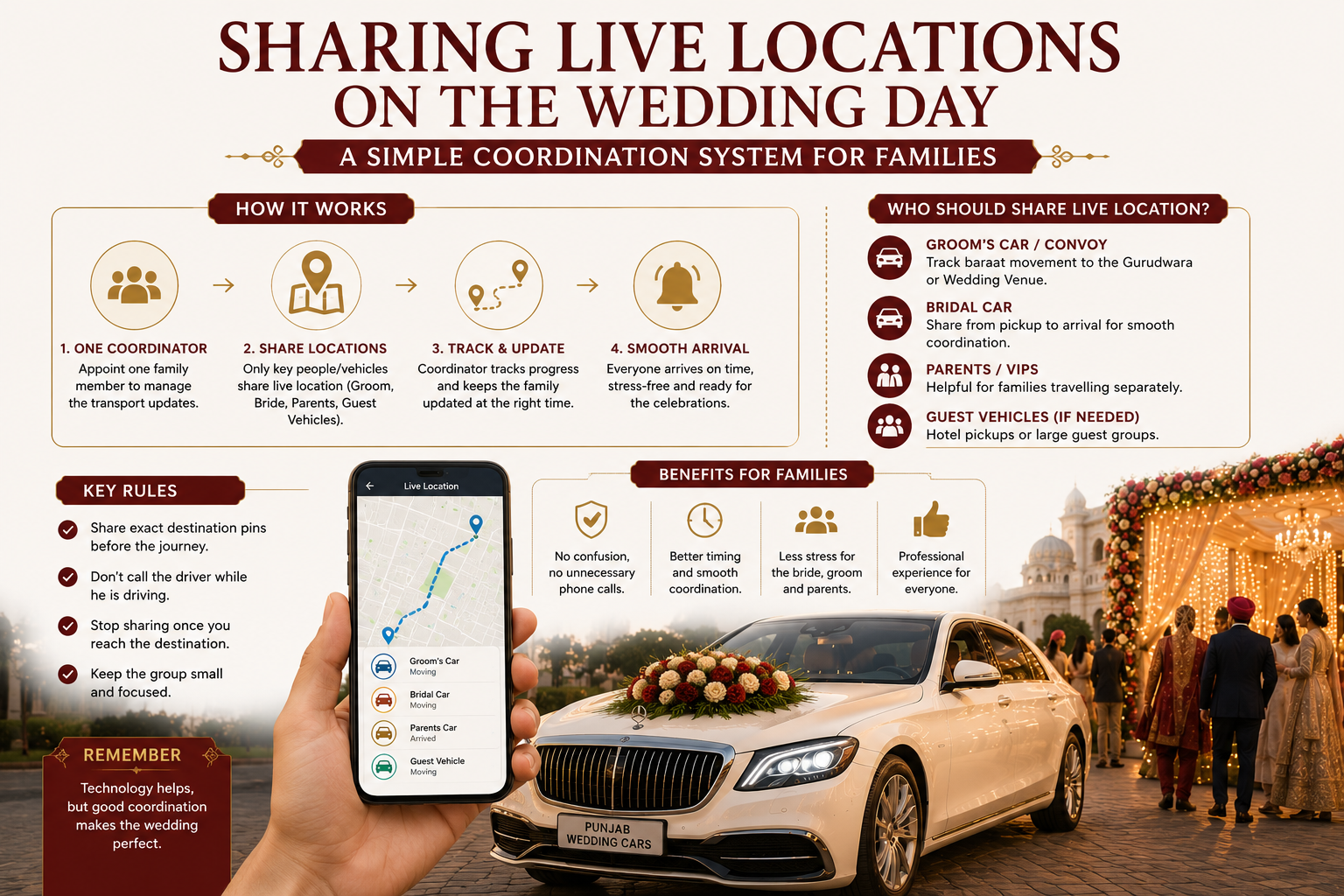
Before the wedding morning, appoint one family transport coordinator and create one small transport communication group. Share the exact map pins for the groom's pickup, bride's pickup, Gurudwara Sahib, reception venue, hotel and final doli destination before anyone starts travelling.
On the wedding day, live location should be shared only for important moving groups such as the groom's car, bridal car where appropriate, parents or a major guest vehicle. The coordinator watches those movements and communicates useful updates to the family.
The bride and groom should not be expected to manage location messages themselves. Chauffeurs should concentrate on driving. Destination pins tell drivers where to go; live locations tell the coordinator where the travelling group currently is.
Those two functions should not be confused.
Start With One Transport Coordinator
The most important part of the system is not the phone.
It is the person using it.
Choose one relative, family friend or wedding coordinator who understands the transport schedule and is comfortable using WhatsApp and maps.
That person should know which vehicle belongs to the groom, which car is carrying the bride, where parents are travelling, which hotel contains the main NRI guest group and what happens after the Anand Karaj.
They do not need to control every car.
They simply need enough information to understand whether the important parts of the transport schedule are moving correctly.
Punjab Wedding Cars' existing Bridal Doli Transport Checklist recommends the same basic principle for the final bridal journey: one person should know the vehicle, luggage arrangement, final destination and chauffeur contact rather than leaving the bride to answer transport questions. citeturn0search3
The same idea works across the entire wedding day.
Create a Small Transport Group, Not Another Family Group
Most Punjabi weddings already have several WhatsApp groups.
There may be one for cousins, one for the bride's family, another for the groom's family and a large general wedding group containing hundreds of messages about clothes, photographs, songs and relatives.
Do not run wedding transportation through that conversation.
Create one small transport group.
It might contain the family transport coordinator, one representative travelling with the groom, one representative from the bride's side, one person responsible for parents or grandparents and another person coordinating major hotel guests.
The exact number is less important than keeping the group functional.
A transport message should not disappear between twenty congratulations, twelve photographs and somebody asking where the mithai has been kept.
Share Destination Pins Before Sharing Live Locations
Live location does not replace an exact destination.
Every important chauffeur should already have the correct map pin before departure.
The groom's driver needs the correct Gurudwara entrance.
The bridal chauffeur needs the correct reporting point and ceremony destination.
Hotel guest drivers need the same Gurudwara pin.
The reception journey needs the actual venue entrance rather than only the venue name.
The final doli journey needs the real destination.
Punjab Wedding Cars' existing wedding-car timing guide specifically recommends sharing the pickup address, Google Maps location, ceremony information, additional stops and final drop before the journey begins. citeturn0search0
This is the foundation.
Live location comes afterwards.
A Destination Pin and Live Location Solve Different Problems
This distinction is extremely useful on a wedding day.
A destination pin answers:
Where are we going?
A live location answers:
Where are we now?
The chauffeur needs the first one.
The coordinator may benefit from the second.
If the groom's representative shares a live location while travelling towards Gurudwara Sahib, the coordinator can see whether the baraat is still near the family home, halfway along the route or approaching the ceremony.
But the chauffeur should not be following somebody else's moving location as a substitute for knowing the actual Gurudwara destination.
Give the driver the destination.
Give the coordinator the movement.
The Groom's Car Is Usually the Most Useful Location to Share
The groom's movement affects many people.
Family members may be waiting at Gurudwara Sahib.
The bride's side may want to know approximately when the baraat is approaching.
The photographer may need to position themselves.
Venue staff may need to prepare the entrance.
That makes the groom group an excellent candidate for live-location sharing.
The groom himself does not need to do it.
A brother, cousin or another person travelling in the groom's vehicle or immediate convoy can share their location with the transport coordinator.
Now the groom can enjoy the journey.
The chauffeur can drive.
The coordinator can watch progress.
That is far better than calling the groom every fifteen minutes.
Share the Groom Location Before the Car Starts Moving
Do not wait until relatives begin asking where the baraat is.
The groom representative can start sharing the live location shortly before departure.
The coordinator can then see when the vehicle actually begins moving.
This matters because the planned departure and real departure are often different.
Punjab Wedding Cars' guide on what time the wedding car should arrive from groom pickup through doli explains why the chauffeur should normally report before departure so there is time for decoration checks, photography and family preparation. citeturn0search0
Live location should therefore begin around the actual travel stage rather than from the moment the chauffeur reports.
The family does not need to track a stationary G Wagon sitting outside the groom's home for an hour.
Do Not Ask the Chauffeur to Constantly Send Locations While Driving
The chauffeur's job is to drive safely and follow the confirmed route.
The family should not repeatedly message:
“Location bhejo.”
“Kithe pahunche?”
“How many minutes?”
“Send live location again.”
If somebody is travelling with the wedding car, that passenger can handle location sharing.
If the chauffeur needs to share something before departure, that can be coordinated while the vehicle is stationary.
Once the journey begins, the system should reduce distractions rather than create them.
A good coordination system makes the driver's job easier.
The Bride's Location Should Be Shared More Carefully
The bridal movement can also benefit from live-location coordination, particularly when the bride is travelling from a hotel, salon or family home to Gurudwara Sahib.
But there is usually less need to distribute the bride's location widely.
One trusted bride-side representative can share the movement with the main coordinator.
That is enough.
The purpose is transportation, not broadcasting where the bride is to the entire wedding party.
When the bride begins moving, the coordinator can understand whether her vehicle is still at the preparation location, travelling or approaching Gurudwara Sahib.
That information can help coordinate the ceremony without requiring anyone to repeatedly contact the bride.
Parents and Grandparents Do Not Need to Follow the Groom's Car
Parents and grandparents may have their own chauffeur-driven vehicle.
Their driver should know the destination independently.
They do not need to remain directly behind the groom's G Wagon simply to avoid getting separated.
Punjab Wedding Cars' guide to cars for parents and grandparents specifically recommends giving their chauffeur the destination and allowing them to travel normally rather than forcing them to remain inside a large convoy. citeturn0search7
Live-location sharing makes that even easier.
The coordinator can know that grandparents are already approaching the Gurudwara while the groom's group remains farther behind.
Nobody needs to physically keep the vehicles together.
Hotel Guests Need One Group Location, Not Twenty Individual Locations
NRI weddings can have many relatives staying in the same hotel.
If twenty guests are travelling together, do not ask all twenty to share live locations.
Choose the person responsible for that hotel group.
If the guests are travelling in a coach, tempo traveller or several coordinated cars, one representative's location is normally enough to show the group's progress.
The existing VIP Wedding Guest Transport guide recommends giving guest groups one confirmed destination and using one family coordinator instead of passing instructions from cousin to cousin. citeturn0search12
The same philosophy should continue on the wedding morning.
Track groups.
Do not track everybody.
Everyone Should Receive the Same Gurudwara Pin
One of the easiest ways to create wedding-morning confusion is sending slightly different destinations to different drivers.
One person searches the Gurudwara name themselves.
Another follows a pin sent six months ago.
A third driver follows the groom's convoy.
A fourth reaches a rear entrance.
Instead, the transport coordinator should distribute one confirmed Gurudwara entrance pin.
Punjab Wedding Cars' winter Anand Karaj planning guide specifically recommends that every driver receive the same Gurudwara map pin and notes that the correct entrance matters because some Gurudwaras have different parking areas or connecting roads. citeturn0search8
This is more important than keeping every car together.
Ten vehicles can take slightly different roads and still arrive correctly if they all have the right destination.
Ten vehicles following each other can all reach the wrong entrance together.
Use Live Location to Reduce Convoy Dependence
Punjabi weddings often create large convoys because drivers worry about losing the vehicle ahead.
That can cause another problem.
One car slows down.
Everyone behind slows down.
A vehicle misses a turn.
Several cars follow it.
The groom car becomes responsible for keeping the entire family together.
That is unnecessary when every chauffeur already has the destination.
The main cars should be free to follow their own appropriate route and timing.
The groom's G Wagon can travel according to the groom's schedule.
Parents can travel comfortably.
Hotel guests can use their own group vehicle.
The photographer can move ahead.
Live-location sharing gives the coordinator visibility without forcing the cars into one physical chain.
The Photographer Should Usually Travel Ahead
Wedding photographers often need to be at the next location before the hero car arrives.
If the photographer remains directly behind the groom or couple's vehicle throughout the journey, the wedding car can reach the entrance before the camera team is ready.
This is especially important at the reception.
Send the photographer the exact venue pin.
Let them move ahead when necessary.
The family coordinator can still see where the principal wedding car is through the live location and provide an approximate arrival update.
This creates much better conditions for a G Wagon, Range Rover Sport, Maybach or Rolls-Royce entrance.
The car arrives when the camera is ready rather than waiting awkwardly outside.
Do Not Turn Live Location Into a Minute-by-Minute Promise
A live map is useful.
It is not a guarantee.
If the map says the groom is twenty minutes away, do not announce to two hundred guests that the baraat will arrive in exactly twenty minutes.
Traffic changes.
The convoy may slow.
Someone may stop briefly.
The venue approach may take longer than the main road.
Use live location to understand progress, not to create unrealistic precision.
The coordinator can say that the groom is approaching or is approximately twenty to thirty minutes away.
That is normally enough information for wedding operations.
The Gurudwara Arrival Should End the Morning Tracking Stage
Once the bride, groom, parents and important guest groups have reached Gurudwara Sahib, the family does not need to keep watching their moving dots.
The first transport stage is complete.
The Anand Karaj begins.
This is where the complete Anand Karaj transport timeline becomes useful: after everyone reaches the ceremony, the cars may wait, and the transport structure changes again when people begin leaving for the reception. citeturn0search2
Stop thinking about the morning convoy.
Prepare for the next journey.
Restart Location Sharing for Gurudwara to Reception
The reception movement is effectively a new transport stage.
Parents may leave first.
General guests may move ahead.
The photographer may need to reach the palace before the couple.
The bride and groom may have another photography stop.
That means the person travelling with the main couple car can begin a new live-location share when the vehicle starts towards the reception.
Again, the purpose is not surveillance.
It is coordination.
The reception team can see when the main vehicle is approaching.
The photographer can prepare.
The entrance can remain clear.
The couple does not need to make phone calls from the back seat.
One Wedding Across Several Venues Benefits Even More
Live-location coordination becomes especially useful when Jaggo, Anand Karaj and reception happen in different places.
Punjab Wedding Cars' guide to planning one wedding across three venues recommends treating each function as its own timeline while connecting the vehicle movements between them. citeturn0search1
That same stage-by-stage method should be used with locations.
Do not keep one live location running unnecessarily all day.
Share it when a significant vehicle starts an important journey.
Stop when the destination is reached.
Start another one when the next transport stage begins.
This keeps the information useful.
Reception Parking Should Not Be Managed Through Live Location Alone
Knowing that the couple is five minutes away does not solve a blocked venue entrance.
Someone physically at the reception should still make sure the arrival area is ready.
Guest coaches should not be unloading across the hero-car entrance.
Family vehicles should not be parked where the couple is supposed to stop.
The photographer should be positioned.
The reception coordinator can use the live location as an early warning.
When the couple is approaching, the entrance can be cleared.
This is where technology supports human coordination rather than replacing it.
The Doli Needs Its Own Location Plan
The final bridal journey can happen much later than originally expected.
Punjab Wedding Cars' guidance on wedding-car waiting explains that a short delay and several additional hours are very different situations, particularly because the chauffeur and vehicle remain committed to the wedding while waiting. citeturn0search6
Once the doli actually begins, one trusted family member can again share the bridal group's live location where it is useful.
This is particularly valuable for a long intercity doli.
The receiving family can understand the general progress without repeatedly calling the bride, groom or chauffeur.
The Bridal Doli Transport Checklist also recommends keeping one family support vehicle behind the bridal car and appointing one person to manage that final journey. citeturn0search3
That support person is the natural person to manage location communication.
Intercity Doli Travel Is Where Live Location Becomes Particularly Useful
A bride travelling fifteen minutes across the same city does not need an elaborate tracking system.
A bride travelling from Amritsar to Jalandhar, Chandigarh towards another Punjab district or between distant family homes has a different journey.
The receiving family may want to know when to expect the couple.
A support vehicle may be travelling separately.
Late-night road conditions may change the arrival time.
One live location shared with the appropriate coordinator can answer most of those questions.
Again, there is no reason for twenty relatives to call the bridal car.
One person watches.
Everyone else waits.
Do Not Share Private Live Locations More Widely Than Necessary
Wedding transport coordination does not require broadcasting people's real-time locations to a huge group.
Keep the live-location group small.
Share only for as long as the transport stage requires it.
When the vehicle reaches the destination, the sharing has served its purpose.
This is particularly sensible for the bride, couple and anyone travelling late at night.
The family needs enough visibility to coordinate the wedding.
It does not need permanent access to everyone's movements.
When Mobile Data Is Weak, Fall Back to the Confirmed Route
Live location is helpful but should never become essential.
Mobile coverage can weaken.
A phone battery can die.
Somebody may accidentally stop sharing.
WhatsApp may not update immediately.
The wedding should still function.
Every chauffeur already has the destination pin.
Every main vehicle already has a reporting schedule.
The transport coordinator already knows which car is going where.
That means a temporary loss of live location should be an inconvenience, not an emergency.
This is another reason the destination and schedule must be confirmed before the wedding morning.
Keep Phones Charged Before the Main Journeys
The person chosen to share the groom or bridal location should begin the wedding morning with a charged phone.
Wedding days are heavy phone-use days.
Photographs, videos, calls, WhatsApp messages and social media can drain a battery quickly.
If the transport coordinator is depending on one person's location, that phone should not begin the main journey at ten per cent battery.
A small power bank can be useful for the family coordinator or designated location-sharing passenger.
The chauffeur's navigation should remain separate from that person's phone wherever possible.
Do Not Make the Bride or Groom the Transport Coordinator
This deserves repeating.
The groom should not be answering:
“Where are you?”
“Have you crossed the bypass?”
“Which road are you on?”
“How long?”
The bride should not be sending Gurudwara pins while finishing makeup.
The couple has other things to do.
The complete Anand Karaj transport timeline similarly recommends keeping one family transport coordinator reachable so the bride, groom and parents do not have to answer multiple driver calls during the ceremony. citeturn0search2
Good transport coordination should make the couple less involved in logistics, not more involved.
Use the Same System for Jalandhar Weddings
For families using Wedding Car Hire in Jalandhar, the same system can connect a groom leaving one part of the city, a bride travelling from another location, NRI guests leaving a hotel and a reception taking place elsewhere in the district.
The coordinator does not need every vehicle to travel together.
Each chauffeur receives the correct destination.
Important groups share location when moving.
The coordinator watches the overall progress.
This becomes especially useful when wedding venues sit outside the central city and different groups approach them from different directions.
It Works the Same Way in Amritsar
Families booking Wedding Car Hire in Amritsar may have an additional complication: NRI guests staying around different parts of the city or near the airport.
The groom can be moving towards Gurudwara Sahib while another guest group leaves its hotel separately.
There is no need to physically merge those vehicles into one convoy.
Give everybody the correct pin.
Track the important groups.
Let them arrive independently.
The same principle applies to Ludhiana, Mohali, Patiala and other Punjab wedding markets.
Live Location Can Also Prevent Unnecessary Empty Trips
Good communication improves efficiency as well as timing.
Punjab Wedding Cars' guide on smarter wedding transport and fewer empty journeys recommends one confirmed route, one map pin and one transport coordinator as simple ways to avoid unnecessary movements. citeturn0search4
Live location adds another layer.
If the coordinator can already see that parents have reached the reception, there is no need to send another vehicle looking for them.
If the hotel group is still twenty minutes away, somebody at the venue does not need to keep calling the driver.
Information prevents unnecessary movement.
Do Not Track Every Car in the Fleet
A large wedding may have twenty, thirty or even more vehicles.
Trying to track all of them defeats the purpose.
Choose the movements that affect the schedule.
The groom.
The bride.
Parents or grandparents when necessary.
A major hotel guest group.
The couple between Gurudwara and reception.
The final doli on a longer journey.
Everything else can simply follow its confirmed destination.
A family car carrying four cousins does not need to become another dot on the coordinator's screen unless there is a specific reason.
The Best System Can Fit on One Phone Screen
Wedding transport coordination does not need specialised fleet-management software for the family.
A simple system can work extremely well:
One coordinator.
One small WhatsApp transport group.
Confirmed map pins.
One groom-side representative.
One bride-side representative.
One hotel or guest representative where necessary.
Live locations only during important journeys.
That is enough for many Punjabi weddings.
Punjab Wedding Cars' broader transport guidance consistently recommends giving every vehicle a clear job rather than expecting all cars to move as one large group. The same philosophy applies to digital coordination. citeturn0search1turn0search4
Give every person a clear role too.
Use Technology to Make the Wedding Feel Less Technical
The best result is not seeing more maps.
It is making fewer phone calls.
The groom should be able to sit in his G Wagon and enjoy the baraat journey.
The bride should be able to travel comfortably in her Maybach, Jaguar, Rolls-Royce or other bridal car without managing logistics.
Parents should know their chauffeur has the correct destination.
NRI hotel guests should know where their vehicle is taking them.
The photographer should be able to reach the reception before the couple.
The family coordinator should be able to understand the important movements without chasing everybody for updates.
That is what live-location sharing is useful for.
Not tracking people for the sake of tracking them.
Not creating another complicated wedding system.
Simply answering one of the most repeated questions on a Punjabi wedding day before anybody needs to ask it:
“Where have they reached?”